
货架制造

Search documents
行业聚焦:全球轻型悬臂式货架市场规模及主要企业排名情况
QYResearch· 2026-03-06 01:11
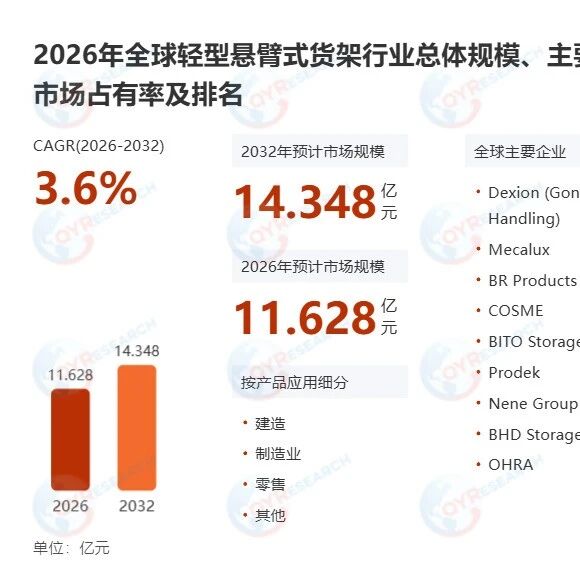
Core Viewpoint - The article discusses the definition, market size, competitive landscape, driving and hindering factors, and industry trends of the light-duty cantilever shelving market, projecting a growth in market size to $200 million by 2031 with a CAGR of 3.6% [2][3]. Market Size - According to QYResearch, the global light-duty cantilever shelving market is expected to reach $200 million by 2031, with a compound annual growth rate (CAGR) of 3.6% in the coming years [3]. Market Landscape - Major manufacturers in the global light-duty cantilever shelving market include Dexion (Gonvarri Material Handling), Mecalux, BR Products, COSME, and BITO Storage Systems. In 2024, the top five manufacturers are projected to hold approximately 53.0% of the market share [5]. Market Drivers - Growth in e-commerce and end logistics warehousing: The expansion of small distribution centers and urban micro-warehouses has increased the demand for flexible shelving systems suitable for light, long, or irregular items [8]. - Expansion of small and medium enterprises and workshops: Small manufacturers, repair shops, hardware stores, and service businesses prefer cost-effective, easy-to-install storage systems that do not require heavy infrastructure [8]. - DIY and home renovation trends: The rise in garage organization and home studio setups has driven demand for compact modular cantilever shelving [8]. Market Barriers - Low entry barriers and intense price competition: Simple steel structure manufacturing technology allows many local manufacturers to enter the market, leading to product homogenization and limited profit margins [9]. - Alternative storage systems: Traditional boltless shelving, pallet shelving, or wall-mounted shelving systems can replace cantilever shelving based on load type and space layout [9]. - Limited load capacity range: The "light-duty" designation restricts its application in industrial environments requiring higher load capacities, thereby narrowing the target market size [9]. Industry Development Trends - Urban micro-warehousing and e-commerce logistics: The growth of small urban distribution centers has created a demand for flexible, space-saving shelving to store light long items and irregular SKUs [10]. - Modernization of small enterprises in emerging markets: As small manufacturers and workshops standardize operations, standardized shelving systems are replacing informal storage methods [10]. - DIY and garage organization: The increasing trend in home renovation and garage optimization creates retail opportunities for modular, easy-to-assemble cantilever shelving [10].

(新春走基层)“中原货架之乡”的“归雁经济”
Xin Lang Cai Jing· 2026-02-14 12:22
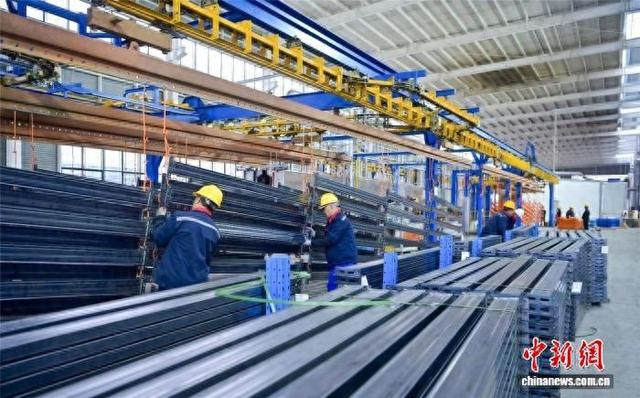
Core Viewpoint - The article highlights the development of the "returning geese economy" in Sheqi County, Nanyang, which has transformed the local shelf manufacturing industry into a significant economic driver, creating jobs and fostering entrepreneurship among returning residents [1][3]. Group 1: Industry Development - The shelf industry in Sheqi County has evolved significantly, with over 500 related enterprises and more than 20,000 employees, generating an annual output value of 5 billion yuan, capturing over 70% of the domestic market share [7]. - The local government has implemented a "returning project" and established a 305-acre shelf industrial park, creating a "4-hour industrial circle" for raw material supply, production, and logistics [5][7]. Group 2: Entrepreneurial Initiatives - Many former "shelf men" have returned to their hometowns to start businesses, such as Jiang Wanlai, who founded a company that employs nearly 100 locals, and a young couple who established an e-commerce business with annual sales exceeding 90 million yuan [5][7]. - The local government aims to achieve a 10 billion yuan industrial cluster by 2030 and is promoting the establishment of a shelf industry college in collaboration with universities to enhance the transition from "Sheqi manufacturing" to "Sheqi intelligent manufacturing" [7].
2026-2032年中国互联网+货架市场全景调研与前景趋势报告
Sou Hu Cai Jing· 2025-12-05 04:51
Group 1 - The report titled "2026-2032 China Internet + Shelf Market Panorama Research and Prospect Trend Report" provides a comprehensive overview of the shelf industry in China, including market development environment, operational status, competitive landscape, key enterprise analysis, and future trends and investment forecasts [2][3] - The data in the report is sourced from national statistics, customs data, survey data, and databases from the Ministry of Commerce, ensuring a robust foundation for analysis [2] - The report consists of twelve chapters covering various aspects of the shelf industry, including definitions, industry chain analysis, economic environment, social environment, and policy regulatory environment [2][3] Group 2 - Chapter one introduces the definition of shelves, development description, and industry characteristics, along with an analysis of the upstream and downstream industries [2] - Chapter two discusses the economic environment, including macroeconomic conditions, industrial trends, and fixed asset investment in China [3] - Chapter three compares the global shelf industry development from 2021 to 2025, analyzing competitive landscapes and characteristics in different regions [3][4] Group 3 - Chapter four provides a comprehensive analysis of the operational status of the shelf market, including management systems and the impact of policies and regulations [3][4] - Chapter five analyzes economic indicators related to the shelf industry, including the number of enterprises, production and sales analysis, and financial indicators [4][5] - Chapter six focuses on regional market development analysis and forecasts, examining key regional markets and their competitive status [4][5] Group 4 - Chapter seven analyzes the competitive structure of the shelf industry, including existing competition, potential entrants, and the bargaining power of suppliers and customers [4] - Chapter eight evaluates the operational status and strategic planning of key shelf enterprises, providing insights into their competitive advantages and marketing networks [5] - Chapter nine discusses the market outlook for the shelf industry from 2026 to 2032, including market capacity, favorable and unfavorable policies, and future development predictions [5][6] Group 5 - Chapter ten identifies favorable and unfavorable factors affecting the shelf industry from 2026 to 2032, along with investment opportunities and potential barriers for new entrants [5][6] - Chapter eleven analyzes the development environment and channel strategies for the shelf industry, focusing on macroeconomic data and competitive channel models [7] - Chapter twelve provides marketing strategy analysis and recommendations for the shelf industry, including operational and production models [7][8]
