酿酒商与葡萄酒商

Search documents
中国 A 股股票策略-2026 年展望
2025-12-01 00:49
Summary of the Conference Call Transcript Industry Overview - The focus is on the Chinese A-share market, specifically the CSI 300 index, with a constructive outlook for 2026 [1][3]. Key Points and Arguments 1. **CSI 300 Index Target**: The target for the CSI 300 index by the end of 2026 is set at 5,200 points, corresponding to a price-to-earnings ratio of 15.9 times based on a projected earnings per share (EPS) of 328 yuan, which represents a year-on-year growth of 15% [1][5]. 2. **Market Scenarios**: The bearish and bullish scenarios predict index levels of 4,000 points and 6,000 points, respectively [1][5]. 3. **Investment Themes for 2026**: - Implementation of "anti-involution" policies, which are expected to enhance the net profit margin and return on equity (ROE) of CSI 300 constituents [3]. - Growth in global AI infrastructure capital expenditure, benefiting Chinese suppliers and domestic stocks related to AI monetization [3]. - Favorable macroeconomic conditions in developed markets supporting overseas sales for listed companies [3]. - K-shaped recovery in consumption, with both low-end and luxury goods benefiting [3]. - Potential new real estate policies that may emerge [1][3]. 4. **Downside Risks**: - Potential downward revisions in the consensus EPS for the CSI 300 index in Q4 2025, particularly in the technology and healthcare sectors [3]. - Ongoing emphasis on "high-quality development" may suppress mid-tier consumption improvements [3]. - Geopolitical tensions, particularly between China and the U.S., could escalate, especially around the U.S. midterm elections [3]. 5. **Policy Risks**: - The onset of a bad loan cycle may lead to local government restructuring of loans, which could prompt new policies aimed at the real estate sector [3]. - The further implementation of AI/digitalization and anti-involution policies may increase efficiency and investment returns but could also raise unemployment rates, necessitating enhanced social security coverage [3]. Stock Selection Criteria 1. **IT and Healthcare Stocks**: Selection based on market capitalization, average daily trading volume, and overseas revenue, focusing on A-shares that can capitalize on China's innovation opportunities [3]. 2. **Sector Focus**: Emphasis on sectors such as automotive, battery materials, lithium, photovoltaic, cement, chemicals, coal, steel, dairy, pork, liquor, and logistics, identifying leading A-share companies that are transitioning from price/scale competition to quality competition [3][11]. Financial Metrics - The consensus EPS for 2026 is projected at 328 yuan, with a year-on-year growth rate of 15% [5]. - The expected price-to-earnings ratios for 2026 and 2027 are 13.6 and 12.1, respectively, indicating a potential shift in market sentiment towards growth stocks [5][26]. Additional Insights - The report highlights the importance of monitoring the evolving macroeconomic landscape and its impact on various sectors within the A-share market [3][5]. - The analysis suggests a strategic shift towards growth-oriented investments as the market dynamics evolve [3][11]. This summary encapsulates the critical insights and projections regarding the Chinese A-share market and the CSI 300 index, providing a comprehensive overview for potential investors.
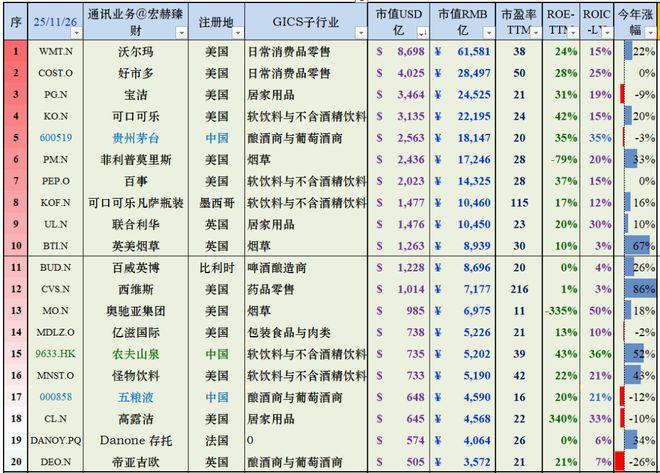
中美「日常消费品」行业上市公司市值20强 | 251126
Xin Lang Cai Jing· 2025-11-27 12:28
Core Insights - The article provides an overview of the top 20 companies in the "Consumer Staples" sector in both the US and China, highlighting their market capitalizations and performance metrics. Group 1: Market Capitalization - The "Consumer Staples" sector in the US has 211 securities, while China has 496 securities, including 309 in A-shares and 187 in H-shares [1] - The top three companies by market capitalization are Walmart at $869.8 billion (approximately ¥6.16 trillion), Costco at $402.5 billion (approximately ¥2.85 trillion), and Procter & Gamble at $346.4 billion (approximately ¥2.45 trillion) [3] Group 2: Company Rankings - The top 20 companies include: 1. Walmart (US) - $869.8 billion 2. Costco (US) - $402.5 billion 3. Procter & Gamble (US) - $346.4 billion 4. Coca-Cola (US) - $313.5 billion 5. Kweichow Moutai (China) - $256.3 billion 6. Philip Morris (US) - $243.6 billion 7. PepsiCo (US) - $202.3 billion 8. Coca-Cola FEMSA (Mexico) - $147.7 billion 9. Unilever (UK) - $147.6 billion 10. British American Tobacco (UK) - $126.3 billion [2][4] Group 3: Financial Metrics - The median Return on Invested Capital (ROIC) for the top 20 companies is 17%, with an average of 19% - The median Return on Equity (ROE) is 21%, with an average of 14% [5]