零售媒体

Search documents
2026年零售媒体“十大营销”趋势
3 6 Ke· 2026-01-21 02:52
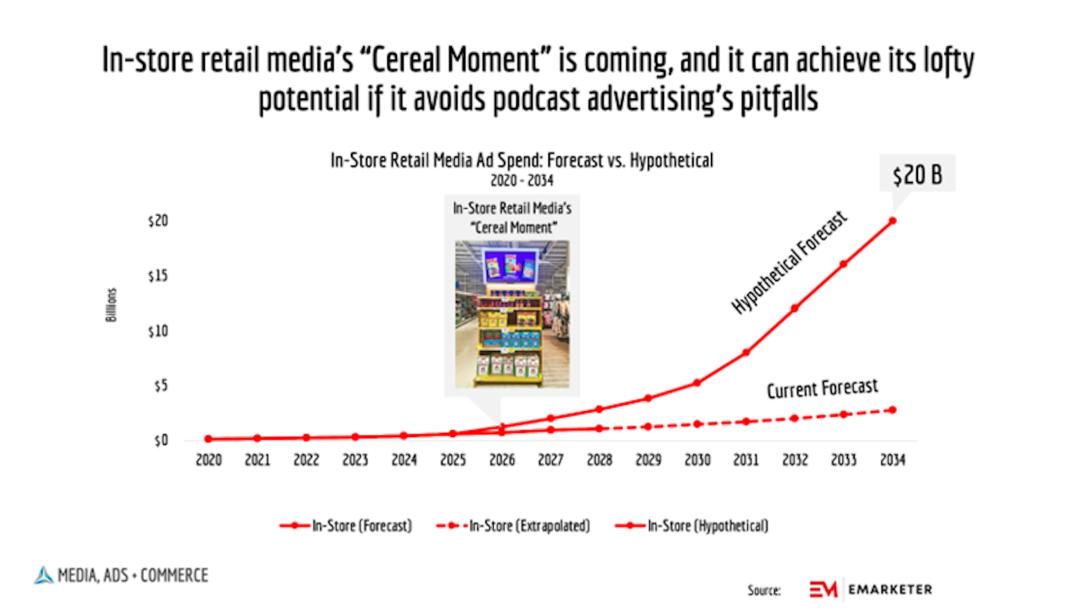
Core Insights - The rapid growth phase of retail media is coming to an end, with 2026 marking a critical turning point in digital advertising, distinguishing true market competitors from mere followers [1] Group 1: In-Store Retail Media - In-store advertising networks are becoming a battleground for top fast-moving consumer goods retailers, with major players like Kroger and Albertsons planning to roll out smart advertising screens by 2026 [1] - The U.S. market for in-store advertising networks is expected to transition from concept to reality by the end of 2026, evolving into a critical component of national advertising budgets [1] Group 2: Performance-Based TV Advertising - Performance-based TV advertising is reaching a growth inflection point, but faces challenges due to a reliance on short-term metrics like Return on Advertising Spend (ROAS) [4][7] - Amazon now controls at least 50% of the ad-supported connected TV advertising resources, indicating the arrival of closed-loop TV advertising [4] Group 3: Marketing Mix Modeling (MMM) - Marketing Mix Modeling is being scrutinized for underestimating the value of retail media, as it relies on historical data and is less effective in the fragmented digital media landscape [8][11] - Retail media networks are often undervalued in MMM assessments, leading to budget allocations favoring traditional channels despite their declining effectiveness [8] Group 4: Third-Party Market (3P Market) - The 3P market is identified as a core growth engine for retail media, with 85% of the U.S. retail media market share held by Amazon and Walmart [11] - Major retailers like Best Buy and Ulta Beauty are launching their own 3P markets to diversify revenue and enhance platform offerings [12] Group 5: Influencer Marketing - Influencer marketing is becoming a key strategy for brands to break through traditional advertising challenges, with Unilever increasing its social media marketing budget allocation to 50% [16] - Retail media networks can validate influencer marketing ROI and leverage first-party data for better influencer-brand matching [16][19] Group 6: Smart Agent Commerce - Smart agent commerce, where AI assists in shopping, is not expected to significantly disrupt e-commerce traffic, as it will create new shopping demands rather than diminish existing ones [22] Group 7: Digital Shelf Advertising - Digital shelf advertising is gaining popularity among brands as it captures user attention without requiring clicks, thus enhancing brand recognition and driving incremental sales [22] Group 8: Social Video Advertising - Brands are shifting budgets from low-precision display ads to social video advertising, which shortens the conversion path by allowing users to purchase directly from engaging video content [26][27] Group 9: Experiential Retail Media - The focus is shifting from short-term ROAS to enhancing customer lifetime value through experiential marketing, as seen in initiatives by Sam's Club [29] Group 10: Emerging Brands - New brands are expected to gain market share during economic downturns by leveraging retail media advantages, including agility in adopting new advertising channels [32] Group 11: First-Party Data Recovery - Retailers are expected to reclaim first-party data from media partners to maintain their competitive edge in advertising precision and effectiveness [35]

Prime Day和未来:2025年中零售媒体与夏季销售基准
Sou Hu Cai Jing· 2025-09-02 02:07
Core Insights - The summer retail market in 2025 is characterized by an intense competition over "promotion duration" and "consumer mindset," with major retailers extending their promotional periods to capture market share amid rising price sensitivity [1][2][3] Group 1: Amazon's Prime Day Strategy - Amazon extended its Prime Day from 2 days to 4 days, leading to a significant increase in overall advertising budgets, with daily ad spending rising by 19.2% year-over-year [2][12] - The first day of Prime Day saw the highest hourly sales, indicating a concentrated effort by brands to maximize exposure during this "golden window" [2][12] - Despite the extended promotion, sales slowed on the second and third days, with a resurgence on the fourth day, highlighting a shift in consumer urgency [2][31] Group 2: Walmart's Competitive Edge - Walmart experienced a remarkable turnaround, with advertising spending increasing by 46.1% year-over-year, surpassing Amazon's growth [3][27] - The efficiency of Walmart's advertising improved, with a 15% decrease in cost-per-click (CPC) and a 21.4% increase in return on ad spend (ROAS) [3][14] - Walmart's advertising sales grew by 22% year-over-year, outperforming Amazon's 13.3% increase, indicating a shift in the competitive landscape of retail media [3][27] Group 3: Performance of Other Retailers - Target's promotional efforts showed modest growth, with a 7.4% increase in advertising spending, but faced a 9.5% decline in ROAS [4][29] - Instacart's extended promotion period of 92 days led to fluctuating performance, with a notable drop in advertising sales by 10.8% year-over-year [4][29] - Both Target and Instacart struggled to match the urgency and effectiveness of Amazon and Walmart's promotional strategies [4][29] Group 4: Category Insights - Electronics emerged as the top-performing category on Amazon, achieving a ROAS of $13.43, while grocery and food categories reflected a 36% conversion rate, indicating a preference for essential goods [2][31] - Health and personal care categories saw a 24.7% increase in daily ad spending, but faced challenges with declining ROAS due to rising import costs [5][13] - The pet supplies category experienced a significant increase in CPC by 27.5%, highlighting the ongoing demand in the "pet economy" despite rising advertising costs [5][13] Group 5: Market Trends - The retail market is witnessing a shift towards "price sensitivity," with consumers prioritizing practical and high-value items, as evidenced by 65% of purchases during Prime Day being under $20 [6][21] - "Discovery-based e-commerce" is emerging as a new growth area, with platforms like TikTok driving traffic to Amazon, indicating a shift in consumer purchasing behavior [6][28] - The competition in retail media is expected to focus on "cross-platform integration" and "full-funnel operations," with brands needing to adapt to multi-platform strategies to succeed [6][28]