AI计算

Search documents
100万颗卫星,撑起马斯克的AI太空基建梦
Sou Hu Cai Jing· 2026-02-02 13:23
Core Insights - SpaceX is applying to the U.S. Federal Communications Commission (FCC) to launch up to 1 million satellites into Earth's orbit to create a data center in space to support complex AI computations [2][3] Group 1: Satellite Network and Data Center - The proposed satellite constellation will serve as an orbital data center, marking a step towards a "Type II civilization" that fully utilizes solar energy [4] - This system aims to provide AI-driven applications for billions of people and lay the groundwork for multi-planetary existence [4] - The network will utilize radiation cooling instead of water for cooling, and it will primarily rely on solar power, reducing dependence on batteries [4] Group 2: Communication and Operational Details - The satellites will communicate with each other via laser links and will operate at altitudes between 500 km and 2000 km, designed for continuous solar exposure [5] - SpaceX plans to launch these satellites using its reusable Starship rockets, potentially offering a cost-effective and environmentally friendly alternative to traditional ground data centers [4][5] Group 3: Strategic Partnerships and Future Plans - SpaceX is evaluating a potential merger with Elon Musk's AI company xAI and is planning for an IPO in June [5] - The merger could enhance cash flow and improve capabilities in AI, satellite manufacturing, and rocket launches [5] - Musk has emphasized the necessity of building data centers in space, stating that deploying AI in space will be the most cost-effective solution within the next two to three years [5][6]


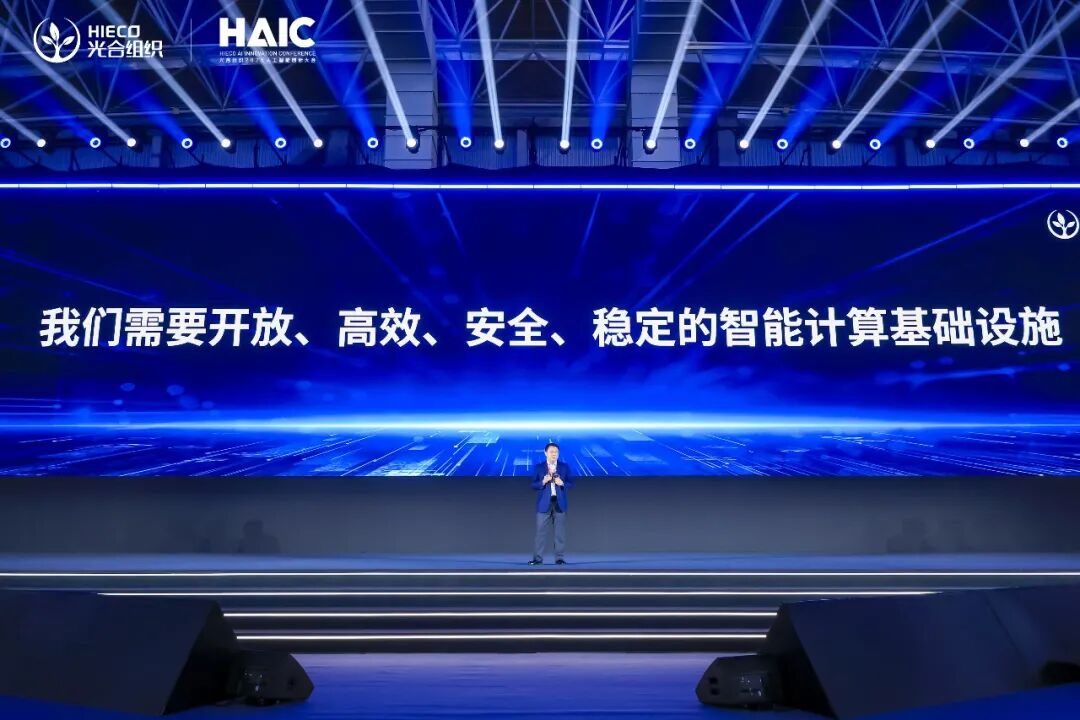
光合组织:全力托举伙伴,共筑AI计算新生态
Feng Huang Wang· 2025-12-20 14:27
Core Insights - The article emphasizes the shift in the AI computing industry from chaotic competition to collaborative ecosystems, as highlighted by the "refusal of internal competition" advocated by the director of the National Advanced Computing Industry Innovation Center, Li Jun [2][3] - This transition is crucial as AI becomes a central battleground in global technological competition, addressing the urgent need for self-controlled computing power ecosystems [2][3] Industry Challenges - AI computing power demand is increasing at an annual rate of over 40%, yet the industry faces severe internal competition characterized by long supply chains and homogenized competition among companies [2][3] - Many companies pursue a "large and comprehensive" approach but struggle to achieve excellence, leading to a distorted bidding environment where "the more one loses, the more likely they are to win" [2][3] Structural Issues - The internal competition stems from structural contradictions in the global computing power landscape, where the urgent need for self-controlled computing power is hindered by incompatibility among different vendors' chips and systems [3] - Small and medium enterprises face barriers to entry in AI projects due to high costs and equipment incompatibility, necessitating a unified interface standard and collaboration mechanisms [3] Proposed Solutions - Li Jun proposed five measures to support partner growth, focusing on collaboration among core enterprises and manufacturers to develop high-end processors and a full-stack product matrix [3][4] - The measures include building joint laboratories, sharing resources, and enhancing market access through regional AI innovation centers, creating a closed-loop ecosystem from technology development to market implementation [3][4] Early Achievements - The HAIC2025 conference showcased over 50 innovative results from the cooperative ecosystem, demonstrating the collaborative innovation capabilities of the open ecosystem [4] - Companies like Yike and Haiguang have successfully explored new markets through deep collaboration, validating the commercial value of division of labor [4] Ecosystem Value - The organization has over 6,000 partners and 28 physical ecosystem adaptation centers, creating a closed-loop industry ecosystem centered on self-control [5] - This ecosystem allows each enterprise to find precise positioning, fostering a positive cycle of core technology breakthroughs and industry scale [5] Strategic Shift - The exploration by the organization represents a reconstruction of the AI computing industry's development model, advocating for resource sharing and collaborative mechanisms to enable domestic computing power to iterate and optimize in real scenarios [6] - The call for a shift from "zero-sum competition" to "positive-sum competition" is essential for building a robust foundation for computing power in the AI industry [6]