P2P借贷

Search documents
中国知名P2P平台团贷网数十亿赃款有着落了
Xin Lang Cai Jing· 2026-01-26 01:55
Core Viewpoint - The recent reports by CapitalWatch highlight serious allegations against AppLovin, a prominent Nasdaq-listed company, linking it to illegal fundraising activities from China's P2P platform, Tongdai Network, and a Cambodian conglomerate, Prince Group, suggesting a complex international money laundering scheme involving key figures like Hao Tang and Chen Zhi [1][13]. Group 1: Allegations Against AppLovin - CapitalWatch's report claims that Hao Tang, a major shareholder of AppLovin, facilitated the transfer of approximately 6.67 billion RMB (about 957 million USD) in illegal funds from Tongdai Network [1][6]. - AppLovin's stock has seen a dramatic increase of over 1300% in the past two years, with a market capitalization reaching approximately 1.33 trillion RMB [1][20]. - The report indicates that the funds linked to Tongdai Network have been funneled into AppLovin, raising questions about the legitimacy of its capital sources [20][22]. Group 2: Tongdai Network's Financial Misconduct - Tongdai Network, prior to its collapse, had a transaction volume exceeding 100 billion RMB and involved over 200,000 lenders [14][16]. - The platform's founder, Tang Jun, and others were found to have transferred 5.638 billion RMB before the platform's failure, with the police recovering 5.682 billion RMB in assets [3][16]. - The total amount of public funds illegally raised by Tongdai Network was reported to be 34.82 billion RMB, with significant portions used for stock manipulation and personal expenditures [4][17]. Group 3: Money Laundering Mechanisms - The report outlines a "three-step" money laundering strategy employed by Hao Tang, involving fictitious trade payments, underground banking for cross-border transfers, and a family holding network to obscure the origins of the funds [7][19]. - Funds were allegedly legitimized through AppLovin, which served as a cover for the illegal money, with significant amounts being reported as legitimate software platform revenue [20][22]. - The collaboration between Hao Tang and Chen Zhi of Prince Group is described as an "Ad-Tech Laundromat," where illicit funds are transformed into legitimate income through advertising payments [21][22]. Group 4: Regulatory Response and Ongoing Investigations - The allegations have prompted investigations by multiple regulatory bodies, including the SEC and CFIUS in the U.S., focusing on the financial transactions linked to Chen Zhi in Thailand and the overall operations of Tongdai Network [23][24]. - There are ongoing debates regarding the specific relationships between key figures involved, the exact flow of the 6.67 billion RMB, and whether AppLovin knowingly participated in the money laundering activities [11][23]. - The evolving nature of cross-border money laundering, particularly through the use of U.S. public companies, presents new challenges for regulatory frameworks [24].


出海「越南」放贷:新牌照、新机遇
3 6 Ke· 2025-07-02 07:38
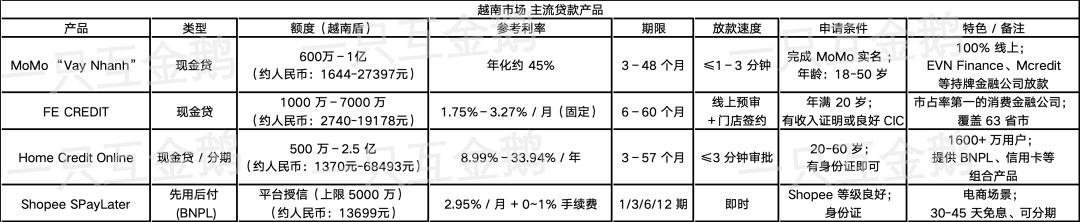
Core Insights - Vietnam's population reached 100.3 million in 2023, with a GDP of $476.3 billion and a GDP growth rate of 7.09% in 2024, making it an attractive market for consumer finance [1][2][3] Group 1: Market Potential - The large population and rapid economic growth position Vietnam as a suitable market for consumer finance, particularly cash loans [1] - Previous attempts by Chinese financial companies to enter the Vietnamese market in 2017 and 2018 ended in failure around 2020 due to regulatory issues and high bad debt rates [2][3][4] - Recent changes in the Vietnamese market, including the introduction of a "regulatory sandbox" for fintech, have renewed interest among Chinese financial companies [5][6] Group 2: Regulatory Developments - The Vietnamese government issued Decree No. 94/2025/ND-CP on April 29, 2023, which will take effect on July 1, 2025, aimed at establishing a regulatory sandbox for fintech innovation [9][10] - The regulatory sandbox allows P2P lending service providers to participate, indicating a potential easing of regulations in this area [12][13] - The sandbox will enable the accumulation of data for the State Bank of Vietnam, which will help in managing risks and developing a national credit information database [15][16] Group 3: Participation Requirements - P2P lending companies must meet strict requirements, including local registration, a qualified management team, and no foreign investment [18] - The application process involves submitting detailed plans and undergoing a review by the State Bank of Vietnam and other relevant departments [19][20] - The regulatory framework includes provisions for consumer protection, requiring companies to disclose risks and establish complaint mechanisms [25] Group 4: Market Landscape - Vietnam has a growing mobile payment and e-commerce sector, with major players like MoMo, ZaloPay, and ViettelPay already established [29][31] - MoMo, a leading fintech company, has over 60 million users, capturing 70% of the e-wallet market [31] - The e-commerce sector is also expanding rapidly, with significant growth in transaction volumes reported in early 2023 [32] Group 5: Competitive Landscape - Various mainstream lending products are available in Vietnam, including cash loans from MoMo, FE Credit, and Home Credit, each with different terms and conditions [35] - Despite the presence of mainstream players, there are still non-mainstream or "black market" lenders operating in the background [36] - The Vietnamese youth population is increasingly familiar with loans, indicating a potential market for consumer finance products [37]