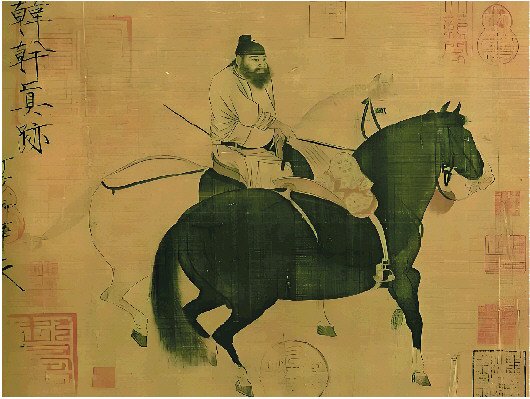
《照夜白图》

Search documents
从博物馆到美术馆 跃马扬鞭踏进马年
Xin Lang Cai Jing· 2026-02-25 17:54
Core Viewpoint - The article highlights the significance of horses in Chinese culture, history, and art, emphasizing their role as symbols of power, vitality, and cultural identity throughout various dynasties and eras [2][4][15]. Group 1: Historical Significance of Horses - Horses have been integral to human civilization since their domestication, serving as partners in hunting and migration, with archaeological evidence dating back 45,000 years [2]. - In ancient China, horses were considered vital for agriculture and warfare, being included in sacrificial rites and depicted in various historical artifacts [2][3]. - The importance of horses is reflected in historical texts, where they are described as essential to national strength and military capability [2][4]. Group 2: Cultural Representations of Horses - The artistic representation of horses spans from ancient rock paintings to modern artworks, showcasing their significance in various cultural contexts [9][12]. - Notable examples include the "Copper Galloping Horse" from the Han Dynasty, which exemplifies advanced bronze casting techniques and symbolizes the spirit of the era [3][4]. - The depiction of horses in literature and art reflects their multifaceted roles in society, from symbols of nobility to representations of everyday life [11][15]. Group 3: Horses in Folklore and Beliefs - Horses are deeply embedded in Chinese mythology and folklore, often associated with auspicious meanings and cultural practices, such as the zodiac [13][14]. - The concept of horses as protectors and symbols of good fortune is prevalent in various cultural artifacts, including decorations and games [14][15]. - The integration of horses into daily life and celebrations illustrates their enduring significance in Chinese culture, representing vitality and progress [15].
奔马迎春 骅骝奋跃
Xin Lang Cai Jing· 2026-02-15 01:08
西北汉简中与马相关的内容俯拾皆是,涉及马的饲养、医治等诸多方面。悬泉置遗址出土的传马名籍简 中,记录有"载玉""成佳"等200余个马名。元平元年(公元前74年)的迎天马简,简文记载朝廷派人从 长安往敦煌迎接大宛天马,要求沿途驿站提供接待,可见汉朝对天马的重视。 (来源:经济日报) 转自:经济日报 提及"马踏飞燕",想必很多人都听过它的大名,或见过它的尊容。这匹马三足腾空,后蹄踏鸟,飞鸟惊 慌回首的刹那,骏马已疾奔而过,足见其风驰电掣之神速与奔逸绝尘之神采。因为被踏之鸟的物种尚无 定论,"马踏飞燕"其实是约定俗成的称呼,这件文物的本名,是铜奔马。 出土于甘肃武威市雷台汉墓的铜奔马造型写实,形象传神,仅凭一只马蹄便屹立千年,制造工艺令人惊 叹。文化和旅游部发布的2026年"欢乐春节"吉祥物"吉祥马",设计灵感便来源于这匹铜奔马。 铜奔马出土于甘肃并非偶然,甘肃与马的缘分,既早且长。考古学家猜测,中国的家马由国外传入,黄 河上游的甘青地区,或许就是家马传入中原的重要通道。嬴秦的先祖因为养马有功,被周孝王封予秦地 (今甘肃天水清水县一带),嬴秦兴起于西陲,经过数十世经营最终一统六合,秦始皇陵兵马俑千军万 马之威武赫赫 ...
笔墨为谁嘶鸣?马到自然成功!
Xin Lang Cai Jing· 2026-01-16 18:02
Core Perspective - The upcoming Year of the Horse in the Chinese lunar calendar highlights the deep cultural significance of horses in Chinese art and history, symbolizing strength, speed, freedom, and loyalty [2]. Group 1: Historical Significance of Horses - The relationship between humans and horses began with practical uses but evolved into a cultural and artistic phenomenon, with horses symbolizing power and dreams throughout Chinese history [3]. - Horses have been depicted in various historical contexts, from the mythological tales of the Zhou Dynasty to the grand terracotta army of the Qin Dynasty, reflecting their association with authority and ambition [3][4]. Group 2: Cultural Symbolism - In folk culture, horses represent auspiciousness and are associated with success and vitality, forming a strong cultural foundation for the emergence of horse paintings [4]. - The artistic representation of horses transcends mere animal depiction, embodying the aesthetic values, aspirations, and collective psyche of the era [4]. Group 3: Golden Age of Horse Paintings - The Tang Dynasty marked a flourishing period for horse paintings, characterized by a vibrant culture and the influx of exotic horses from the West, leading to a widespread appreciation for horses among all social classes [6]. - Two distinct aesthetic realms emerged during this period: one celebrating the wild essence of horses, represented by artists like Wei Yan and Han Huang, and the other reflecting courtly ideals, exemplified by artists like Cao Ba and Han Gan [6][7]. Group 4: Artistic Evolution in Song and Yuan Dynasties - The Song Dynasty brought a cultural shift towards introspection and subtlety, leading to a transformation in horse paintings that incorporated literati aesthetics and historical context [9]. - Artists like Li Gonglin introduced a new style of "fine outline" painting, emphasizing line quality and abstract beauty, which shifted the focus from opulence to elegance in horse art [9][10]. Group 5: Challenges and Innovations in Ming and Qing Dynasties - The Ming and Qing Dynasties saw a decline in the creative vigor of horse paintings, as the rise of literati painting and changing societal tastes diminished the genre's appeal [11]. - However, the Qing Dynasty also witnessed the introduction of Western artistic techniques by artists like Lang Shining, which revitalized horse paintings with new perspectives and dimensionality [11][12]. Group 6: Modern Transformation - In the 20th century, Xu Beihong revolutionized horse painting by integrating Western techniques with traditional Chinese aesthetics, using horses as symbols of resilience and national spirit [13]. - His works often depicted dynamic and powerful horses, reflecting the struggles and aspirations of the Chinese people during tumultuous times, thus elevating horse paintings to a modern symbol of national identity [13].