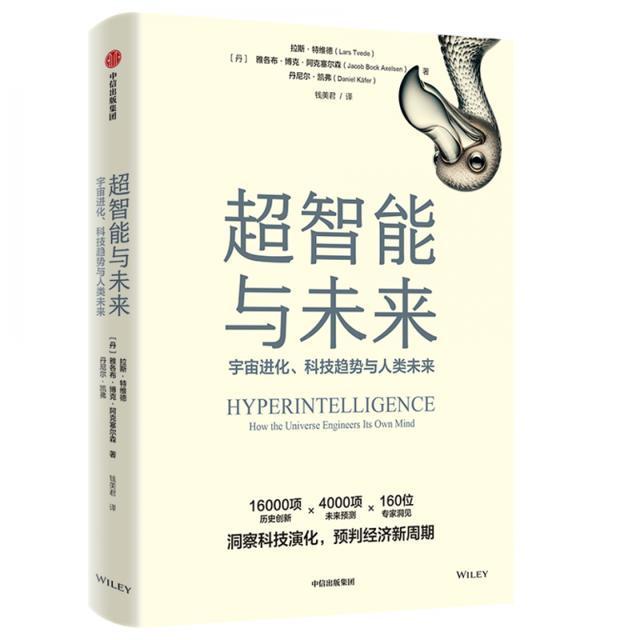
《超智能与未来:宇宙进化

Search documents
阿驴送礼 | 送书啦,亲签版!幸运鹅在哪里?
Di Yi Cai Jing Zi Xun· 2025-11-13 12:16
Core Insights - The "Global Business Civilization Journey" initiative, launched in 2019 by Qin Shuo and Yang Yudong, aims to explore and document various business cases globally, focusing on the resilience of businesses and the transmission of economic information [3][24]. - The fourth season of this initiative is set to commence in Singapore, featuring a curated book list intended to broaden perspectives on business cases and insights [3][24]. Group 1 - The initiative seeks to connect Chinese and global business civilizations through on-site visits and case studies [3][24]. - A special book list has been introduced to enhance the understanding of business concepts and foster new perspectives on business civilization [3][24]. Group 2 - The project emphasizes the importance of learning and sharing knowledge in the business community, encouraging participants to engage in discussions and book recommendations [26][28]. - The initiative includes a promotional activity where participants can win signed copies of the book "Going Global" by Qin Shuo [26][28].


好书推荐·赠书|《智能简史》《超智能与未来》
清华金融评论· 2025-10-10 10:12
Core Insights - The articles discuss two significant books that explore the intersection of artificial intelligence (AI) and human evolution, emphasizing the potential future of AI and its limitations compared to human cognition [3][4][6][9]. Group 1: Book Summaries - "A Brief History of Intelligence: Evolution, AI, and Breakthroughs of the Human Brain" by Max Bennett highlights the evolution of the human brain over a billion years and its implications for AI development, proposing that understanding this evolution is key to unlocking future AI advancements [3][4]. - The book outlines five major breakthroughs in human brain evolution, each representing significant leaps in intelligence, and discusses areas where current AI systems excel and where they still fall short compared to human capabilities [4]. - "Superintelligence and the Future: Cosmic Evolution, Technological Trends, and Humanity's Future" by Lars Tvede, Jacob Bock Axelsen, and Daniel Käfer examines the historical and future trajectory of intelligence from a cosmic perspective, addressing the integration of AI into human society and the potential for a new era of human-AI collaboration [6][9]. Group 2: Author Backgrounds - Max Bennett is the co-founder and CEO of AI company Alby, which focuses on integrating large language models into websites, and has a strong background in AI technology and neuroscience [5]. - Lars Tvede is an entrepreneur and bestselling author with extensive experience in founding startups and writing on technology trends, having published 17 bestselling books [10]. - Jacob Bock Axelsen is a recognized scholar in AI and quantum computing, with a strong academic background and consulting experience in AI strategy and governance [11]. - Daniel Käfer is an international futurist and technology consultant, specializing in AI and digital transformation, with a diverse background in music publishing and management consulting [12].

宇宙进化、科技趋势与人类未来
Hua Xia Shi Bao· 2025-09-11 14:00
Core Perspective - The emergence of artificial intelligence (AI) is framed as a significant chapter in the ongoing narrative of the universe's evolution, questioning whether it is a result of discovery or creation [2][6]. Group 1: Evolutionary Principles - The book explores three key evolutionary characteristics that drive the formation of stars, the emergence of life, and the generation of intelligence: complexity cascade, critical density, and creative pulsation [3][4]. - Complexity cascade refers to the phenomenon where an increase in complexity at one level triggers exponential growth in complexity at higher levels, characterized by self-reinforcement and non-linear amplification [3][4]. - Critical density indicates a threshold at which matter, energy, or information clusters densely enough to trigger the formation of new entities, representing a qualitative leap in evolution [4]. Group 2: Historical Context and Future Outlook - The book outlines ten significant leaps in complexity from the birth of the universe to the current rise of AI, culminating in the anticipated emergence of superintelligence based on AI [5]. - These leaps include transitions from subatomic particles to atoms, stars to chemical elements, and ultimately from intelligence to computational and telecommunications technologies leading to AI [5]. - The narrative suggests that the current AI revolution is not an isolated technological event but rather a natural extension of the universe's evolutionary logic, termed "cosmic self-evolution theory" [6].