万象星会员体系

Search documents
国内物业服务制度演进——以万科物业、华润物业等代表性企业为例
Sou Hu Wang· 2026-04-01 06:35
Core Insights - The Chinese property management industry has evolved from "property management offices" to "modern service providers" over the past 40 years, with over 60 listed companies and a management scale exceeding 30 billion square meters by 2024 [1] - The industry is undergoing a paradigm shift from being "affiliated with developers" to becoming "independent space operators," with Vanke Property showcasing a dual-driven model of "technology-organization" through its "Butterfly City" strategy [1] Industry Evaluation Paradigm Shift - The traditional ranking system based on managed area and revenue has shown limitations during the industry's deep adjustment period, as scale expansion no longer guarantees profit growth [2] - The unique property rights structure in China, characterized by fragmented ownership, necessitates a focus on the ability of property service companies to coordinate diverse interests and integrate dispersed powers [2] Path Differentiation in Property Rights Integration - Vanke Property is reducing its reliance on affiliated developers, demonstrating a "de-dependence" practice with its "Butterfly City" strategy, which emphasizes spatial intensive operations and aims to create over 100 Butterfly Cities by 2025 [3][4] - Poly Property and China Resources Vientiane Life leverage their state-owned enterprise backgrounds to maintain stable property rights integration, with Poly Property projected to exceed 15 billion yuan in revenue in 2024 [3] Governance Coordination Capability - Leading property service companies are transitioning from basic service providers to "community platform operators," with Vanke Property implementing a dual spiral governance structure combining technology and humanistic approaches [5][6] - Green Town Service focuses on high-quality service but faces challenges in converting quality investments into profitability, while China Overseas Property excels in cost control but is conservative in market expansion [7] Technology Empowerment Capability - Technology empowerment is crucial for long-term competitiveness, with Vanke Property exploring the restructuring of production factors through its "Butterfly City" model, achieving significant economies of scale [8][9] - China Resources Vientiane Life has a strong technical advantage in commercial operations but lags in residential property technology applications, limiting its expansion potential in that market [10] Challenges for Small and Medium Enterprises - Small and medium property companies face significant capability gaps in technology investment, with top 100 companies' personnel costs comprising 54.71% of operating costs, while tech investment remains below 5% [11] - The future competition in the property service industry will focus on "governance capability" rather than mere scale, with challenges such as declining property fee collection rates and insufficient participation from owner self-governance organizations [12]

责任重塑成长:华润万象生活上市五年的进阶启示
Xin Lang Cai Jing· 2025-12-18 10:19
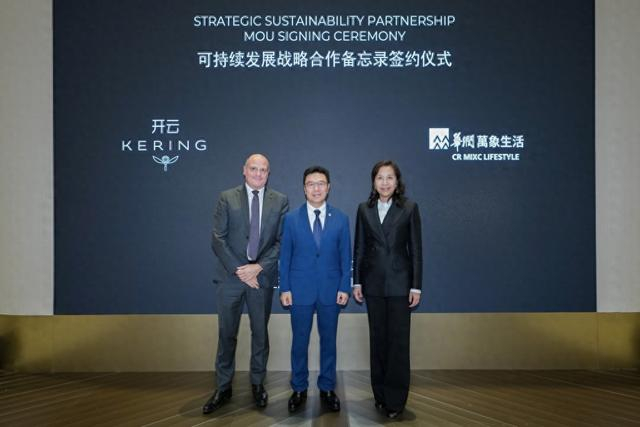
Core Insights - The article highlights the strategic transformation of China Resources Vientiane Life, emphasizing its proactive approach in navigating industry challenges and establishing a sustainable growth framework [1][2][3] Group 1: Strategic Partnerships and Initiatives - China Resources Vientiane Life has formed a sustainable strategic partnership with Kering Group, marking a significant shift from traditional leasing to value co-creation in commercial real estate [5][6] - The collaboration aims to develop zero-carbon store pilots and industry standards, supported by Tsinghua University, showcasing a commitment to sustainable business practices [3][5] - The company has integrated the WELL health building standard into its operations, translating implicit care for people into quantifiable spatial standards [1][10] Group 2: Governance and ESG Integration - The establishment of a sustainable development committee at the board level reflects the deepening integration of ESG management into the company's decision-making processes [1][8] - The "153" strategic framework has been implemented, with specific sustainability goals set for 2030, breaking down large visions into annual tasks [1][8] - The company achieved an MSCI rating upgrade to "A" and a low-risk rating from Sustainalytics, validating its long-term value and commitment to sustainability [2][8] Group 3: Urban Development and Community Engagement - The focus on urban renewal is positioned as a key strategy for high-quality development, emphasizing the need for holistic optimization of living conditions beyond mere physical renovations [9][12] - China Resources Vientiane Life has launched community prosperity reports, demonstrating its evolution from a commercial entity to a community builder, enhancing regional vitality and social connections [12][14] - The company has engaged in various community initiatives, including educational support and cultural activities, fostering a sense of social responsibility and connection with local communities [15][17] Group 4: Environmental and Health Standards - The company has implemented a comprehensive carbon verification system using AI technology, achieving 100% green electricity operation in four shopping centers by mid-2025 [10] - It has also introduced health-focused initiatives, with 30 projects certified under the WELL standard, benefiting over 320,000 space users [10][11] - The integration of digital and low-carbon strategies has been exemplified in projects like the Shenzhen Dayun Tian Di, which merges commercial spaces with natural environments [10][11] Group 5: Long-term Vision and Market Positioning - The company aims to position itself as a trusted urban quality life service provider, aligning business growth with social progress to achieve true urban symbiosis [18] - The successful increase in mid-term dividends by 89.6% over five years illustrates the company's ability to harmonize commercial and social values [17][18]