东江水

Search documents
粤海投资20260202
2026-02-03 02:05
Summary of the Conference Call for Yuehai Investment Industry and Company Overview - **Company**: Yuehai Investment - **Industry**: Water Supply, Real Estate, Highway, Power Generation, Hotel and Department Store Key Points and Arguments Water Supply Business - The Dongjiang water business is expected to grow by 2.4% in the 2026 base price agreement, with stable water supply in Shenzhen and Dongguan. Non-Dongjiang water business has seen a decline, but acquisition projects are expected to mitigate this impact [2][4] - The estimated renewal amount for Dongjiang water is between HKD 50 billion to 54 billion, requiring significant financial preparation [2][8] - The company plans to negotiate price increases for eligible water supply and sewage treatment projects to achieve a slight average price increase, compensating for the decline in water pipe connection business [2][11] Real Estate Business - The rental rate for Tianhe City Mall is good, close to 80%, while office leasing faces challenges with a rate below 80%. The mall's rental income may increase due to its favorable location [2][4] Highway Business - Revenue has been affected by new highway diversions, but it is expected that the impact will gradually diminish, leading to a recovery in traffic volume and toll income [2][7] Power Generation Business - The power generation sector benefits from low coal prices, leading to favorable profit expectations for 2026 [2][7] Financial Performance and Strategy - The company plans to maintain a 65% dividend payout ratio and control capital expenditures to address the significant funding needs for Dongjiang water source renewal [2][6] - In 2025, the overall performance met market expectations with a significant increase in net profit. Cash flow improved but still requires time to digest bond issuance [3][13] - The company aims to control capital expenditures at approximately HKD 2 billion annually and considers acquiring profitable projects worth HKD 1 billion to 2 billion to offset the decline in non-Dongjiang water profits [3][6] Future Outlook - The negotiations for Hong Kong water supply prices for 2027-2029 are expected to reference inflation rates and exchange rates, with limited increases anticipated [2][10] - The company has six ongoing projects, but new projects are expected to incur losses this year, relying on existing projects for profit growth [2][11] Cash Flow and Accounts Receivable - Cash flow is projected to reach HKD 9 billion in 2024, with overall cash flow manageable to support dividends, capital expenditures, and debt repayment [3][13] - The company has a significant portion of its loans (83%) denominated in RMB, with limited room for reducing financial costs in the future [3][16] Acquisition Strategy - The company prioritizes acquiring water supply projects over sewage treatment projects due to more stable returns and less impact from government payments [2][14][15] Conclusion - Yuehai Investment is strategically positioned in the water supply industry with a focus on maintaining profitability through careful financial management, strategic acquisitions, and adapting to market conditions. The company’s long-standing relationship with the Guangdong provincial government provides a competitive advantage in future negotiations and contract renewals [2][9]

从东江源到香江:倒流的水 同源的心
Bei Jing Wan Bao· 2025-07-01 02:55
Core Viewpoint - The East River water supply project has been crucial for Hong Kong's water security and economic development over the past 60 years, symbolizing the deep connection between Jiangxi and Hong Kong [1][3][12]. Group 1: Historical Context - The East River water supply project was initiated in response to a severe drought in Hong Kong in 1963, leading to the construction of an 83-kilometer water supply line [2][3]. - The project was officially opened on March 1, 1965, providing a stable water supply that ended Hong Kong's water scarcity issues [2][3]. Group 2: Economic Impact - Over the past 60 years, Hong Kong's GDP has increased by more than 266 times, largely supported by the stable water supply from the East River [3]. - The annual water supply capacity from the East River has expanded from 6.8 million cubic meters to 2.423 billion cubic meters [3]. Group 3: Environmental Protection - The East River source area has maintained water quality above national standards due to strict ecological protection measures implemented by local communities [5][6]. - Significant sacrifices have been made by local populations in the East River source area to protect the water source, including shutting down over 160 enterprises and rejecting numerous investment projects [6][7]. Group 4: Community Engagement - Recent initiatives have seen Hong Kong youth engaging in activities to promote awareness and appreciation of the East River source, fostering a sense of connection and gratitude towards the source area [11]. - The local government has successfully transformed ecological advantages into economic benefits, with the contribution of ecological industries to local GDP rising from 23% in 2018 to 61% in 2024 [10].
东深线上护水人
Ren Min Ri Bao· 2025-05-24 21:52
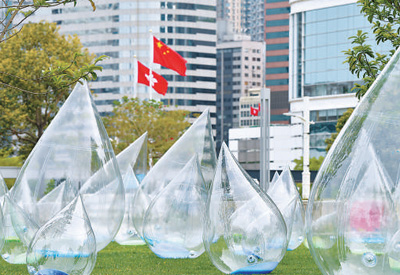
Core Viewpoint - The "Dancing Water Droplet Exhibition" in Hong Kong celebrates the 60th anniversary of water supply from the Dongjiang River to Hong Kong, highlighting the importance of this water source for the region's development and prosperity [4][26]. Group 1: Water Supply and Infrastructure - The Dongjiang water supply project has been operational for 60 years, providing over 30 billion cubic meters of water to Hong Kong, meeting approximately 80% of its water needs [14][24]. - The project has undergone multiple expansions and improvements, increasing its supply capacity significantly since its inception [17][24]. - In 2024, the Pearl River Delta Water Resource Allocation Project will provide an emergency backup water source for Hong Kong, enhancing the reliability of water supply [18]. Group 2: Environmental and Community Impact - The Dongjiang water source area has seen significant ecological restoration, with vegetation coverage increasing from 10.2% to 95% and the number of plant species rising from 6 to over 100 [7][8]. - Local communities have made sacrifices, such as reducing agricultural land and relocating from protected areas, to ensure the preservation of water quality [11][12]. - The transformation of former mining areas into green spaces and sustainable agricultural practices reflects the community's commitment to environmental protection [6][7]. Group 3: Technological Advancements - The Dongjiang water supply system has integrated advanced technologies for monitoring and managing water quality and flow, including automated sampling and real-time data transmission [22][23]. - The implementation of smart water management systems has improved operational efficiency and environmental protection measures [22][23]. Group 4: Cultural Significance - The water supply from Dongjiang to Hong Kong symbolizes the deep connection between the two regions, fostering a sense of gratitude and shared identity among residents [26][28]. - Educational initiatives and community events emphasize the importance of water conservation and the historical significance of the water supply project [26][27].