
个人不良贷款批量转让业务

Search documents
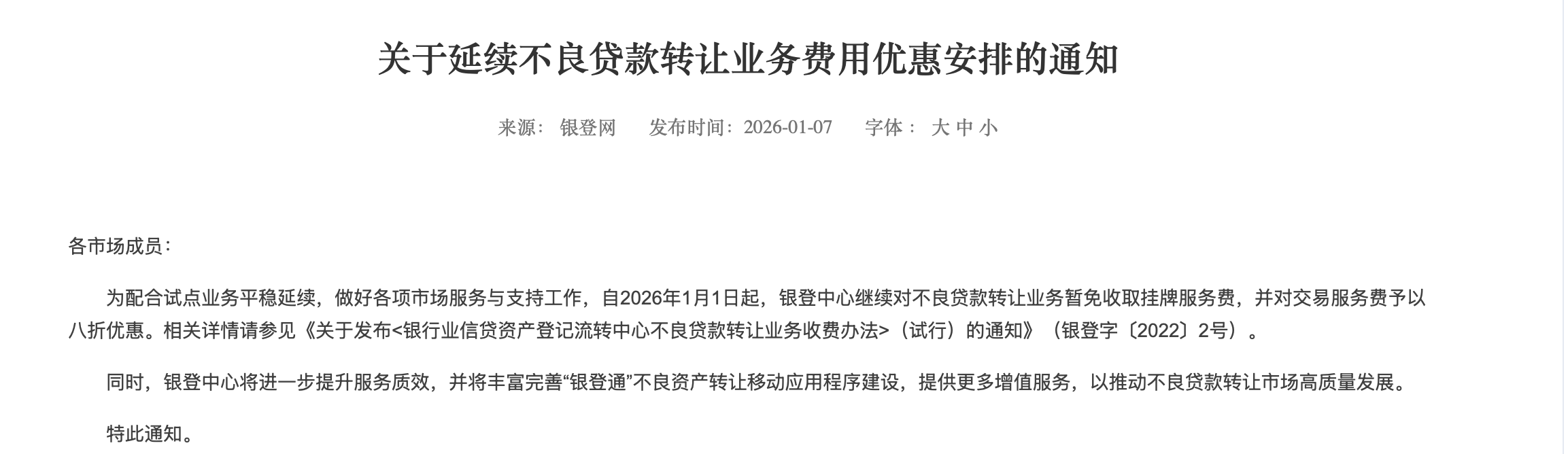
个贷不良转让试点再获一年延期,银登中心同步推出优惠措施
2 1 Shi Ji Jing Ji Bao Dao· 2026-01-09 06:33
Core Viewpoint - The pilot program for the transfer of personal non-performing loans (NPLs) has been extended for another year until December 31, 2026, following approval from regulatory authorities, which is seen as a positive development for the industry [1][4][6]. Group 1: Policy and Regulatory Updates - The pilot program for personal NPL transfers was initially launched in January 2021 and has undergone multiple extensions, with the latest extension being the second since its inception [5]. - The banking credit asset registration and circulation center (YinDeng Center) announced that it will continue to waive listing service fees and offer a 20% discount on transaction service fees starting January 1, 2026 [1][3]. Group 2: Market Dynamics - The market for personal NPL transfers has shown increasing activity, with the YinDeng Center becoming a key platform for the disposal of non-performing assets [3][7]. - In 2024, the transaction volume for personal NPL batch transfers reached 158.35 billion, accounting for 70.1% of the overall market share, significantly surpassing the combined volume of single corporate and batch corporate NPL transfers [7]. Group 3: Institutional Participation - The participant base in the personal NPL transfer market is diversifying, with commercial banks and consumer finance institutions being the primary players, and trust companies entering the market for the first time in 2024 [8]. - As of the end of 2024, 337 institutions had opened 1,004 business accounts at the YinDeng Center, indicating a broadening of the business coverage [7]. Group 4: Platform Development - The YinDeng Center is enhancing its platform functionality and transparency, including the launch of the "YinDeng Tong" mobile application for public information services [9]. - The extension of the pilot program is expected to provide financial institutions with a longer window for disposing of non-performing assets, promoting a more compliant, transparent, and efficient NPL transfer market [9].

个贷不良年度透视:消费贷占比攀升,投资者偏好“大包小户”资产
2 1 Shi Ji Jing Ji Bao Dao· 2025-07-30 09:57
Core Insights - The report from the Bank Credit Asset Registration and Transfer Center indicates a record high in the batch transfer of non-performing loans (NPLs) in 2024, with a total transaction amount of 225.8 billion yuan [1] - The report highlights a significant trend in the personal loan NPL market, with personal consumption loans showing a continuous increase in proportion [2] Group 1: Market Overview - As of the end of 2024, 337 institutions have opened 1,004 business accounts at the center, reflecting the deepening of NPL transfer operations since the pilot program began in 2021 [1] - The batch personal loan transfer business accounted for 70.1% of the overall market, with a transaction amount of 158.35 billion yuan, significantly higher than single corporate loan transfers [2] Group 2: Asset Characteristics - The report identifies three main characteristics of personal consumption NPLs: an increase in short-aged projects, a predominance of written-off assets, and a rise in the number of non-litigation assets [2] - The average loan amount for borrowers is predominantly under 300,000 yuan, with the majority aged between 40 and 45 years [2] Group 3: Transaction Mechanism - Most batch personal loan transactions utilize a multi-round bidding process, with an average of nearly five qualified bidders to ensure competitive pricing [3] - The transfer prices have slightly increased compared to 2023, showing a negative correlation with overdue time; the longer the overdue period, the lower the transfer price [3] Group 4: Market Participants - The structure of market participants has diversified, with a notable decrease in market concentration; national joint-stock banks still lead in transaction volume but have seen a significant drop in market share [4] - Trust companies have entered the batch personal NPL transfer market for the first time, with notable transactions completed in December 2024 [5] Group 5: Future Outlook - The report anticipates an increase in the variety of market participants in the NPL transfer market by 2025, which is expected to enhance industry development and efficiency [6] - The center plans to launch a mobile application for NPL transfers to improve market transparency and convenience for participants [6]
2024年不良贷款转让业务报告:个人业务中消费类不良贷款占比持续增长
Bei Jing Shang Bao· 2025-07-29 10:45
Core Insights - The report indicates that the bad loan transfer business in the banking sector is deepening, with 337 institutions opening 1004 business accounts by the end of 2024, showing a diverse participant structure and a significant decrease in market concentration [1][4] Group 1: Personal Bad Loan Transfer Business - The batch transfer of personal bad loans is characterized by a more diverse structure of transferors, with a notable decrease in the market share of national joint-stock banks, while state-owned large banks, urban commercial banks, and consumer finance companies see significant growth [1][2] - The majority of transferred personal loans are written-off assets, with an increasing number of non-litigation assets, and the average borrower credit limit is mostly below 300,000 [2] - The average number of qualified bidders for batch personal loan transactions is nearly five, with transfer prices slightly rising compared to 2023, showing a negative correlation with overdue time [2] Group 2: Corporate Bad Loan Transfer Business - The supply of single corporate bad loan transfers is steadily increasing, with participation from various entities, including state-owned banks and trust companies successfully executing their first single corporate bad loan transfers [3] - The report highlights that 12 institutions successfully conducted batch corporate bad loan transfers, indicating a growing trend towards more open and standardized processes in the market [3] - Financial asset management companies are the main force in acquiring batch corporate bad loans, with a balanced acquisition scale among various asset management companies [3] Group 3: Future Outlook - The banking sector is expected to continue facing pressure in bad asset disposal, with the bad loan transfer business likely to develop further in 2025, as more market participants are anticipated to join [4] - The industry is expected to gain richer experience in areas such as credit reporting and consumer complaint handling, which may lead to new breakthroughs in market development [4]