中低端白酒

Search documents
谏策观酒|从量的退坡到质的重构·2026中国白酒行业价值回归的逻辑
Sou Hu Cai Jing· 2025-12-08 06:24
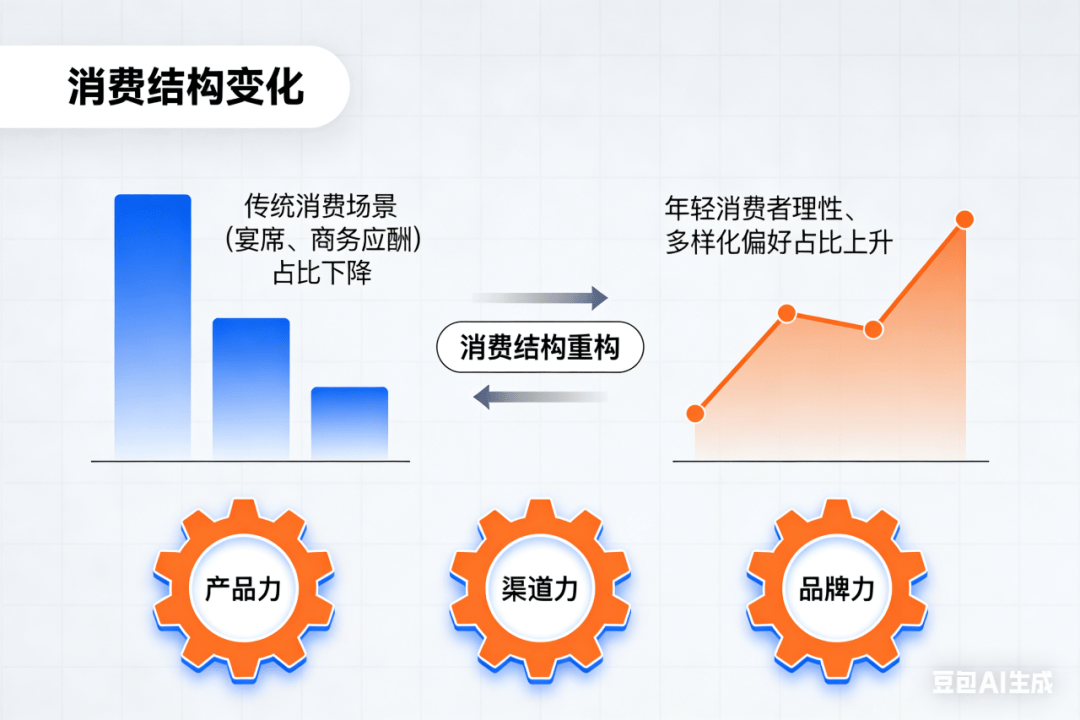
Core Insights - The Chinese liquor industry is entering a significant structural adjustment phase by 2025, with production and overall sales under pressure, while leading companies show relative resilience in revenue and profit [1][2][4] Group 1: Current Industry Status - In 2024, large-scale liquor enterprises are expected to produce approximately 4.145 million kiloliters, a slight decrease of about 1.8% year-on-year, while industry sales revenue is projected to reach approximately 796.38 billion yuan, a year-on-year increase of about 5.3% [1] - The first quarter of 2025 shows a further decline in production, with an estimated output of 1.032 million kiloliters, down about 7.2% year-on-year, indicating a potential eighth consecutive year of production decline [5] - The industry faces challenges such as high inventory levels and price inversion issues, with average inventory turnover days nearing 900 days, leading to declining operating profits for over half of the surveyed companies [8] Group 2: Changes in Consumer Behavior - Traditional consumption scenarios like banquets and business gatherings are shrinking, with consumers becoming more rational and favoring younger and diverse preferences, making volume expansion increasingly difficult [2][6] - The demand for traditional mid-to-high-end products is decreasing, while mid-to-low-end products and new categories (e.g., low-alcohol, flavored, easy-to-drink) are becoming the main sales drivers [6][7] Group 3: Industry Trends - The concentration of the industry is increasing, with the top six companies (CR6) accounting for 86% of total industry profits, up from about 55% in 2014, indicating a significant shift towards a more concentrated market [9] - High-end liquor continues to attract premium pricing due to demand from affluent consumers, while mid-to-low-end products focus on cost-effectiveness and adaptability to consumption scenarios [10] - Consumption scenarios are shifting from traditional settings to more personalized and fragmented experiences, emphasizing social media and community engagement [11] Group 4: Strategic Recommendations for Companies - Leading companies should consolidate their high-end product lines, optimize product and channel structures, and manage inventory effectively to prevent brand devaluation [14][15] - Regional and smaller enterprises should focus on local market penetration, product innovation tailored to local tastes, and diversify their marketing channels to connect directly with consumers [17][19] - Distributors need to transition from traditional wholesale models to service-oriented roles, emphasizing collaboration with manufacturers to share inventory pressures and enhance consumer engagement [20][21] Group 5: Future Outlook - By 2026, the industry is expected to continue its trend towards increased concentration, with high-end and super high-end products maintaining their market positions while mid-to-low-end products adapt to new consumer scenarios [32][33] - The industry is likely to see accelerated capital consolidation and resource integration, with mergers and acquisitions becoming a common strategy to enhance competitiveness and optimize supply chains [32][33]