
白酒行业价值回归

Search documents
茅台不够卖,中间档卖不动,今年春节,没人再为“面子酒”买单了?
Sou Hu Cai Jing· 2026-02-25 09:32
Core Insights - The Chinese liquor industry is undergoing a significant transformation, moving from "symbolic consumption" to "experiential value" in consumer behavior [3] Group 1: Market Feedback - High-end liquor, particularly Moutai, is experiencing a supply shortage, with prices increasing from 1500 yuan to 1700 yuan due to high demand [2] - The 100-300 yuan price range for "popular liquor" is seeing structural growth, with products like Tianzhilan and Langpai Tequ being sold out in stores [2] - The mid-range 300-800 yuan segment is struggling, with sales declining by 14%-20% as business banquets have not fully returned and consumers find it unappealing [2] Group 2: Consumer Behavior Changes - The shift in consumer spending indicates that liquor must be consumed rather than just purchased for status, as evidenced by a 400% increase in the opening rate of Qinghua Lang during the Spring Festival [3] - Instant retail services like Meituan and JD Daojia are becoming the norm, with consumers opting for quick deliveries rather than bulk purchases [3] - The year 2026 is viewed as the beginning of a long bottoming process for the liquor industry, reflecting a return to the true essence of liquor consumption [3]
谏策观酒|从量的退坡到质的重构·2026中国白酒行业价值回归的逻辑
Sou Hu Cai Jing· 2025-12-08 06:24
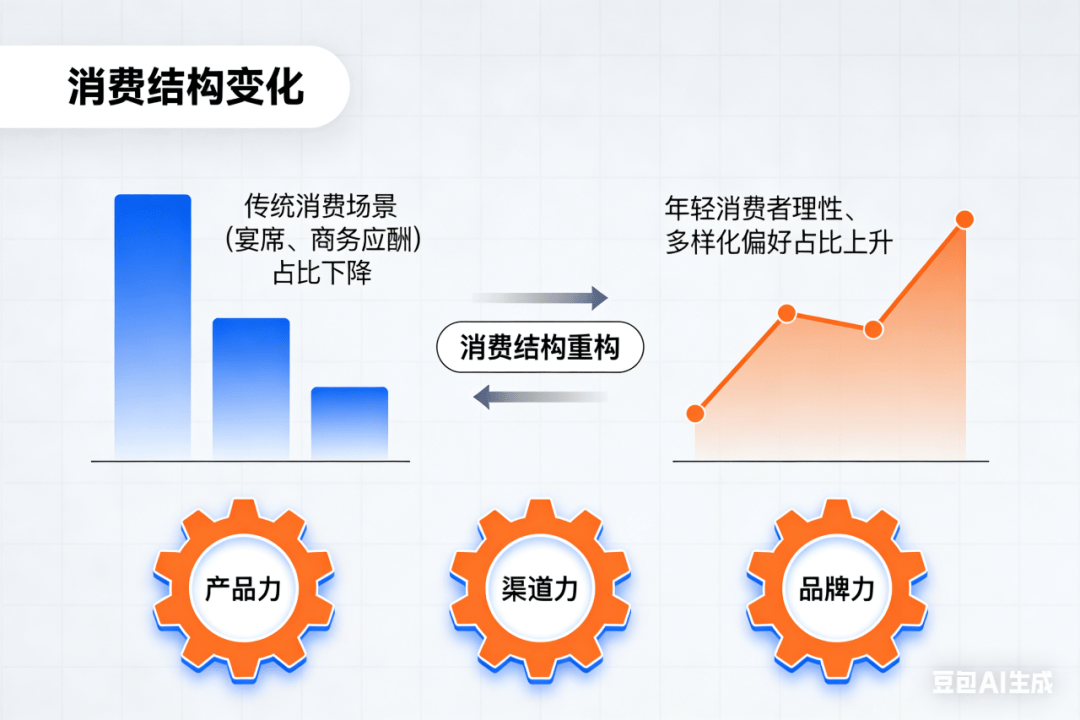
Core Insights - The Chinese liquor industry is entering a significant structural adjustment phase by 2025, with production and overall sales under pressure, while leading companies show relative resilience in revenue and profit [1][2][4] Group 1: Current Industry Status - In 2024, large-scale liquor enterprises are expected to produce approximately 4.145 million kiloliters, a slight decrease of about 1.8% year-on-year, while industry sales revenue is projected to reach approximately 796.38 billion yuan, a year-on-year increase of about 5.3% [1] - The first quarter of 2025 shows a further decline in production, with an estimated output of 1.032 million kiloliters, down about 7.2% year-on-year, indicating a potential eighth consecutive year of production decline [5] - The industry faces challenges such as high inventory levels and price inversion issues, with average inventory turnover days nearing 900 days, leading to declining operating profits for over half of the surveyed companies [8] Group 2: Changes in Consumer Behavior - Traditional consumption scenarios like banquets and business gatherings are shrinking, with consumers becoming more rational and favoring younger and diverse preferences, making volume expansion increasingly difficult [2][6] - The demand for traditional mid-to-high-end products is decreasing, while mid-to-low-end products and new categories (e.g., low-alcohol, flavored, easy-to-drink) are becoming the main sales drivers [6][7] Group 3: Industry Trends - The concentration of the industry is increasing, with the top six companies (CR6) accounting for 86% of total industry profits, up from about 55% in 2014, indicating a significant shift towards a more concentrated market [9] - High-end liquor continues to attract premium pricing due to demand from affluent consumers, while mid-to-low-end products focus on cost-effectiveness and adaptability to consumption scenarios [10] - Consumption scenarios are shifting from traditional settings to more personalized and fragmented experiences, emphasizing social media and community engagement [11] Group 4: Strategic Recommendations for Companies - Leading companies should consolidate their high-end product lines, optimize product and channel structures, and manage inventory effectively to prevent brand devaluation [14][15] - Regional and smaller enterprises should focus on local market penetration, product innovation tailored to local tastes, and diversify their marketing channels to connect directly with consumers [17][19] - Distributors need to transition from traditional wholesale models to service-oriented roles, emphasizing collaboration with manufacturers to share inventory pressures and enhance consumer engagement [20][21] Group 5: Future Outlook - By 2026, the industry is expected to continue its trend towards increased concentration, with high-end and super high-end products maintaining their market positions while mid-to-low-end products adapt to new consumer scenarios [32][33] - The industry is likely to see accelerated capital consolidation and resource integration, with mergers and acquisitions becoming a common strategy to enhance competitiveness and optimize supply chains [32][33]

光瓶酒市场爆发:名酒扎堆背后的消费逻辑重构
Xin Lang Cai Jing· 2025-08-12 10:34
Core Insights - The "light bottle" trend in the liquor industry is gaining momentum, with companies like Yanghe and Yilite launching new products and strategies to capitalize on this shift from "face economy" to "substance demand" [1][2] Market Overview - The light bottle liquor market is projected to exceed 150 billion yuan in 2024 and reach 200 billion yuan in 2025, with the 50-100 yuan price range experiencing over 40% growth [2] - The shift towards light bottle liquor is driven by rational consumer behavior and industry adjustments, moving from low-cost competition to a quality-driven phase due to new national standards [2] Competitive Landscape - The market is becoming increasingly competitive, with brands like Guojiao, Green Neck Xifeng, and Shunpinlang emerging in the 60 yuan price range, leading to high-density competition in regional markets [3] - Companies are adopting innovative strategies, such as Yanghe's collaboration with JD.com for online and offline market penetration, and creating lifestyle associations with products [3] Challenges and Opportunities - Despite the promising outlook, the industry faces challenges such as severe homogenization, limited consumption scenarios, and distorted price ranges [4] - The dominance of low-priced light bottle liquor continues to perpetuate the stereotype of "light bottle equals low-end," which needs to be addressed through quality upgrades and brand premiumization [4] - The entry of well-known brands is accelerating industry consolidation, presenting both challenges and opportunities for small and medium-sized enterprises to differentiate themselves [4]
白酒寒冬来了?茅台跌破2000元,9%增速目标创8年新低!
Sou Hu Cai Jing· 2025-06-19 04:46
Core Viewpoint - The recent decline in the price of Moutai, particularly the wholesale reference price of Flying Moutai dropping below 2000 yuan per bottle, signals a shift in the white liquor market and introduces new uncertainties for the industry [2][6][18]. Price Dynamics - The wholesale price of Flying Moutai has decreased from 2700 yuan per bottle at the beginning of 2024 to below 2000 yuan, indicating significant pressure on the pricing structure [12][18]. - The price drop is attributed to a shift from speculative investment to genuine consumer demand, with a noted 35% decrease in business banquet frequency and a 28% drop in wedding wine orders [6][8]. Company Performance and Strategy - Guizhou Moutai has set a revenue growth target of approximately 9% for 2025, marking the first time since 2017 that the growth target has been set in single digits [3][18]. - In Q1 2025, Moutai's revenue reached 43.557 billion yuan, accounting for 86.12% of total revenue, while series liquor contributed only 70.22 billion yuan, or 13.88% [12][18]. Market Trends and Consumer Behavior - The younger generation (ages 18-35) shows a preference for lower-alcohol beverages, with 63% opting for these over high-alcohol spirits, leading to a 12% year-on-year decline in high-alcohol consumption [8][17]. - The white liquor market is transitioning from a phase of "scale expansion" to "value cultivation," with overall industry inventory exceeding 1 trillion yuan, indicating a supply-demand imbalance [16][17]. Competitive Landscape - Moutai faces intense competition in the 1000-2000 yuan price range from established brands like Wuliangye and Luzhou Laojiao, as well as increasing penetration from alternatives like whiskey [14]. - The purchasing experience for Moutai has been criticized compared to luxury retail standards, impacting brand perception [14]. Regulatory and Economic Factors - The introduction of policies such as the "Eight Regulations" has significantly reduced the market for high-end liquor in government consumption, which previously accounted for 15% of Moutai's sales [17][18]. - The overall market sentiment is shifting towards rational consumption, with consumers increasingly prioritizing quality and health considerations over brand prestige [17][18].

