中医智能诊断设备

Search documents
促进规范人工智能深度融入健康服务 到2030年基本实现基层诊疗智能辅助应用全覆盖
Ren Min Ri Bao· 2025-11-30 02:12
Core Viewpoint - The implementation of artificial intelligence (AI) in healthcare is set to achieve comprehensive coverage of intelligent auxiliary applications in primary care by 2030, enhancing service capabilities and optimizing resource allocation to meet the growing health service demands of the population [2][4]. Group 1: Policy and Implementation - Five departments have released implementation opinions to promote and standardize the application of "AI + healthcare," outlining a timeline for development [2]. - By 2030, it is expected that intelligent auxiliary applications in primary care will be fully covered, and secondary hospitals will widely adopt AI technologies for medical imaging and clinical decision support [2]. Group 2: Focus Areas for AI Integration - The implementation opinions emphasize several key areas, including the promotion of AI in clinical diagnosis, patient services, and public health, with specific measures to enhance these applications [3]. - There is a strong focus on grassroots applications, aiming to strengthen intelligent auxiliary diagnostic applications for primary care physicians and improve chronic disease management services [3]. Group 3: Development and Innovation - The initiative encourages the development of new service models such as intelligent health check-ups and health management, supporting collaboration between medical equipment manufacturers and healthcare institutions for R&D [3]. - The goal is to establish a public support service platform for vertical large models in the healthcare sector, enhancing the overall AI medical service system [4].
促进规范人工智能深度融入健康服务
Ren Min Ri Bao· 2025-11-29 23:51
Core Viewpoint - The integration of artificial intelligence (AI) in healthcare is being promoted to enhance service capabilities, optimize resource allocation, and meet the growing health service demands of the population [1][2][3] Group 1: AI Applications in Healthcare - AI technologies are being applied in various medical fields, including medical imaging diagnosis, clinical decision support, and chronic disease management [1] - The implementation of AI in healthcare aims to provide personalized health management suggestions and assist primary care physicians with diagnostic and treatment processes [1][2] Group 2: Implementation Guidelines - Five departments have released guidelines to promote and regulate the application of AI in healthcare, with a timeline set for 2030 to achieve comprehensive coverage of intelligent assistance in primary care [1][2] - Specific measures include promoting intelligent diagnostic services, expanding clinical decision support applications, and enhancing chronic disease management services [2] Group 3: Focus Areas - The guidelines emphasize the importance of grassroots applications, clinical diagnosis, patient services, and public health [2] - There is a focus on developing intelligent health management services, including health consultations and personalized health profiles for chronic disease management [2] Group 4: Regulatory and Safety Measures - The approach to AI in healthcare emphasizes empowerment rather than replacement, with a commitment to optimizing industry management and enhancing data security and privacy protection [3] - Plans include establishing clinical specialty data sets and AI corpus, as well as creating a public support service platform for vertical AI models in the healthcare sector [3]
到2030年基本实现基层诊疗智能辅助应用全覆盖 促进规范人工智能深度融入健康服务(政策速递)
Ren Min Ri Bao· 2025-11-29 22:32
Core Viewpoint - The integration of artificial intelligence (AI) in healthcare is being promoted to enhance service capabilities, optimize resource allocation, and meet the growing health service demands of the population, with a target for comprehensive implementation by 2030 [1][2]. Group 1: AI Applications in Healthcare - AI is being utilized in various medical fields, including imaging diagnosis, clinical decision support, and chronic disease management, providing personalized health management advice through tools like "digital doctors" [1]. - The implementation plan emphasizes the need for AI applications in real-world healthcare scenarios, focusing on grassroots applications, clinical diagnosis, patient services, and public health [2]. Group 2: Focus on Grassroots and Integration - The plan highlights the importance of strengthening intelligent applications in community healthcare systems, enhancing chronic disease management, and promoting health management services for vulnerable populations [2]. - There is a push for the development of new service models such as intelligent health check-ups and consultations, encouraging collaboration between medical equipment manufacturers and healthcare institutions for innovative AI solutions [2]. Group 3: Regulatory and Data Management - The initiative aims to ensure that AI enhances rather than replaces human roles in healthcare, with a focus on optimizing management and regulatory frameworks, as well as protecting data security and personal privacy [3]. - Efforts will be made to establish clinical specialty data sets and AI corpora, along with a public support service platform for vertical AI models in the healthcare sector [3].
促进规范人工智能深度融入健康服务(政策速递)
Ren Min Ri Bao· 2025-11-29 22:11
Core Viewpoint - The integration of artificial intelligence (AI) in healthcare is being promoted to enhance service capabilities, optimize resource allocation, and meet the growing health service demands of the population by 2030 [1][2][3] Group 1: AI Applications in Healthcare - AI is being widely applied in various medical fields, including medical imaging diagnosis, clinical decision support, and chronic disease management [1] - The implementation plan emphasizes the need for AI applications to be driven by real business scenarios and to address actual needs, focusing on grassroots applications, clinical diagnosis, patient services, and public health [2] Group 2: Development Goals and Timeline - By 2030, the goal is to achieve full coverage of intelligent assistance applications in grassroots diagnosis and treatment, with secondary hospitals widely adopting AI technologies for medical imaging and clinical decision support [1][2] - A comprehensive standard and regulatory framework for "AI + healthcare" applications is expected to be established, along with the creation of leading technology innovation and talent training bases [1] Group 3: Focus Areas for Implementation - The plan highlights the importance of strengthening intelligent applications in tightly-knit county medical communities and enhancing chronic disease management services [2] - It encourages the development of new service models such as intelligent health check-ups, health consultations, and health management, while supporting collaboration between medical equipment manufacturers and healthcare institutions [2] Group 4: Regulatory and Safety Measures - The initiative aims to ensure that AI empowers rather than replaces healthcare professionals, optimizing industry management and regulatory systems while enhancing data security and personal privacy protection [3] - The establishment of clinical specialty data sets and AI corpus, along with a public support service platform for vertical AI models, is being explored to facilitate the effective implementation of AI in healthcare [3]
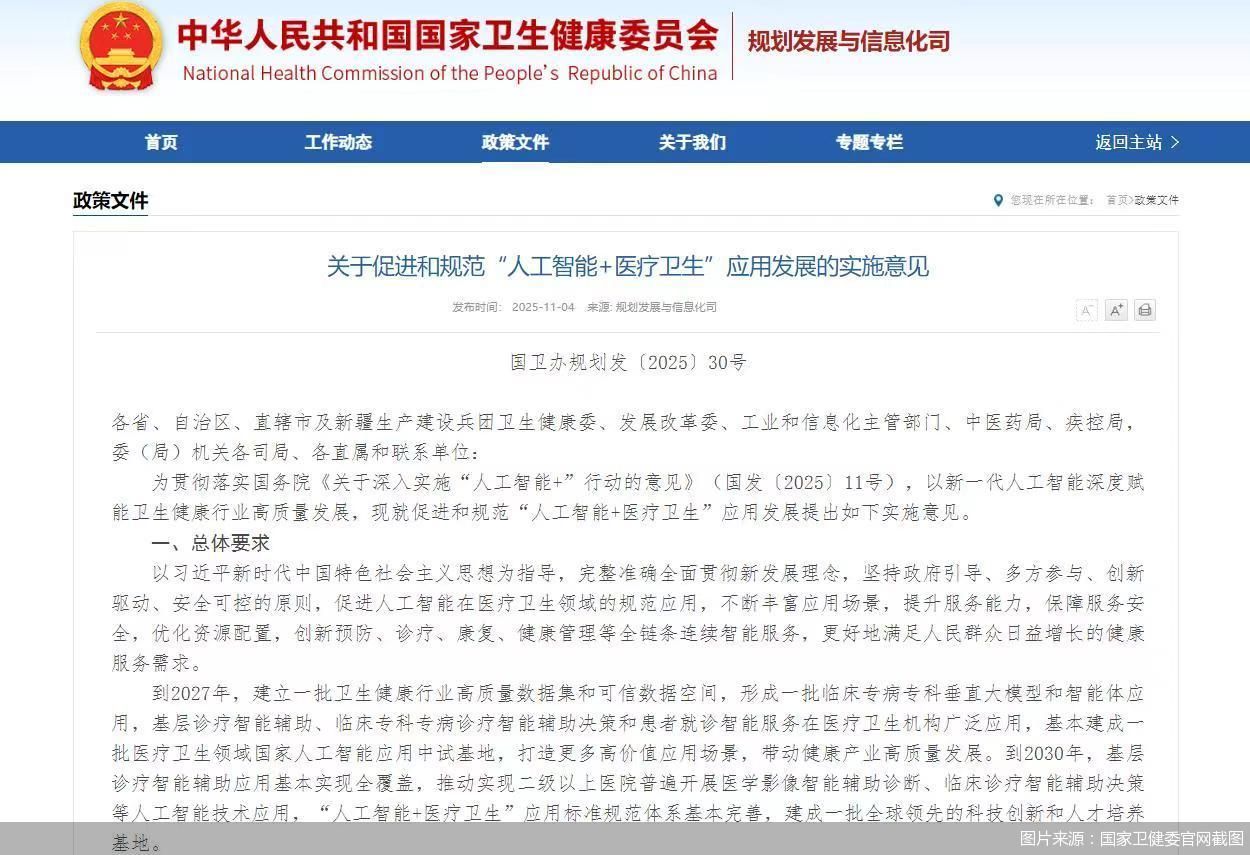
多部门联合发布实施意见,促进规范“人工智能+医疗卫生”应用发展
Bei Jing Shang Bao· 2025-11-04 09:01
Core Viewpoint - The implementation opinion released by the National Health Commission and other departments aims to promote and standardize the application of "Artificial Intelligence + Healthcare" with specific development goals set for 2027 and 2030, focusing on enhancing healthcare efficiency and addressing resource shortages through AI technology [1][4]. Group 1: Development Goals - By 2027, a high-quality data set and trusted data space for the healthcare industry will be established, along with the development of clinical specialized models and intelligent applications [4]. - By 2030, intelligent auxiliary applications for grassroots diagnosis and treatment will achieve full coverage, with secondary hospitals widely adopting AI technologies for medical imaging and clinical decision-making [4]. Group 2: Key Application Areas - The opinion outlines 24 key applications across eight areas, including grassroots applications, clinical diagnosis, patient services, traditional Chinese medicine, public health, research and education, industry governance, and the health industry [4][5]. - AI will enhance grassroots medical institutions by providing intelligent services for common diseases, prescription reviews, and follow-up management [5]. Group 3: Clinical Diagnosis and Treatment - The opinion encourages the expansion of AI-assisted medical imaging diagnostics in secondary hospitals and supports high-level hospitals in aggregating and developing high-quality medical imaging data [6]. - Specialized diagnostic services will focus on pediatrics, mental health, oncology, and rare diseases, utilizing AI clinical decision support systems to improve diagnostic capabilities [6]. Group 4: Intelligent Services and Patient Experience - Comprehensive intelligent services will be provided in hospitals, including precise appointment scheduling, intelligent pre-consultation, and follow-up services, significantly improving patient experience [6][7]. - Smart bedside devices will enable condition monitoring and intelligent nursing, while cross-regional sharing of test results will become a reality [7]. Group 5: Integration of Traditional Chinese Medicine - The opinion emphasizes the integration of traditional Chinese medicine with AI, focusing on building clinical knowledge bases and implementing full-cycle intelligent management of traditional Chinese medicine [7]. - Intelligent diagnostic devices for traditional Chinese medicine will be developed to modernize traditional practices, including the use of robots for acupuncture and massage [7].