中国空间站巡天空间望远镜

Search documents
【人民日报】我国巡天空间望远镜科学数据仿真研究取得进展
Ren Min Ri Bao· 2026-01-08 01:55
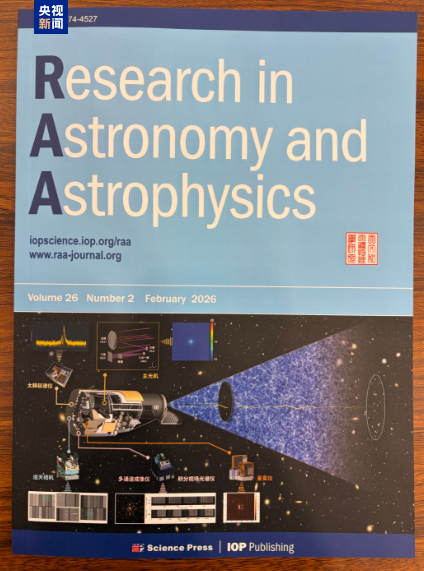
Core Insights - The Chinese research team has made progress in simulating scientific data for the Chinese space station's survey space telescope, with findings published in the journal "Research in Astronomy and Astrophysics" [1] Group 1: Telescope Development - The survey space telescope is part of the fourth generation of survey telescopes, featuring a 2-meter aperture, large field of view, high image quality, and wide wavelength range [1] - The telescope is a significant component of China's manned space program and aims to enhance astronomical observations [1] Group 2: Data Simulation and Performance Evaluation - To ensure timely and reliable scientific output from the telescope, the research team developed an end-to-end observation simulation suite that provides pixel-level high-quality simulations of observational data [1] - This simulation suite will be used for comprehensive performance evaluation of the telescope [1] Group 3: Research Contributions - The research paper systematically presents the instrument performance and simulation data for the main survey module and its auxiliary modules [1] - The findings provide reliable data support for the development and testing of the data processing system prior to the telescope's launch, as well as for scientific operations post-launch [1]
影响市场重大事件:日本欲打造本土版“星链”系统;国资委主任张玉卓:央企要大力发展战略性新兴产业,开辟增长的“第二曲线”
Mei Ri Jing Ji Xin Wen· 2026-01-07 22:11
Group 1 - Japan is working on developing a domestic version of the "Starlink" system to enhance communication services through low Earth orbit satellite constellations [1] - The Chinese government emphasizes the importance of state-owned enterprises (SOEs) in developing strategic emerging industries to create a "second curve" of growth [2] - Shandong Province is drafting policies to upgrade its aerospace industry, aiming to become a leading hub in aerospace manufacturing [3] Group 2 - The Ministry of Industry and Information Technology (MIIT) is promoting the integration of industrial internet and artificial intelligence to enhance computing power supply and encourage the deployment of edge computing devices [4] - By 2028, MIIT aims to have at least 50,000 enterprises implement new industrial network upgrades, enhancing the integration of industrial data and governance [5] - The postal industry is set to introduce policies to accelerate the application of unmanned delivery technologies by 2026, focusing on automation and green technologies [6] Group 3 - MIIT is fostering the development of specialized service providers in industrial data and models, encouraging the transformation of industrial internet solution providers into intelligent solution suppliers [7] - The ministry is also promoting collaboration between AI and industrial internet companies to advance the smart upgrade of industrial systems [8] Group 4 - Goldman Sachs recommends an overweight position in A-shares and H-shares for 2026, predicting a 20% increase in the MSCI China Index driven by double-digit earnings growth and moderate valuations [9] - The Chinese space station's survey telescope has released significant scientific simulation research results, which are crucial for achieving its scientific objectives [10]
中国空间站巡天空间望远镜 “数字分身”训练取得新突破
Huan Qiu Wang Zi Xun· 2026-01-07 07:02
Core Viewpoint - The successful construction of the "digital twin" of the Chinese space station's survey telescope, a 2-meter aperture "space giant eye," which is now open to global scientists [3]. Group 1 - The telescope is designed to enhance astronomical observations and research capabilities [3]. - It represents a significant advancement in China's space exploration technology [3]. - The initiative aims to foster international collaboration in scientific research [3].
成果发布!一文了解中国空间站巡天空间望远镜研究最新进展
Yang Shi Xin Wen· 2026-01-07 03:36
Core Insights - The China Space Station Surveying Telescope (CSST) is a next-generation flagship astronomical observation facility for China's manned space program, featuring large field of view, high image quality, and wide wavelength range [2][4] - The telescope is equipped with various observational terminals including a large field optical survey camera, terahertz spectrometer, multi-channel imager, integral field spectrograph, and exoplanet imaging coronagraph, aiming to achieve breakthroughs in astrophysics, cosmology, and fundamental physics over the next decade [4] Group 1 - The CSST has a 2-meter aperture and is classified as a fourth-generation survey telescope, representing a significant project in China's future space optical astronomy [4] - A comprehensive end-to-end observation simulation suite has been developed by Chinese scientists to ensure the timely and reliable scientific output of the telescope, simulating various optical system changes and their impacts on observational data [2] - The simulation research results provide high-quality pixel-level simulations of the telescope's observational data, which will be used for overall performance evaluation and personalized testing data for the data processing pipeline [2] Group 2 - The telescope's multi-functional optical facilities are designed to complete high spatial resolution, large-area deep multi-color imaging, and seamless spectral survey observations [4] - The telescope is expected to conduct detailed observational studies of selected celestial bodies using various instruments, contributing to significant advancements in major scientific questions [4]

中国空间站巡天空间望远镜科学仿真研究系列成果发布
Xin Lang Cai Jing· 2026-01-07 03:06
Core Insights - The Chinese Space Station Survey Space Telescope (CSST) is a next-generation flagship astronomical observation facility, characterized by large field of view, high image quality, and wide spectral range [1] - A comprehensive end-to-end observation simulation suite has been developed to ensure the timely and reliable scientific output of the telescope, simulating various optical and environmental factors affecting observations [1] - The CSST is a 2-meter aperture space optical telescope, part of the fourth generation of survey telescopes, expected to achieve breakthroughs in astrophysics, cosmology, and fundamental physics over the next decade [1] Summary by Sections - **Scientific Simulation Research**: The simulation suite includes all observation terminals such as the main optical system, survey camera, multi-channel imager, integral field spectrograph, terahertz spectrometer, and exoplanet imaging coronagraph, providing pixel-level high-quality simulations [1] - **Data Processing and Evaluation**: The software and data generated will be used for comprehensive performance evaluation of the telescope and provide personalized test data for the data processing pipeline, ensuring quantitative assessment of the telescope's scientific effectiveness [1] - **Future Prospects**: The CSST aims to conduct deep multi-color imaging and seamless spectral survey observations with high spatial resolution and large sky coverage, facilitating detailed observational studies of selected celestial bodies [1]
开年重磅,北大团队证实一颗“流浪”行星!
Xin Lang Cai Jing· 2026-01-02 02:01
Core Viewpoint - The research team led by Professor Dong Subo from Peking University has successfully measured the mass of a candidate free-floating planet, confirming its planetary status and that it has a mass comparable to Saturn. This significant finding was published in the journal Science on January 1, 2026, marking a new milestone in the study of rogue planets [1][10][17]. Group 1: Definition and Characteristics of Rogue Planets - Rogue planets are celestial bodies that do not orbit any star and drift through interstellar space, unlike the orderly planets in our solar system [4]. - They may form through two primary mechanisms: being ejected from their original planetary systems due to gravitational interactions or forming directly from interstellar gas clouds that collapse without becoming stars [5]. Group 2: Methodology and Observations - The breakthrough occurred on May 3, 2024, when two ground-based microlensing surveys detected a lensing event lasting about two days, coinciding with the European Space Agency's Gaia satellite observations [6][9]. - The combined observations allowed the research team to utilize a triangulation method to determine the distance and mass of the rogue planet candidate, which was found to be approximately one-fifth the mass of Jupiter and comparable to Saturn [10][9]. Group 3: Implications and Future Research - This research provides strong evidence that the Milky Way may contain billions to trillions of rogue planets, suggesting they are common in the galaxy [10][11]. - The findings pave the way for future large-scale surveys using next-generation telescopes, such as NASA's Nancy Grace Roman Space Telescope and China's upcoming CSST, which aim to discover hundreds of rogue planets [11][10]. - Understanding the origins of these rogue planets could reshape our knowledge of planetary formation and the dynamics of planetary systems [11][10].