
工业互联网

Search documents
容知日新:2025年营收6.46亿元,净利润同比降21.96%
Xin Lang Cai Jing· 2026-02-27 08:04
Core Viewpoint - The company reported a total operating revenue of 645.598 million yuan for the year 2025, reflecting a year-on-year growth of 10.60%, while the net profit attributable to the parent company decreased by 21.96% to 83.9087 million yuan [1] Financial Performance - Total assets at the end of the reporting period reached 1,448.9155 million yuan, an increase of 15.36% compared to the beginning of the period [1] - Equity attributable to the parent company grew by 5.16% to 1,103.7481 million yuan from the start of the period [1] - Operating profit and total profit decreased by 32.70% and 33.91% year-on-year, respectively [1] Strategic Outlook - The decline in profits is attributed to the company's proactive strategic investments during a period of AI capability restructuring and industrial upgrading, which is expected to enhance long-term value despite short-term profit impacts [1]

人工智能成制造业升级关键变量
Xin Lang Cai Jing· 2026-02-25 22:05
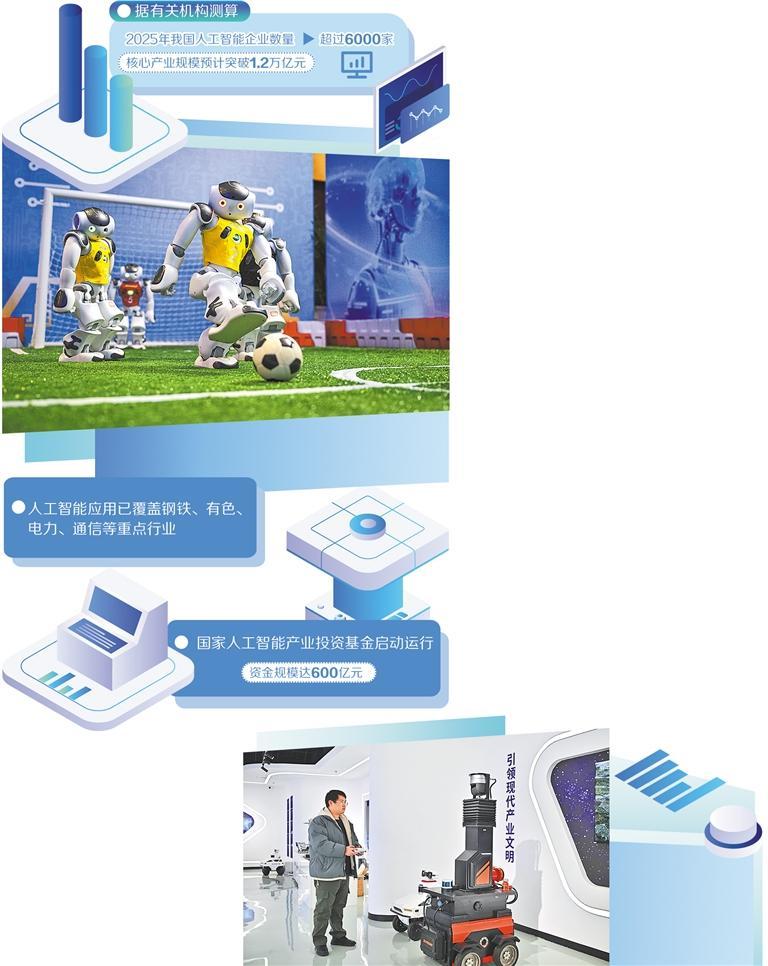
Core Viewpoint - The integration of artificial intelligence (AI) into the manufacturing sector is accelerating, driven by new policies aimed at enhancing productivity and fostering innovation, marking a significant shift from pilot projects to comprehensive implementation [3][4]. Group 1: Policy and Strategic Initiatives - The Ministry of Industry and Information Technology, along with eight other departments, has released the "Implementation Opinions on the 'AI + Manufacturing' Special Action," which aims to promote the integration of AI technologies in manufacturing [3]. - By 2025, it is projected that the number of AI companies in China will exceed 6,000, with the core industry scale expected to surpass 1.2 trillion yuan [4]. - The national AI industry investment fund has been initiated with a funding scale of 60 billion yuan [4]. Group 2: Industry Impact and Development - AI is expected to significantly reshape production models and economic forms within the manufacturing industry, enhancing competitiveness and fostering a new industrial ecosystem [4][5]. - The implementation of AI technologies is anticipated to lead to a 1% efficiency improvement, translating to over 330 billion yuan in economic growth [9]. - The integration of AI with manufacturing is seen as a crucial strategy for maintaining a robust real economy and ensuring stable industrial development [9]. Group 3: Technological Advancements and Applications - The "Implementation Opinions" outline goals for 2027, including the secure supply of key AI technologies and the deep application of 3 to 5 general large models in manufacturing [6]. - AI applications are already covering key industries such as steel, non-ferrous metals, electricity, and telecommunications, enhancing product development, quality inspection, and customer service [4][8]. - The development of industry-specific AI models, such as the JoyIndustrial model by JD, aims to address high costs and low efficiency in industrial supply chains [8]. Group 4: Collaborative Efforts and Ecosystem Building - The successful integration of AI into manufacturing requires collaboration among government, enterprises, and industry organizations to optimize the development environment and promote intelligent transformation [9][10]. - The Ministry of Industry and Information Technology plans to cultivate key industry intelligent entities and accelerate the intelligent upgrade of manufacturing [10]. - A systematic approach is being adopted to ensure the integration of infrastructure, data elements, intelligent applications, and safety guarantees, forming a complete industrial chain and policy loop [6].

春节后开工一线观察:策马扬鞭再出发
Xin Lang Cai Jing· 2026-02-25 18:56
Group 1 - Multiple regions in China have initiated major projects and resumed operations post-Spring Festival, emphasizing a strong start to the year 2026 [1][4] - Guangdong Province's high-quality development conference set the tone for the year, focusing on innovation-driven growth and the collaboration between manufacturing and service industries [1] - Various local governments, such as Shenzhen and Nanjing, have introduced specific policies to enhance the business environment and support enterprises [2] Group 2 - The construction of significant infrastructure projects, such as the Lanzhang High-speed Railway and various urban development initiatives, is underway, showcasing a commitment to effective investment [3][4] - Companies like Beijing SANY Intelligent Manufacturing are ramping up production with high employee attendance rates, indicating a robust recovery in the manufacturing sector [5] - New technologies are being rapidly developed and implemented across industries, with companies focusing on innovative solutions in fields like medical technology and advanced manufacturing [6][7] Group 3 - Policies aimed at fostering new economic drivers, such as artificial intelligence and quantum technology, are being rolled out, reflecting a strategic approach to future growth [7] - The emphasis on innovation and technology integration is evident in various sectors, with companies aiming to enhance productivity and market competitiveness [6][7]
广州天河:今年举办超50场演唱会、超40场赛事
Nan Fang Du Shi Bao· 2026-02-25 16:33
Group 1 - The Tianhe District aims to achieve a GDP growth target of over 5% by 2026, with fixed asset investment exceeding 93 billion yuan and a growth rate of over 10% [1] - The district plans to enhance modern service industries, targeting an added value of 530 billion yuan with a growth rate of 5.5%, and aims for artificial intelligence industry revenue to exceed 62 billion yuan with a growth rate of 12% [1] - Tianhe District will focus on attracting 300 new industrial projects and nurturing 1,600 "Four Up" enterprises [1] Group 2 - Key development areas include the Guangzhou International Financial City, Guangtang Science and Technology Innovation City, and the Guangdong Olympic Cultural and Sports Event Demonstration Zone [2] - The district plans to accelerate the construction of 1 million square meters of science and technology innovation space and open 15 application scenarios [2] - The district aims to enhance the Guangdong Olympic Cultural and Sports Event Demonstration Zone by hosting over 50 concerts and 40 sports events this year [2] Group 3 - The district will strengthen the modern service industry by increasing licensed financial institutions to over 310 and leveraging significant funds for the real economy [3] - There will be a focus on developing industrial internet, industrial software, and digital creativity to better integrate production services into the manufacturing sector [3] - The Tianhe Road-Zhujiang New Town area will see over 300 special consumption activities and the construction of advanced manufacturing projects [3]

全省推动超5万家规模以上工业企业数字化转型
2 1 Shi Ji Jing Ji Bao Dao· 2026-02-25 12:11
Group 1 - The provincial high-quality development conference was held in Guangzhou on February 24, focusing on the development paths of intelligent manufacturing and industrial internet [1] - The conference emphasized the importance of building a modern industrial system with advanced manufacturing as its backbone [1]
告别海尔“温室”,卡奥斯离真正的工业互联网巨头还有多远?
Zhi Tong Cai Jing· 2026-02-25 12:02
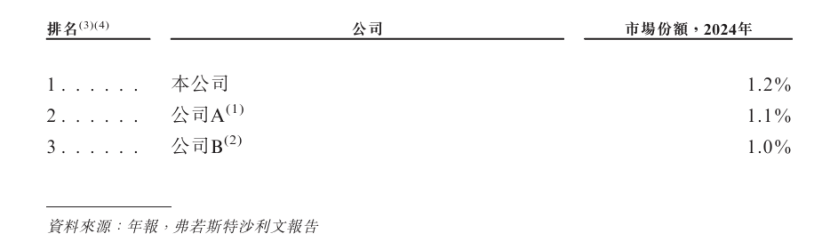
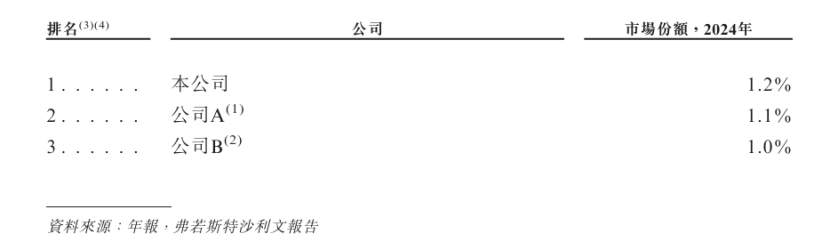
Core Viewpoint - Kaos IoT Technology Co., Ltd., a subsidiary of Haier Group, has officially shifted its IPO plans from A-shares to Hong Kong, aiming to leverage capital markets for growth in the industrial AI era [1]. Group 1: Company Overview - Kaos has developed the COSMOPlat industrial internet platform, leveraging Haier's 40 years of manufacturing experience and large-scale customization [1]. - The company holds a 1.2% market share in the platform-based industrial data intelligence solutions market in China for 2024, ranking first in the industry [1][4]. Group 2: Business Model and Revenue Structure - The revenue model is primarily supported by data intelligence and IoT solutions, with IoT solutions contributing over 70% of revenue but having a low gross margin of around 12.7% [2]. - Data intelligence solutions, which have a gross margin exceeding 30%, are increasing in proportion, rising from 18.3% in 2023 to 29.0% in the first nine months of 2025 [2]. Group 3: Financial Performance - The company's revenue for 2023, 2024, and the first nine months of 2025 was 4.994 billion, 5.069 billion, and 4.421 billion respectively, with a notable profit increase from a loss of 82.72 million in 2023 to a profit of 176 million in the first nine months of 2025 [5][6]. - Government subsidies significantly impact profits, with confirmed subsidies of 97.6 million and 79.7 million in 2023 and 2024, respectively, exceeding net profits for those years [6]. Group 4: Market Position and Challenges - The market remains fragmented, with the top three players holding only 3.3% combined market share, indicating no absolute monopoly yet [2]. - Kaos is addressing challenges related to its dependence on Haier Group, which accounted for 57.7% of its revenue in the first nine months of 2025, down from 72.2% [6][7]. Group 5: Strategic Direction - The company plans to use IPO proceeds to enhance industrial AI capabilities and expand globally, with overseas revenue reaching 709 million in 2024 [7][8]. - Kaos aims to transition from being a mere industry participant to a builder of the industrial internet ecosystem, focusing on "platform + software + hardware" capabilities [8].
新股前瞻 | 告别海尔“温室”,卡奥斯离真正的工业互联网巨头还有多远?
智通财经网· 2026-02-25 12:01
Core Viewpoint - Kaos IoT Technology Co., Ltd., a subsidiary of Haier Group, has officially shifted its IPO focus from A-shares to Hong Kong, aiming to leverage capital markets for growth in the industrial AI era [1]. Group 1: Company Overview - Kaos has developed the COSMOPlat industrial internet platform, which integrates 40 years of manufacturing experience and large-scale customization from Haier Group [1]. - The company holds a 1.2% market share in the platform-based industrial data intelligence solutions market in China for 2024, leading the industry [1][2]. Group 2: Business Model and Revenue Structure - Kaos's revenue is primarily derived from data intelligence solutions and IoT solutions, with the former focusing on smart and green manufacturing [2]. - In the first nine months of 2023 to 2025, IoT solutions contributed over 70% of revenue, but with a low gross margin of approximately 12.7%, impacting overall profitability [2][5]. - Data intelligence solutions, with a gross margin exceeding 30%, have increased their share from 18.3% in 2023 to 29.0% in the first nine months of 2025 [2]. Group 3: Financial Performance - The company's revenue for 2023, 2024, and the first nine months of 2025 was 4.994 billion, 5.069 billion, and 4.421 billion yuan, respectively [5]. - Kaos transitioned from a loss of 82.72 million yuan in 2023 to a profit of 65.14 million yuan in 2024, with profits rising to 176 million yuan in the first nine months of 2025 [5][6]. Group 4: Strategic Moves and Market Position - Kaos is enhancing its green manufacturing capabilities through acquisitions and divesting non-core assets, reflecting a strategy to optimize asset quality [4]. - The company is addressing its reliance on Haier Group, which accounted for 57.7% of its revenue in the first nine months of 2025, down from 72.2% in 2023 [6]. Group 5: Future Outlook - Kaos plans to use IPO proceeds to upgrade its industrial models and develop high-value industrial intelligence, aiming for a transition from equipment connectivity to value creation [7]. - The company is also focusing on expanding its overseas market presence, with overseas revenue reaching 709 million yuan in 2024, indicating a growing share of total revenue [7][8].

卡奥斯IPO弃A转H背后:关联依赖考验独立性 海尔系高管的资本盛宴?
Xin Lang Zheng Quan· 2026-02-25 08:33
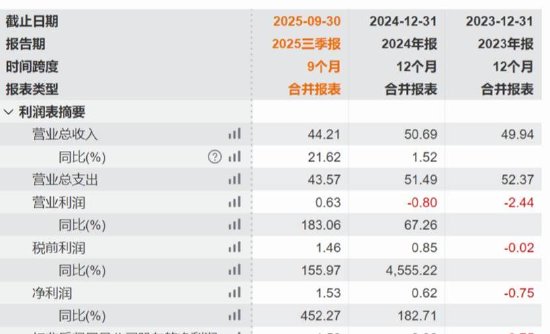
Core Viewpoint - Kaos Technology's IPO has shifted from A-shares to H-shares after five rounds of guidance, primarily due to its reliance on its parent company and significant related-party transactions, raising concerns about its operational independence [1][4]. Group 1: Company Overview - Kaos Technology, established in 2017, is a leading provider of industrial intelligent products and solutions in China, developing the COSMOPlat industrial internet platform [2][7]. - The company aims to raise funds for enhancing core platform capabilities, expanding market reach, and pursuing potential investments and acquisitions [1]. Group 2: Financial Performance - The company's revenue for the reporting periods was 49.94 billion, 50.69 billion, and 44.21 billion, with net profits of -0.75 million, 0.62 million, and 1.53 million respectively [2][3]. - The revenue from the top five customers accounted for approximately 81.7%, 80.2%, and 69.7% of total sales in 2023, 2024, and the first three quarters of 2025, indicating a high dependency on a limited customer base [3][4]. Group 3: Market Position and Competition - Kaos Technology ranks first in China's industrial data intelligence solutions market with a market share of 1.2%, despite the low percentage indicating a fragmented and competitive industry [9]. - The company's gross margin is relatively low at around 17% to 18%, compared to competitors like RootCloud, which has a gross margin of 40% to 50% [9][11]. Group 4: Related-Party Transactions and Governance - The company has significant related-party transactions, with over 50% of its revenue linked to its parent company, Haier Group, raising concerns about its operational independence [1][4]. - The governance structure includes multiple employee stock ownership platforms benefiting management, indicating potential conflicts of interest [15][16]. Group 5: Industry Context - The industrial internet platform sector in China is transitioning from a phase of high investment and scale expansion to a focus on sustainable development and profitability [13]. - Challenges such as market competition, underdeveloped service capabilities, and insufficient user demand hinder the profitability of industrial internet platforms in China [13].
树根科技:展示“工业互联网+AI”双轮驱动赋能两业融合的实践路径 | 省高质量发展大会
Guang Zhou Ri Bao· 2026-02-25 06:14
Group 1 - The Guangdong High-Quality Development Conference highlighted the collaboration between manufacturing and service industries, with Shugen Technology showcasing its innovative applications of industrial intelligence in various scenarios [1] - Shugen Technology's latest product, the Equipment Maintenance Assistant, utilizes intelligent diagnosis, translation, and retrieval engines to address service challenges for Chinese manufacturing companies expanding overseas, achieving a 50% reduction in fault diagnosis time and a 30% increase in maintenance efficiency [1] - The company aims to create a global intelligent service platform, facilitating the transition of Chinese enterprises from manufacturing to global service [1] Group 2 - At the conference's forum on intelligent manufacturing and industrial internet, Shugen Technology emphasized its mission to empower industrial progress through its core capabilities: "Enterprise Brain" for management decision-making and "Robot Brain" for autonomous production [2] - The company has developed large models across 10 vertical fields to shift manufacturing from reliance on human experience to a dual drive of data and intelligence, promoting high-quality, advanced, intelligent, and green industrial development [2] Group 3 - During the forum on industrial integration and policy innovation, Shugen Technology discussed the need for "chain digital transformation" to help small and medium-sized enterprises overcome barriers to transformation [3] - The company plans to leverage its experience in industrial internet and artificial intelligence to create replicable industry benchmarks and reduce application barriers through lightweight, low-cost technology models [3] - Shugen Technology has already integrated over 1,100 industrial protocols and aims to strengthen its role as an enabler of industrial integration in Guangdong [3]
全省高质量发展大会围绕五大主题举行分会场会议为广东推进制造业与服务业协同发展凝聚强大合力
Nan Fang Ri Bao Wang Luo Ban· 2026-02-25 02:13
Group 1: Core Themes of the Conference - The conference focused on high-quality development through industrial integration, policy innovation, and the role of technology and finance in empowering industries [1][2][3][4][5][6][7] - Emphasis was placed on deepening the integration of advanced manufacturing and modern services, as well as the digital economy with traditional industries [2][3][5] Group 2: Key Discussions and Initiatives - The "Industry Integration and Policy Innovation" session highlighted the need for practical measures to enhance policy innovation and create a modern industrial system [2] - The "Technology and Financial Innovation Empowering Industry Integration" session stressed the importance of financial support for technological innovation and the establishment of a high-level cycle ecosystem between technology, industry, and finance [3] - The "Smart Manufacturing and Industrial Internet" session called for leveraging AI and industrial internet to strengthen manufacturing capabilities and enhance competitiveness [4] - The "Digital Economy and New Trade Formats" session discussed the advantages of Guangdong in digital trade and the need for further integration of digital and physical economies [5] - The "Hundred-Thousand Project" session emphasized the importance of county-level industrial integration and the need for coordinated regional development [6][7]