中国空间站巡天空间望远镜(CSST)

Search documents
JUST光谱望远镜向未知发问
Xin Lang Cai Jing· 2026-02-07 07:21
Core Insights - The article discusses the advancements in astronomical observation and the significance of dark matter and dark energy in understanding the universe, highlighting the need for innovative observational tools to explore these mysteries [2][3]. Group 1: Dark Matter and Dark Energy - Less than 5% of the universe is composed of visible matter, while over 95% consists of dark matter and dark energy, which are crucial for shaping galaxy structures and driving cosmic expansion [2]. - Understanding dark matter and dark energy could lead to a revolution in physics, comparable to the impacts of relativity and quantum mechanics [2]. Group 2: Global Scientific Efforts - Global scientific efforts have been ongoing for decades, with various international observational projects like the DESI project in the U.S., the Euclid space telescope in Europe, and Japan's Subaru-PFS aiming to uncover the secrets of the universe [2][3]. Group 3: China's Astronomical Advancements - China is making significant strides in astronomy, although it still lags behind in ground-based optical spectral observation capabilities compared to international standards [3]. - The Guo Shoujing Telescope (LAMOST) and the upcoming Chinese Space Station Telescope (CSST) are notable projects, with CSST expected to achieve breakthroughs in galaxy imaging by 2027 [3][4]. Group 4: JUST Telescope Project - The JUST telescope, a 4.4-meter spectroscopic telescope located in Qinghai, aims to capture the "fingerprints" of the universe by obtaining spectra from tens of millions of galaxies [4]. - JUST is designed to have the highest fiber positioning density globally, allowing it to capture spectra from dense regions of the sky, significantly improving coverage compared to existing telescopes [4][5]. Group 5: Scientific Goals and Future Plans - JUST plans to observe over ten million galaxies within the next five years, creating a detailed three-dimensional map of the universe and accurately measuring the history of cosmic expansion [5]. - The telescope will utilize advanced technology and a prime observational site to transition China's astronomy from data consumption to active interpretation of cosmic phenomena [5].


中国空间站巡天空间望远镜最新成果发布!
Ren Min Ri Bao· 2026-01-27 01:36
Core Insights - The article discusses significant advancements made by Chinese scientists in the simulation of scientific data for the Chinese Space Station Telescope (CSST) [1] - A comprehensive end-to-end observation simulation suite has been developed to ensure the timeliness and reliability of CSST's scientific output [1] Group 1: Simulation Development - The simulation suite models five backend modules, including the main optical system, survey camera, multi-channel imager, integral field spectrograph, exoplanet imaging coronagraph, and terahertz spectrometer [1] - It simulates the impact of optical design residuals, gravitational fields, and temperature variations on the optical system, as well as the effects of components like filters, gratings, and shutters on observations [1] - This simulation provides pixel-level high-quality data for CSST's observational data [1] Group 2: Scientific Impact - The results showcase the instrument performance and simulated data for the CSST survey camera and precision measurement modules, supporting the development and testing of the scientific data processing system prior to launch [1] - The simulation is crucial for scientific preparation, given the massive data and high precision requirements posed by CSST [1] - CSST is a flagship project for China's space astronomical observation, featuring a 2-meter aperture and characteristics such as large field of view, high image quality, and wide spectral range [1]

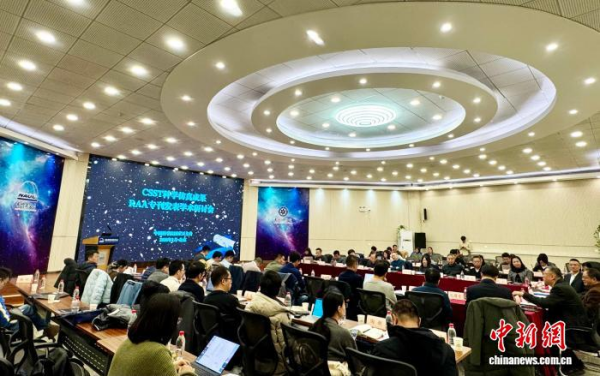
【中国新闻网】中国空间站巡天空间望远镜科学仿真研究获重要进展 发表系列成果
Zhong Guo Xin Wen Wang· 2026-01-08 01:55
Core Insights - The China Space Station Telescope (CSST) has made significant progress in scientific data simulation research, with results published in a special issue of the international academic journal Research in Astronomy and Astrophysics (RAA) [2][5] - CSST is a next-generation flagship space astronomical observation facility, characterized by a large field of view, high image quality, and a wide range of wavelengths, which is crucial for achieving its scientific goals [3] Group 1: Scientific Research and Development - The CSST scientific simulation research team has developed an end-to-end observation simulation suite to ensure the timeliness and reliability of CSST's scientific output [4][6] - This simulation software models all observation terminals of the telescope, including the main optical system and various instruments, to achieve high-quality pixel-level simulation of future observational data [4] Group 2: Technological and Scientific Impact - The simulation data will be used for comprehensive performance evaluation of the space telescope and provide personalized test data for the data processing pipeline, ensuring quantitative assessment of CSST's scientific effectiveness [6] - The end-to-end simulation system is expected to play a crucial role in the scientific preparation phase of CSST, laying a solid foundation for data processing research and scientific analysis [7]
巡天望远镜有了“数字分身”
Xin Lang Cai Jing· 2026-01-07 06:54
Core Viewpoint - The China Space Station Survey Telescope (CSST) is set to enhance space astronomy with advanced observational capabilities, having undergone extensive digital simulations to ensure high-quality data collection post-launch [1][2] Group 1: Telescope Specifications and Capabilities - CSST features a two-meter aperture and a field of view 300 times larger than the Hubble Space Telescope, equipped with multiple advanced observational instruments [1] - The telescope is expected to observe an area of 17,500 square degrees and will be capable of cataloging approximately 1 billion galaxies [2] Group 2: Pre-launch Preparations and Simulations - Prior to launch, a digital replica of the telescope's observational environment has been created to simulate data collection and address potential errors [2] - The research team has developed a "digital twin" of the telescope's main optical system and observational terminals to preemptively analyze the effects of environmental changes on data accuracy [1][2]
天文观测重大突破 我科学家为“流浪”行星“验明正身”
Xin Lang Cai Jing· 2026-01-02 18:29
Core Insights - A research team led by Professor Dong Subo from Peking University has successfully measured the mass of a candidate rogue planet, confirming it to be a planet with a mass comparable to Saturn, marking a significant milestone in understanding planetary formation and dynamics [1][2] Group 1: Research Findings - The rogue planet, which does not orbit any star and drifts in interstellar space, was identified through a microlensing event where its gravitational field bent the light from a background star, causing a temporary brightening [1] - The team utilized a rare observational opportunity on May 3, 2024, when both ground-based telescopes from the KMTNet and OGLE projects and the European Space Agency's Gaia satellite were observing the same region, allowing for precise measurements [2] - The mass of the rogue planet was determined to be approximately one-fifth that of Jupiter, confirming its classification as a planet and ruling out the possibility of it being a brown dwarf or star [2] Group 2: Implications for Future Research - This discovery indicates that rogue planets may be abundant in the Milky Way, likely ejected from their original planetary systems [2] - The microlensing parallax measurement method developed in this research paves the way for large-scale detection by next-generation space telescopes, such as NASA's upcoming Roman Space Telescope and China's space station survey telescope (CSST) [2] - Future missions, including the "Earth 2.0" satellite, will focus on detecting rogue planets, aiming to answer fundamental questions about their prevalence and characteristics within the galaxy [2]