中邮核心成长A

Search documents
薪酬新规透视 | 中邮创业基金11年“老将”陈梁在管4产品三年齐跑输基准,中邮核心成长A跑输超42%
Xin Lang Cai Jing· 2025-12-15 06:43
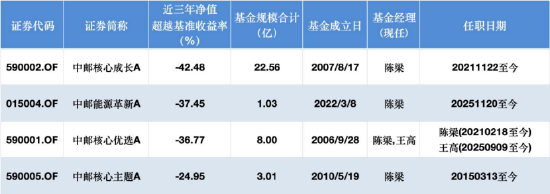
Core Viewpoint - The recent reform in the fund industry emphasizes performance, leading to potential salary reductions for nearly a thousand fund managers if their products underperform significantly against benchmarks over the past three years [1][10]. Fund Performance and Manager Changes - According to new regulations from the Asset Management Association of China, fund managers whose products have returns below the benchmark by more than 10 percentage points and have negative profit margins will see their performance-based compensation reduced by at least 30% [1][10]. - Chen Liang, the manager of four funds at Zhongyou Chuangye Fund, has shown significant negative excess returns over the past three years, with his funds underperforming their benchmarks by substantial margins [10][12]. - Specifically, Zhongyou Kexin Growth A has underperformed its benchmark by 42.48%, with a fund size of 2.256 billion yuan; Zhongyou Energy Innovation A has underperformed by 37.45%, with a size of 103 million yuan; Zhongyou Kexin Preferred A has underperformed by 36.77%, with a size of 800 million yuan; and Zhongyou Kexin Theme A has underperformed by 24.95%, with a size of 301 million yuan [12][10]. Fund Holdings and Investment Strategy - Zhongyou Kexin Preferred A exhibits a diversified portfolio, with its top ten holdings spread across various traditional industries, and individual stock holdings generally around 2%, with the highest being Ping An Insurance at 2.34% [3][12]. - In contrast, Zhongyou Kexin Growth A shows a more concentrated investment strategy, with its top ten holdings primarily consisting of bank stocks, including Industrial and Commercial Bank of China, China Construction Bank, and Bank of Communications [5][13]. Manager Background and Performance Metrics - Chen Liang has over 11 years of experience in investment management and has managed 12 funds, currently overseeing four, all within the same company, making him a typical "long-distance runner" in the industry [7][15]. - His total return as a fund manager stands at 55.04%, with an annualized return of 3.92%, which is significantly lower than the total return of the CSI 300 benchmark at 103.49% and its annualized return of 6.43% [9][17]. - Over the past three years, Chen's performance has yielded a return of -21.34%, which is markedly below the benchmark, and this gap has widened recently, with a year-to-date return of -2.73% compared to the benchmark's 15.69% [17].


持有基金十年收益如何?最高收益超6倍 最差亏损近五成
Nan Fang Du Shi Bao· 2025-09-29 17:30
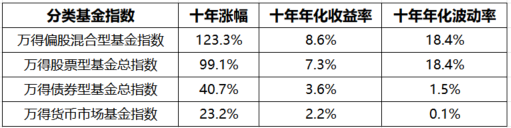
Core Insights - The founder of Hainan Xiwa Private Fund Management Co., Liang Hong, announced a gift of mobile phones to investors who bought into the fund in 2015, marking a decade of partnership [1] - Over the past ten years, the average return of public funds that have been established for over ten years is 93.4%, with an average annualized return of 6.1% [2][3] - Despite the overall positive performance, 51 funds have recorded losses over the past decade, with the worst performer, China Merchants HuShen 300 Real Estate, showing a return of -48.2% [1][10] Fund Performance - As of September 26, 2025, there are 2,036 public funds that have been established for over ten years, with 97.2% of them achieving positive cumulative returns [2] - The top-performing fund, Huashang New Trend Preferred, has a cumulative return of 649.2% and an annualized return of 22.3%, making it the only fund to exceed six times its initial investment [8] - The performance of various fund types shows that equity funds have outperformed others, with the mixed equity fund index rising by 123.3% over ten years [3][4] Volatility and Risk - Active management equity funds have a high annualized volatility of 18.4%, which can lead to significant risks for average investors [6] - In contrast, bond and money market funds have lower returns but also exhibit much lower volatility, with annualized volatility of 1.5% and 0.1%, respectively [6] Underperforming Funds - A total of 58 funds have recorded losses over the past decade, with some funds experiencing maximum drawdowns exceeding 65% [10][11] - The underperforming funds include several that were once large-scale funds, with the worst performer, China Merchants HuShen 300 Real Estate A, showing a cumulative loss of -48.2% [11][12]
盘点权益类近十年跌幅榜:天治新消费跌55%居首,太平灵活配置跌54%随后,民生加银精选成立15年换12将
Xin Lang Ji Jin· 2025-08-20 09:15
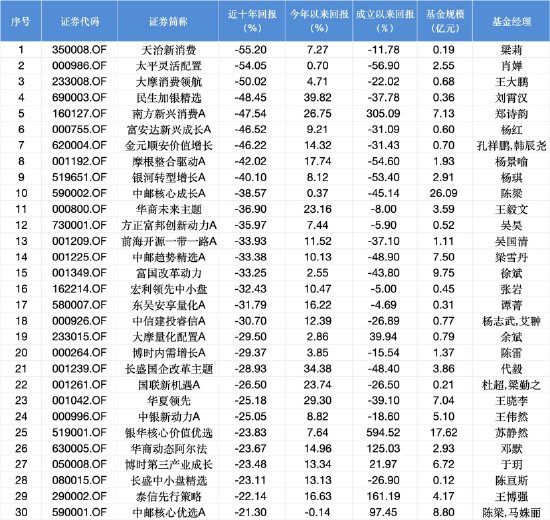
Core Insights - The A-share market has reached a ten-year high, yet many equity funds have failed to capture the economic growth dividends, with 154 funds showing negative returns over the past decade, 91 of which are equity products [1] Fund Performance - The top underperforming fund, Tianzhi New Consumption, has a ten-year return of -55.20%, with a current scale of 0.19 billion yuan and a total return since inception of -11.78% [2] - Taiping Flexible Allocation follows closely with a ten-year return of -54.05% and a total return since inception of -56.90%, focusing on leading consumer stocks [3] - Other funds like Morgan Consumption Leading and Minsheng Jiayin Select have also seen declines exceeding 50% over the past decade [3] Fund Types and Management - Nearly half of the funds on the loss list are flexible allocation funds, which are expected to have strong asset adjustment capabilities but have failed to demonstrate effective risk control [3] - Many poorly performing funds have experienced frequent changes in fund managers, leading to a lack of continuity in investment strategies, which negatively impacts long-term performance [5][6] Market Trends - Despite some funds showing short-term rebounds in 2023, their long-term total returns remain in negative territory, indicating that short-term performance does not guarantee a recovery from long-term declines [7] - The persistent underperformance of these funds highlights the importance of focusing on long-term stability, clear strategies, and cohesive management teams when selecting investment funds [7]