公募绩效改革

Search documents
绩效新规|富国基金三年给基民亏626亿,给股东分红35亿,连续3年分红率超57%
Xin Lang Cai Jing· 2026-01-07 09:48
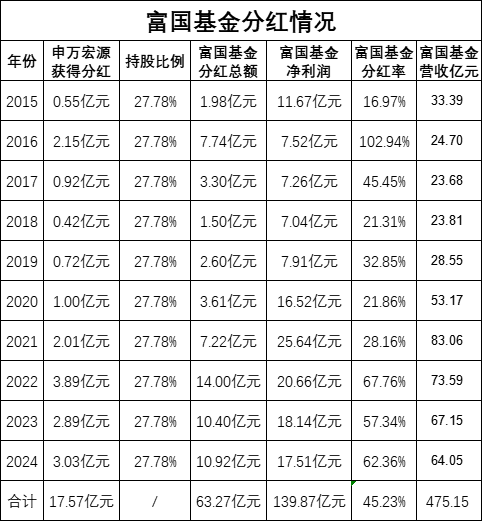
Core Viewpoint - The recent draft of the "Guidelines for Performance Assessment of Fund Management Companies" introduces significant reforms in the public fund industry, emphasizing performance-based compensation and dividend distribution, which may lead to salary reductions for nearly a thousand fund managers [1][6]. Group 1: Dividend Distribution Regulations - The guidelines require fund companies to prudently determine dividend frequency and ratio based on the long-term performance of fund products and investor gains and losses [1][6]. - For funds with poor performance over the past three years, the guidelines suggest reducing both the frequency and ratio of dividends [1][6]. Group 2: Financial Performance of Fuguo Fund - In 2024, Fuguo Fund reported an operating income of 6.405 billion yuan and a net profit of 1.751 billion yuan, with a total dividend payout of 1.092 billion yuan and a dividend rate of 62.36% [1][3]. - From 2015 to 2024, Fuguo Fund accumulated operating income of 47.515 billion yuan, net profit of 13.987 billion yuan, and total dividends of 6.327 billion yuan [1][3]. Group 3: Historical Dividend Rates - Fuguo Fund maintained a dividend rate exceeding 57% for three consecutive years from 2022 to 2024, distributing over 3.5 billion yuan in total dividends during this period [2][7]. - The dividend distribution data shows fluctuations, with the highest dividend rate recorded in 2016 at 102.94% and the lowest in 2015 at 16.97% [3][8]. Group 4: Fund Performance Metrics - From 2022 to 2024, 65% of Fuguo Fund's 237 products reported losses, with 59% underperforming their benchmarks [5][10]. - In contrast, from 2023 to 2025, only 9% of 278 products reported losses, indicating an improvement in performance metrics [4][9]. Group 5: Market Insights on Dividend Policies - Market analysts argue that excessively high dividend rates can hinder capital accumulation and risk management for fund companies, potentially affecting their innovation and expansion capabilities [11].

绩效新规|中欧基金9年分红18.28亿元,总经理刘建平获分红9000万元,近三年43%的产品跑输业绩基准
Xin Lang Cai Jing· 2026-01-05 08:01
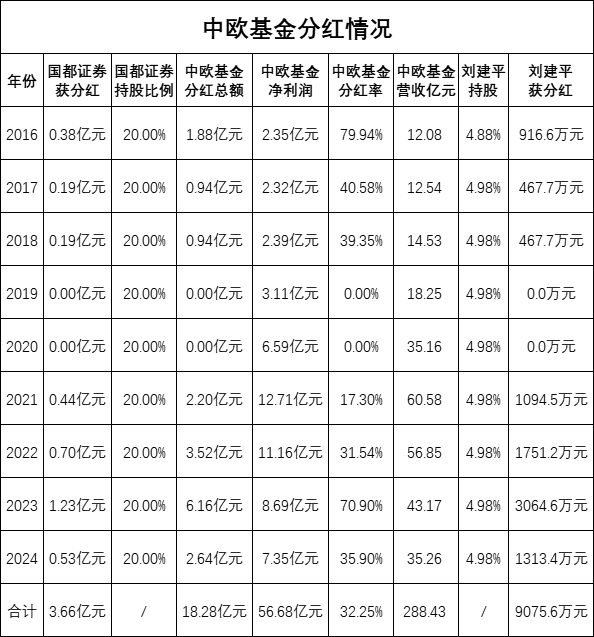
Core Viewpoint - The recent draft of the "Guidelines for Performance Assessment Management of Fund Management Companies" has sparked significant discussion in the industry, emphasizing the importance of performance in fund management and potentially leading to salary reductions for nearly a thousand fund managers [1][8]. Fund Performance and Dividend Distribution - The guidelines stipulate that fund companies should prudently determine dividend frequency and ratio based on the long-term performance of fund products and investor gains and losses, particularly lowering dividends for funds with poor performance over the past three years [1][7]. - According to Guodu Securities' 2024 report, China Europe Fund reported operating income of 3.526 billion yuan and net profit of 735 million yuan, with a total dividend payout of 264 million yuan and a dividend rate of 35.9% [1][8]. - From 2016 to 2024, China Europe Fund accumulated revenue of 28.843 billion yuan, net profit of 5.668 billion yuan, and total dividends of 1.828 billion yuan, with Guodu Securities receiving 366 million yuan in dividends during this period [1][9]. Employee Shareholding Structure - China Europe Fund is one of the first public fund companies in the industry to implement employee shareholding, having undergone three rounds of equity transfers to core employees since 2014, resulting in over 50% of shares held by employees [3][10]. - As of now, the shareholding structure includes Huaping Investment at 23.3%, Guodu Securities at 20%, and core employees holding a total of 56.7% [3][10]. Fund Product Performance - Data from Wind indicates that from 2022 to 2024, 66% of the 103 fund products under China Europe Fund experienced losses, with 76% underperforming their benchmarks, resulting in a total loss of 116.2 billion yuan for investors [5][12]. - For the period from 2023 to 2025, among 135 products, only 11.85% are expected to incur losses, with 43.7% underperforming their benchmarks [5][12].
绩效新规|春华资本投入18亿买华夏基金10%股权,持有13年卖35亿元,又获8.3亿元分红,累计大赚25亿元
Xin Lang Cai Jing· 2025-12-26 07:31
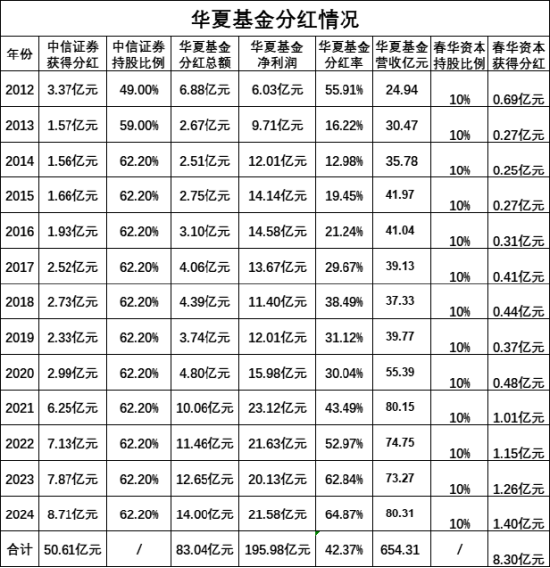
Core Insights - The recent draft of the "Guidelines for Performance Assessment Management of Fund Management Companies" has sparked significant discussion in the industry, indicating a shift towards a performance-driven era in public funds [1][5] - The guidelines impose restrictions on dividend distributions to shareholders based on the long-term performance of fund products and investor profit and loss situations [1][5] Fund Performance and Dividend Distribution - In 2024, Huaxia Fund reported an operating income of 8.03 billion yuan and a net profit of 2.16 billion yuan, with a dividend payout of 871 million yuan, resulting in a dividend rate of 64.87%, the highest in the past decade [5][6] - Over the past ten years (2015-2024), Huaxia Fund has accumulated revenues of 56.31 billion yuan and net profits of 16.82 billion yuan, distributing a total of 7.10 billion yuan in dividends to shareholders [5][6] - The dividend rate has increased consecutively for four years from 30% to 64.87% from 2020 to 2024 [5][6] Shareholder Insights - CITIC Securities holds a 62.20% stake in Huaxia Fund and has received a total of 5.06 billion yuan in dividends over the past decade [8] - Tianjin Haipeng, through Springhua Capital, acquired a 10% stake in Huaxia Fund for approximately 1.8 billion yuan in 2011 and is set to sell the same stake for no less than 490 million USD in 2025, valuing Huaxia Fund at approximately 4.9 billion USD or 35 billion yuan [6][7] Historical Dividend Data - The historical dividend data for Huaxia Fund shows a consistent increase in both total dividends and dividend rates from 2012 to 2024, with notable peaks in 2021 and 2022 [8] - The total dividends received by Tianjin Haipeng from 2012 to 2024 amount to 830 million yuan, alongside capital gains from the sale of shares [7][8]
绩效新规|华夏基金8年给外资股东分红14.35亿元,迈凯希金融公司91亿元的投入成本已收回15.78%
Xin Lang Cai Jing· 2025-12-26 07:26
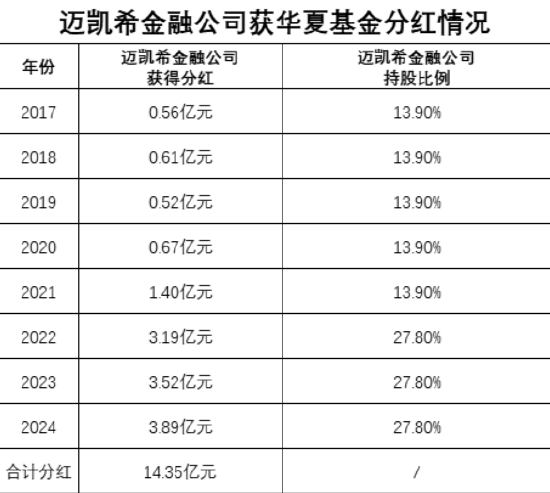
Core Viewpoint - The recent draft of the "Guidelines for Performance Assessment Management of Fund Management Companies" has sparked significant discussion in the industry, indicating a shift towards a performance-driven era in public fund management, with nearly a thousand fund managers facing potential salary reductions [1][4]. Group 1: Guidelines and Performance Assessment - The guidelines stipulate that fund companies must prudently determine dividend frequency and ratio based on the long-term performance of fund products and investor profit and loss situations [1][4]. - For fund products with poor performance and significant investor losses over the past three years, the guidelines recommend a reduction in both dividend frequency and ratio [1][4]. Group 2: Financial Performance of Huaxia Fund - According to CITIC Securities' 2024 annual report, Huaxia Fund reported an operating income of 8.031 billion yuan and a net profit of 2.158 billion yuan, with a total dividend payout of 1.4 billion yuan and a dividend rate of 64.87% [1][4]. - Over the past decade (2015-2024), Huaxia Fund has accumulated revenues of 56.312 billion yuan and net profits of 16.824 billion yuan, distributing a total of 7.099 billion yuan in dividends to shareholders [1][4]. Group 3: Mackay Financial's Investment in Huaxia Fund - Mackay Financial acquired a 3.9% stake in Huaxia Fund for 936 million yuan in 2017, along with a previous 10% stake for 2.4 billion yuan, totaling 3.336 billion yuan for a 13.9% ownership [2][5]. - In December 2022, Mackay Financial was approved to acquire an additional 13.9% stake from the Canadian Power Group for 5.758 billion yuan, bringing its total investment to approximately 9.094 billion yuan for a 27.8% stake [2][5][6]. Group 4: Dividend Earnings of Mackay Financial - From 2017 to 2024, Mackay Financial received a total of 1.435 billion yuan in dividends from Huaxia Fund, which represents a recovery of 15.78% of its initial investment based solely on dividends [2][6][7]. - The annual dividend earnings for Mackay Financial are as follows: 0.056 billion yuan in 2017, 0.061 billion yuan in 2018, 0.052 billion yuan in 2019, 0.067 billion yuan in 2020, 0.14 billion yuan in 2021, 0.319 billion yuan in 2022, 0.352 billion yuan in 2023, and 0.389 billion yuan in 2024 [3][7].
绩效新规|浦银安盛基金十年分红8.8亿,浦发银行获4.5亿,外资股东安盛投资获3.44亿,近三年6成产品跑输基准
Xin Lang Cai Jing· 2025-12-23 10:42
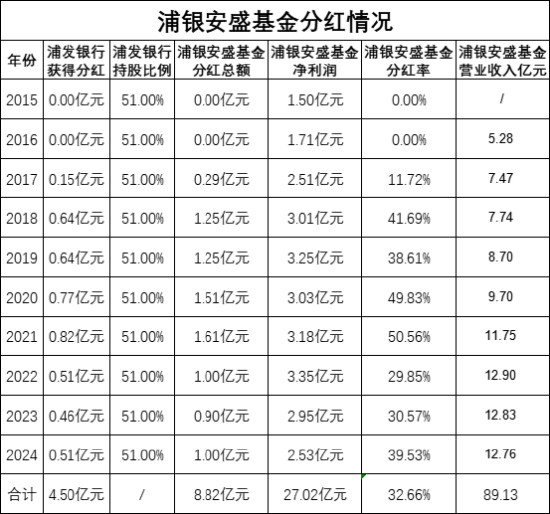
Core Viewpoint - The recent draft of the "Guidelines for Performance Assessment Management of Fund Management Companies" introduces significant reforms in the public fund industry, emphasizing performance-based evaluations and potentially leading to salary reductions for nearly a thousand fund managers [1][7]. Fund Performance and Dividend Distribution - The guidelines stipulate that fund companies should prudently determine dividend frequency and ratios based on the long-term performance of fund products and investor gains or losses, particularly reducing dividends for funds with poor performance over the past three years [1][7]. - According to the 2024 annual report of Shanghai Pudong Development Bank, the operating income of Puyin Ansheng Fund was 1.276 billion yuan, with a net profit of 253 million yuan, resulting in a total dividend of 100 million yuan and a dividend rate of 39.53% [1][7]. - Over the past decade (2015-2024), Puyin Ansheng Fund has accumulated a net profit of 2.702 billion yuan and distributed a total of 882 million yuan in dividends to shareholders, with Shanghai Pudong Development Bank receiving 450 million yuan [1][8]. Comparison with Foreign Shareholders - The foreign shareholder, AXA Investment Managers, has received a total of 344 million yuan in dividends over the same period, having invested at least 468 million yuan since the fund's establishment in 2007 [3][10]. - In contrast, foreign shareholders in the industry, such as the second-largest shareholder of Penghua Fund, have seen significantly higher returns, with a total of 1.667 billion yuan in dividends over the past decade, indicating a stark difference in investment returns compared to AXA [10]. Fund Product Performance - Data from Wind shows that from 2022 to 2024, 32 out of 74 fund products (43%) under Puyin Ansheng Fund reported losses, and 47 products (63%) underperformed their benchmarks, with 17 products (22%) underperforming by more than 10% [5][11]. - For the period from December 1, 2022, to November 30, 2025, 15 out of 86 products (17%) are expected to incur losses, with 55 products (63%) underperforming their benchmarks [5][12].

绩效新规|东方红资产管理10年给东方证券分红31.7亿,2022至2023给基民亏480亿元分红率却连续两年超过86%
Xin Lang Cai Jing· 2025-12-16 07:57
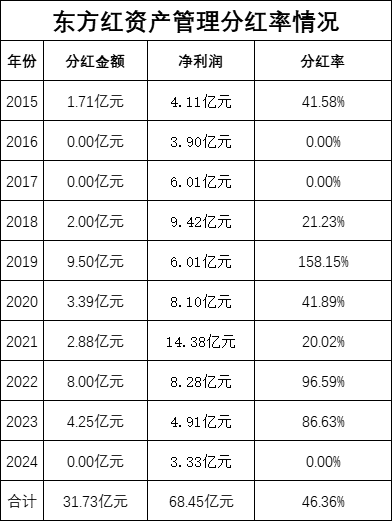
Core Viewpoint - The recent draft of the "Guidelines for Performance Assessment Management of Fund Management Companies" has sparked significant discussion in the industry, emphasizing the need for fund companies to prudently determine dividend frequency and ratios based on long-term performance and investor losses [1][6]. Group 1: Dividend Policy Changes - The guidelines require fund companies to adjust dividend frequency and ratios for funds with poor performance and significant investor losses over the past three years [1][6]. - In 2024, Oriental Red Asset Management reported revenue of 1.438 billion yuan and a net profit of 333 million yuan, with a cumulative net profit of 6.845 billion yuan and total dividends of 3.173 billion yuan over the past decade [1][6]. Group 2: Dividend Rate Analysis - The dividend rates for Oriental Red Asset Management in 2022 and 2023 were notably high at 96.59% and 86.63%, respectively, despite the company reporting significant losses for investors [2][7]. - Over the years, the dividend amounts and net profits have varied, with a total of 3.173 billion yuan in dividends against 6.845 billion yuan in net profits from 2015 to 2024 [2][7]. Group 3: Performance Metrics - From 2022 to 2024, 53% of the 76 fund products under Oriental Red Asset Management reported losses, with 65% underperforming their benchmarks [3][8]. - In the same period, the total losses for investors amounted to 42.6 billion yuan, highlighting a significant disparity between shareholder dividends and investor returns [3][8]. Group 4: Market Reactions - Market analysts have raised concerns that excessively high dividend rates could hinder capital accumulation and risk management for fund companies, potentially impacting their ability to innovate and expand [5][9]. - The practice of distributing high dividends during periods of poor investor performance is viewed as detrimental to the overall investor experience [5][9].

薪酬新规透视 | 中邮创业基金11年“老将”陈梁在管4产品三年齐跑输基准,中邮核心成长A跑输超42%
Xin Lang Cai Jing· 2025-12-15 06:43
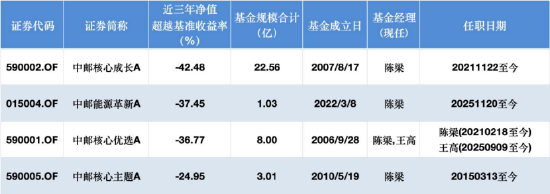
Core Viewpoint - The recent reform in the fund industry emphasizes performance, leading to potential salary reductions for nearly a thousand fund managers if their products underperform significantly against benchmarks over the past three years [1][10]. Fund Performance and Manager Changes - According to new regulations from the Asset Management Association of China, fund managers whose products have returns below the benchmark by more than 10 percentage points and have negative profit margins will see their performance-based compensation reduced by at least 30% [1][10]. - Chen Liang, the manager of four funds at Zhongyou Chuangye Fund, has shown significant negative excess returns over the past three years, with his funds underperforming their benchmarks by substantial margins [10][12]. - Specifically, Zhongyou Kexin Growth A has underperformed its benchmark by 42.48%, with a fund size of 2.256 billion yuan; Zhongyou Energy Innovation A has underperformed by 37.45%, with a size of 103 million yuan; Zhongyou Kexin Preferred A has underperformed by 36.77%, with a size of 800 million yuan; and Zhongyou Kexin Theme A has underperformed by 24.95%, with a size of 301 million yuan [12][10]. Fund Holdings and Investment Strategy - Zhongyou Kexin Preferred A exhibits a diversified portfolio, with its top ten holdings spread across various traditional industries, and individual stock holdings generally around 2%, with the highest being Ping An Insurance at 2.34% [3][12]. - In contrast, Zhongyou Kexin Growth A shows a more concentrated investment strategy, with its top ten holdings primarily consisting of bank stocks, including Industrial and Commercial Bank of China, China Construction Bank, and Bank of Communications [5][13]. Manager Background and Performance Metrics - Chen Liang has over 11 years of experience in investment management and has managed 12 funds, currently overseeing four, all within the same company, making him a typical "long-distance runner" in the industry [7][15]. - His total return as a fund manager stands at 55.04%, with an annualized return of 3.92%, which is significantly lower than the total return of the CSI 300 benchmark at 103.49% and its annualized return of 6.43% [9][17]. - Over the past three years, Chen's performance has yielded a return of -21.34%, which is markedly below the benchmark, and this gap has widened recently, with a year-to-date return of -2.73% compared to the benchmark's 15.69% [17].

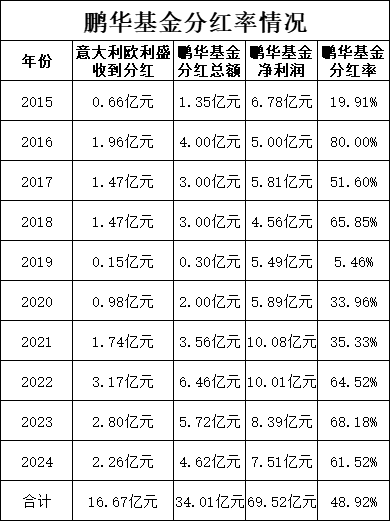
绩效新规|鹏华基金外资股东意大利欧利盛赚的盆满钵满:2007年投入5.7亿元收购49%股权,近十年获分红16.67亿
Xin Lang Cai Jing· 2025-12-12 06:45
Core Viewpoint - The recent draft of the "Guidelines for Performance Assessment Management of Fund Management Companies" introduces significant reforms in the public fund industry, emphasizing performance-based compensation and potentially leading to salary reductions for nearly a thousand fund managers [1][4]. Summary by Relevant Sections Performance Assessment Guidelines - The guidelines require fund companies to prudently determine dividend frequency and ratios based on long-term performance and investor gains or losses, particularly for funds with poor performance over the past three years [1][4]. - Fund companies are encouraged to invest in capital accumulation, research and development, risk prevention, information technology, investor education, and social responsibility before distributing dividends [1][4]. Penghua Fund Financial Performance - In 2024, Penghua Fund reported an operating income of 3.594 billion yuan and a net profit of 751 million yuan, with a total dividend payout of 462 million yuan, resulting in a dividend rate of 61.52% [1][4]. - Over the past decade (2015-2024), Penghua Fund has accumulated a net profit of 6.952 billion yuan and distributed a total of 3.401 billion yuan in dividends [1][4]. Foreign Shareholder Earnings - The second-largest shareholder of Penghua Fund, Italy's Eurizon Capital, holds a 49% stake and has received dividends totaling 1.667 billion yuan over the past decade [2][5]. - Eurizon Capital acquired its stake in Penghua Fund for approximately 570 million yuan in 2007, indicating that it has recouped its investment and earned an additional profit of 1.1 billion yuan from dividends alone [2][5].
薪酬新规透视 | 富国王园园旗下6只产品近三年全线跑输基准,5只跑输超21%,富国消费主题A跑输近34%
Xin Lang Cai Jing· 2025-12-10 09:33
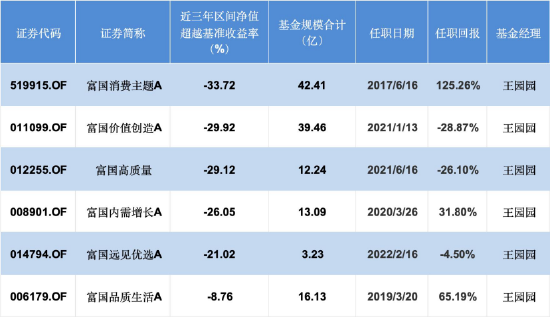
Core Viewpoint - The fund industry is undergoing significant reform in its compensation system, with nearly a thousand fund managers facing potential salary reductions due to underperformance over the past three years [1][3]. Group 1: Compensation Reform - New regulations from the Asset Management Association of China stipulate that if a fund manager's product returns are more than 10 percentage points below the performance benchmark and the fund's profit is negative, their performance-based compensation must be reduced by at least 30% [1][3]. - Fund companies are required to assess fund managers managing multiple products based on weighted performance evaluations considering fund size and management duration, excluding funds managed for less than one year from the assessment [1][3]. Group 2: Performance of Wang Yuanyuan's Funds - Wang Yuanyuan manages six funds with a total scale of 12.657 billion yuan, but all of them have underperformed their respective benchmarks over the past three years [4][6]. - Specifically, the fund "Fuguo Consumption Theme A" has underperformed its benchmark by 33.72%, while "Fuguo Value Creation A" and "Fuguo High Quality" have underperformed by 29.92% and 29.12%, respectively [5][6]. - The relatively better-performing fund, "Fuguo Quality Life A," has underperformed its benchmark by 8.76%, with a performance gap of over 24 percentage points compared to the worst-performing fund [6]. Group 3: Fund Size and Impact - Among the funds that underperformed by more than 20 percentage points, "Fuguo Consumption Theme A" has a scale of 4.241 billion yuan, and "Fuguo Value Creation A" has a scale of 3.946 billion yuan, together accounting for nearly two-thirds of Wang Yuanyuan's total managed scale [6]. - If the funds managed by Wang Yuanyuan have negative profit margins, five of the six funds will trigger the salary reduction clause due to their significant underperformance [6].
蹲后续!公募绩效新规有3处留白
Xin Lang Cai Jing· 2025-12-08 12:25
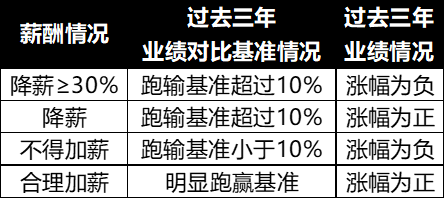
Core Viewpoint - The new performance compensation regulation, "Guidelines for Performance Assessment Management of Fund Management Companies," has sparked significant debate within the public fund industry, indicating its profound impact on fund managers' compensation structures and performance evaluation criteria [1][22]. Group 1: Key Changes in Compensation Structure - Fund manager compensation is now closely tied to two hard indicators: whether the fund outperforms its benchmark over three years and whether the performance increase is positive [2][24]. - Absolute returns have a veto clause; if a fund incurs losses during the assessment period, salary increases are off the table [2][24]. - Specific salary adjustments based on performance metrics include: - Salary reduction of 30% or more for underperforming the benchmark by over 10% with negative performance [3][25]. - No salary increase for underperforming the benchmark by less than 10% with negative performance [3][25]. - Reasonable salary increases for significantly outperforming the benchmark with positive performance [3][25]. Group 2: Implications for Fund Managers - The regulation raises questions about the fairness of evaluating fund managers in bear markets versus bull markets, particularly regarding risk management capabilities [4][26]. - There is a potential need for supplementary rules to address the evaluation discrepancies in different market conditions, especially for managers who excel in risk management during downturns [5][27]. Group 3: Impact on Investment Strategies - The new guidelines may lead to increased herd behavior among institutions, as managers may prefer to invest heavily in benchmark index constituents to avoid underperformance [8][30]. - This could solidify the holding structure of institutions and exacerbate the herd mentality, potentially leading to collective underperformance when market conditions change [8][31]. Group 4: Value Investors' Challenges - The three-year waiting period is not considered long in value investing, but if a value-oriented fund manager's chosen undervalued sectors do not perform well over three years, their compensation is likely to decrease [10][33]. - The essence of public funds is to manage others' money responsibly, emphasizing that fund managers should not let investors bear the costs of their investment philosophies [13][35]. Group 5: Talent Mobility and Opportunities for New Managers - The new performance guidelines may lead to a talent exodus from public funds, as top managers may find the compensation structure less appealing [16][37]. - Conversely, the stringent regulations could attract a new breed of talent aligned with the long-term investment ethos of public funds, potentially benefiting the industry [18][38]. - New fund managers with less than three years of experience may find the regulations more lenient, providing them with opportunities to showcase their performance and build their reputations [19][41].