
乙酰半胱氨酸泡腾片

Search documents
医药周报:基药目录前瞻、JPM大会看点
Guolian Minsheng Securities· 2026-01-22 02:45
Investment Rating - The report maintains a positive investment rating for the pharmaceutical sector [6] Core Insights - The pharmaceutical sector experienced a week-on-week decline of 0.68%, underperforming compared to the ChiNext and CSI 300 indices, ranking 17th among all industries [2][36] - The report emphasizes the importance of innovation, international expansion, and overcoming challenges as key themes for investment in 2026, with a focus on BD 2.0, small nucleic acids, and supply chain opportunities [3][4] - The upcoming adjustment of the National Essential Drug List is seen as critical, aiming to address clinical needs that have evolved since the last update in 2018, particularly in pediatrics, oncology, and rare diseases [5][14] Summary by Sections National Essential Drug List Adjustment Analysis - The current drug list has not been updated since 2018, leading to a disconnect with clinical needs, necessitating a systematic adjustment [14] - The adjustment will focus on filling gaps in disease coverage, particularly in pediatrics, oncology, and rare diseases, while also solidifying the integration of collective procurement and national negotiation outcomes [18][19] - The report identifies potential beneficiaries in traditional Chinese medicine, particularly in areas with previously weak coverage [28] JP Morgan Conference Overview - The 44th JP Morgan Health Conference highlighted strategic developments from major global pharmaceutical companies, showcasing their core pipeline advancements and key clinical milestones for 2026 [33] - Companies like Pfizer, Merck, and Eli Lilly presented their focus on innovative treatments and upcoming clinical trials, indicating a robust pipeline for future growth [34][35] Pharmaceutical Market Review and Hotspot Tracking - The pharmaceutical sector's performance in early 2026 has shown a 7.08% increase, outperforming both the CSI 300 and ChiNext indices [36] - The report notes a shift in market sentiment, with certain innovative sectors like AI healthcare and medical robotics showing strong performance, while traditional sectors faced adjustments [2][3]
年销超4亿复合磷酸氢钾注射液获批,医药市场持续扩容中!
Ge Long Hui· 2025-12-31 14:04
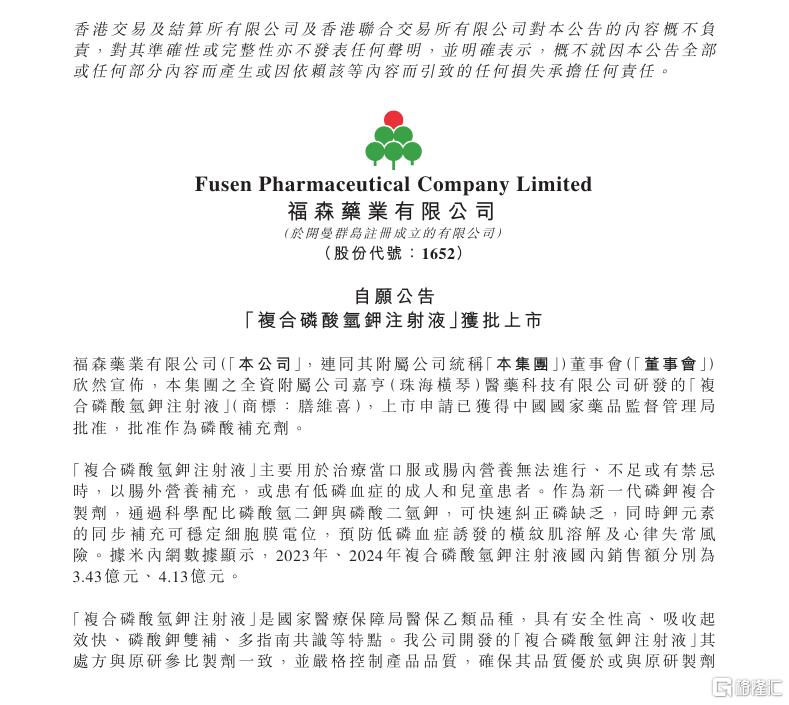
Core Insights - A new potassium hydrogen phosphate injection (Shanweixi) has been approved for market release by the National Medical Products Administration, entering a growing market with annual sales exceeding 400 million yuan and a year-on-year growth of 27.3% [1][4]. Market Overview - The compound potassium hydrogen phosphate injection is crucial for correcting hypophosphatemia in adults and children, especially when oral supplementation is not feasible, serving as a vital intravenous electrolyte replenishment solution [4]. - The product has been included in the National Medical Insurance Category B for several years, indicating a mature clinical understanding and usage [4]. - Market data from the MoSheng Pharmaceutical Database shows stable growth over the past three years, with sales expected to exceed 400 million yuan in 2024, reflecting a 27.3% increase [4]. Competitive Landscape - Prior to this approval, 24 pharmaceutical companies already held production licenses for this product, with 19 having passed consistency evaluations, indicating a stable competitive landscape [6]. - Despite the existing competition, there remains strong interest, with 15 additional companies currently in the process of applying for generic drug approvals, highlighting ongoing optimism regarding the market value of this product [6][9]. Future Outlook - For new entrants in the pharmaceutical sector, despite facing significant competition, the continuous growth of the market size and clear clinical positioning still provide opportunities for market entry [9]. - As more companies join the market, competition is expected to intensify, which may enhance product accessibility and optimize clinical medication costs [12].

康恩贝频繁换帅,却难解业绩困境
Guo Ji Jin Rong Bao· 2025-12-10 13:07
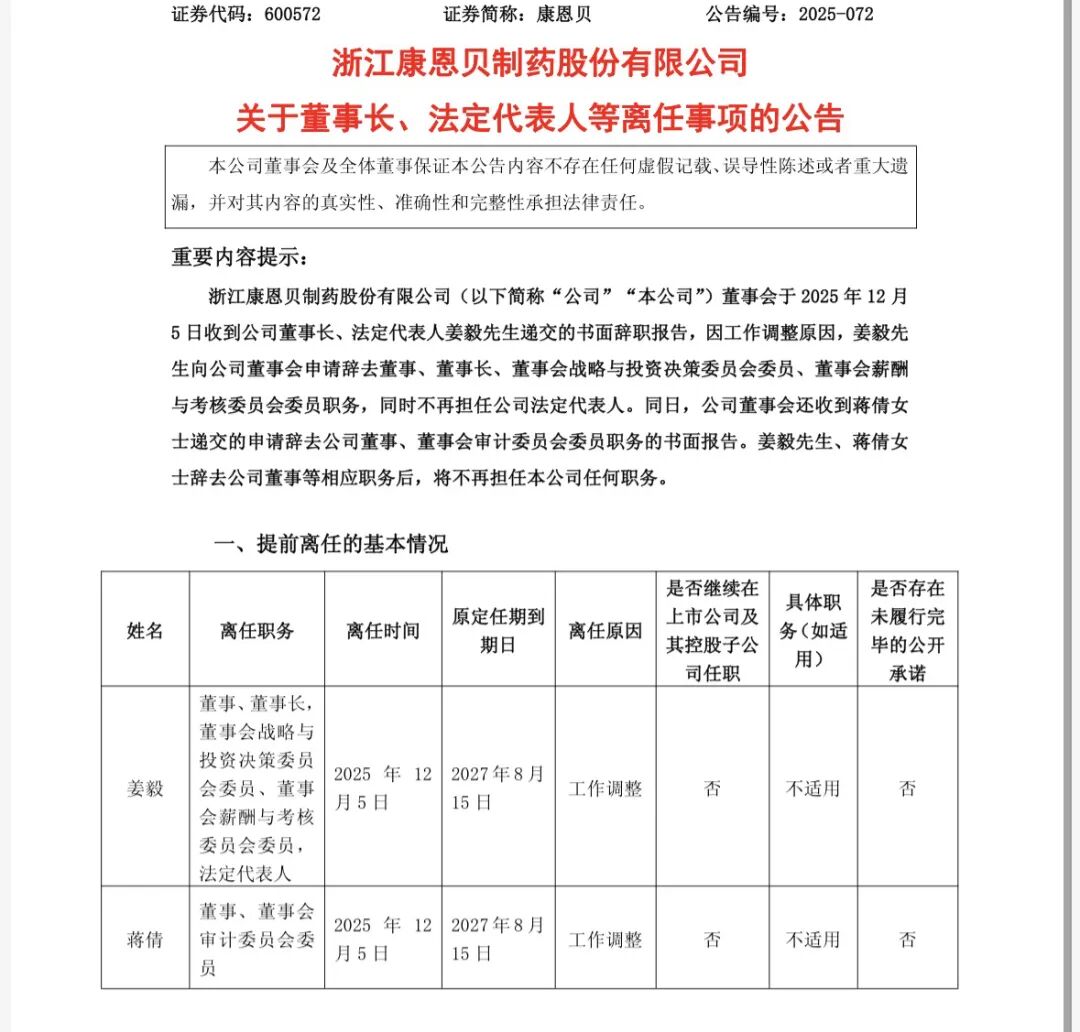
Group 1 - The core point of the article discusses the frequent changes in top management at companies like Kang En Bei, questioning the effectiveness of such changes in boosting performance during challenging times [1][6] - Kang En Bei has recently experienced a wave of executive turnover, with the resignation of Chairman Jiang Yi and board member Jiang Qian, both of whom were expected to serve until August 2027 [2][3] - The company has a history of management changes, with significant shifts occurring since the entry of Zhejiang Guomao Group in 2020, leading to concerns about the stability of its strategic direction [8][9] Group 2 - Kang En Bei's financial performance has stagnated, with revenue figures from 2020 to 2024 showing minimal growth, and the latest quarterly report indicating a slight year-on-year revenue increase of 1.27% [10][11] - The company's revenue breakdown for the first three quarters of 2025 shows that the traditional Chinese medicine segment remains the largest contributor, but sales of key products have not recovered, and the health consumer goods segment is still underperforming [10] - The stock price of Kang En Bei has been in decline, with a reported market value of 11.69 billion yuan, down approximately 80% from its peak [11]

集采失标又陷质量危机,康恩贝年销3.5亿元核心化药被暂停采购,转型路再遇挫折
Hua Xia Shi Bao· 2025-09-18 12:24
Core Viewpoint - The recent suspension of procurement qualifications for acetylcysteine effervescent tablets produced by Zhejiang Jinhua Kang En Bei Pharmaceutical Co., Ltd. due to non-compliance with regulations poses significant challenges for the company, particularly during its critical transformation phase into "Traditional Chinese Medicine (TCM) Health" [2][3][9]. Group 1: Company Performance and Financial Impact - In 2022, the sales revenue of acetylcysteine effervescent tablets was nearly 300 million yuan, with a year-on-year growth of over 16% in 2023, estimated to reach approximately 350 million yuan, accounting for over 5% of total revenue [2]. - The company's revenue for the first half of 2025 was 3.358 billion yuan, with a net profit of 354 million yuan, both showing a decline, continuing the downward trend from 2024 [5]. - The core chemical drug business saw a revenue drop of 11.22% in the first half of 2025, primarily due to the failure to win bids in the national centralized procurement [5][10]. Group 2: Quality Control and Regulatory Issues - The National Medical Products Administration announced the suspension of sales and recall measures for acetylcysteine effervescent tablets due to non-compliance with specifications, which directly impacts the business line reliant on this product [3][8]. - The quality issues have exposed vulnerabilities in the company's quality control processes, raising concerns about its strategic execution capabilities [2][11]. Group 3: Strategic Transformation Challenges - The company is undergoing a critical transformation into "TCM Health," facing difficulties as traditional Chinese medicine revenues are projected to decline in 2024, and the chemical drug sector has suffered quality setbacks [2][9]. - The company's recent restructuring efforts, including the introduction of a state-owned entity as a controlling shareholder, have not alleviated the pressures from price reductions in centralized procurement and rising raw material costs [9][10]. - Despite increasing R&D investments, the company's R&D intensity has decreased, indicating challenges in maintaining competitive innovation levels [10]. Group 4: Market Position and Brand Value - As of September 16, 2025, the company's market value was 11.384 billion yuan, ranking 23rd in the TCM sector, reflecting a significant decline in industry standing [8]. - The recent quality crisis is expected to have long-term implications for brand value and consumer trust, particularly in the respiratory medication sector [11].

浙江金华康恩贝生物制药有限公司因产品不合规被暂停采购
Qi Lu Wan Bao· 2025-09-15 03:29
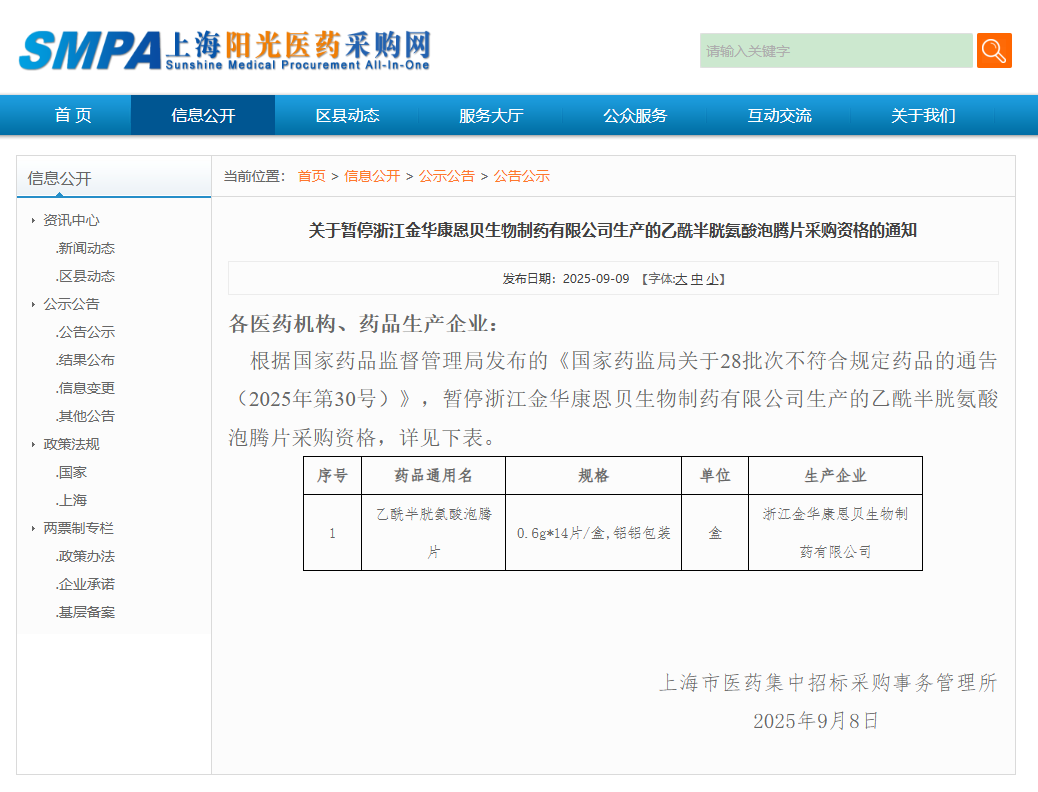
Core Points - Shanghai Sunshine Pharmaceutical Procurement Network announced the suspension of procurement qualifications for acetylcysteine effervescent tablets produced by Zhejiang Jinhua Kang En Bei Biological Pharmaceutical Co., Ltd. [1] - The suspension is based on the National Medical Products Administration's announcement regarding 28 batches of non-compliant drugs [1]. Company Overview - Zhejiang Jinhua Kang En Bei Biological Pharmaceutical Co., Ltd. is a subsidiary of Zhejiang Kang En Bei Pharmaceutical Co., Ltd. (600572) and specializes in chemical pharmaceuticals [1]. - The company holds a leading position in specialized chemical raw materials and freeze-dried, controlled-release formulations in China [1]. - It is recognized as a key pharmaceutical enterprise in Zhejiang Province and a national high-tech enterprise [1]. - The company was established in April 1958 and became a member of Kang En Bei Group in September 1996, achieving indirect listing in 2007 [1]. - In April 2020, the Zhejiang Provincial State-owned Assets Supervision and Administration Commission became the actual controlling shareholder [1].
康恩贝一款重点产品因抽检不合格被暂停采购资格
Bei Ke Cai Jing· 2025-09-11 07:00
Core Viewpoint - The procurement qualification of Zhejiang Jinhua Kang'enbei Biopharmaceutical Co., Ltd. for acetylcysteine effervescent tablets has been suspended due to non-compliance with regulations as per the announcement from the Shanghai Sunshine Pharmaceutical Procurement Network and the National Medical Products Administration [1][2]. Group 1: Company Performance - In the first half of 2025, Kang'enbei achieved operating revenue of 859 million yuan and net profit of 53.93 million yuan, accounting for 25.58% and 15.25% of Kang'enbei Pharmaceutical's total revenue and net profit respectively [1]. - The acetylcysteine effervescent tablets are a key product for Kang'enbei, with sales revenue of approximately 300 million yuan in 2022 and an estimated 350 million yuan in 2023, representing over 5% of total revenue for the year [2]. Group 2: Regulatory Issues - The National Medical Products Administration reported that one batch of acetylcysteine effervescent tablets produced by Kang'enbei did not meet regulatory standards, specifically regarding its characteristics [1]. - The suspension of procurement qualifications affects not only Kang'enbei but also 16 other companies, indicating a broader issue within the pharmaceutical industry regarding compliance with drug regulations [4]. Group 3: Market Impact - Kang'enbei's main business revenue in the first half of 2025 was 3.315 billion yuan, a year-on-year decrease of 2.68%, influenced by the failure to win bids in national procurement for acetylcysteine effervescent tablets and price reductions in other products [2].
国家药监局关于28批次不符合规定药品的通告(2025年第30号)
Zhong Guo Zhi Liang Xin Wen Wang· 2025-08-27 14:04
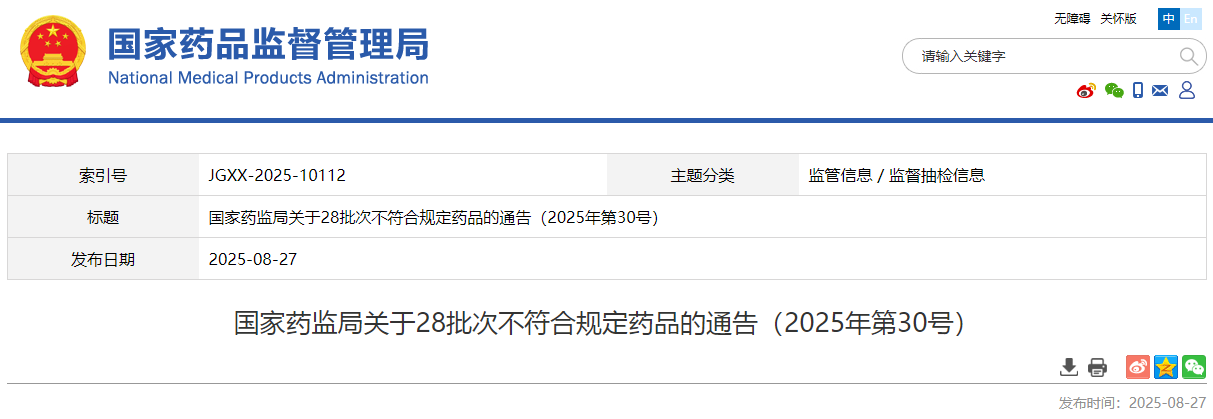
Core Viewpoint - The National Medical Products Administration (NMPA) announced that 28 batches of drugs produced by 17 companies do not meet regulatory standards, prompting investigations and corrective actions [3][5]. Group 1: Non-compliant Drugs - Five batches of fusidic acid cream produced by Aomei Pharmaceutical Factory failed due to particle size issues [3]. - Two batches of loratadine syrup from Want Pharmaceutical (Hainan) Co., Ltd. did not meet standards related to impurities [3]. - One batch of sodium phosphate oral solution from Shanghai Haihong Industrial Group's Chao Hu Jinchen Pharmaceutical Co., Ltd. failed due to relative density [3]. - Two batches of tocilizumab capsules from Shaanxi Xiyue Pharmaceutical Co., Ltd. did not meet dissolution rate standards [3]. - One batch of acetylcysteine effervescent tablets from Zhejiang Jinhua Kang'enbei Biopharmaceutical Co., Ltd. failed due to physical characteristics [3]. - Two batches of Twenty-five Flavor Coral Pills from Tibet Shenhui Pharmaceutical Co., Ltd. did not meet weight difference standards [3]. - Two batches of Qili San from Hubei Minkan Pharmaceutical Co., Ltd. failed due to content determination [3]. Group 2: Regulatory Actions - The NMPA has mandated that the involved companies take risk control measures such as suspending sales and conducting recalls [5]. - The NMPA requires provincial drug supervision departments to investigate potential illegal activities by the companies involved and to publicly disclose the results of these investigations [5].
国家药监局通告28批次药品不符合规定
Zhong Guo Xin Wen Wang· 2025-08-27 13:28
Core Viewpoint - The National Medical Products Administration (NMPA) announced that 28 batches of drugs produced by 17 companies do not meet regulatory standards, highlighting quality control issues in the pharmaceutical industry [1][2][3]. Summary by Categories Non-compliance Details - Five batches of fusidic acid cream produced by Aumei Pharmaceutical are non-compliant due to particle size [1] - Two batches of loratadine syrup from Wante Pharmaceutical (Hainan) are non-compliant due to related substances [1] - One batch of sodium phosphate oral solution from Shanghai Haihong Industrial Group is non-compliant due to relative density [1] - Two batches of tosylate capsules from Shaanxi Xiyue Pharmaceutical are non-compliant due to dissolution rate [1] - One batch of acetylcysteine effervescent tablets from Zhejiang Jinhua Kang'enbei Biopharmaceutical is non-compliant due to physical properties [1] - Two batches of Twenty-five Flavor Coral Pills from Tibet Shenhou Pharmaceutical are non-compliant due to weight differences [1] Additional Non-compliance Findings - Two batches of Qili Powder from Hubei Minkan Pharmaceutical are non-compliant due to content measurement [2] - Four batches of Qingqi Huatan Pills from Hubei Ruihua Pharmaceutical are non-compliant due to dosage discrepancies [2] - Two batches of red peony from Sichuan Jinke Pharmaceutical and Sichuan Yixiangkang Pharmaceutical are non-compliant due to physical properties [2] - Three batches of red ginseng (red ginseng slices) from multiple companies are non-compliant due to identification issues and pesticide residue [2] - One batch of Gentian from Jiangsu Heshengtang Pharmaceutical is non-compliant due to impurities [2] - One batch of wild chrysanthemum from Jiangxi Xinjian Pharmaceutical is non-compliant due to content measurement [2] Regulatory Actions - The NMPA has mandated that the involved companies take risk control measures such as halting sales and conducting recalls [3] - Investigations into the causes of non-compliance are required, along with corrective actions [3] - Provincial drug supervision departments are instructed to investigate potential illegal activities by the companies involved [3] Public Awareness Initiatives - The NMPA has provided educational information regarding the significance of various non-compliance indicators, such as particle size, related substances, relative density, dissolution rate, physical properties, weight differences, content measurement, identification, pesticide residues, total reducing sugars, impurities, and moisture content [4][5]
国家药监局发布通告28批次药品不符合规定
Yang Shi Wang· 2025-08-27 09:29
Summary of Key Points Core Viewpoint - The National Medical Products Administration (NMPA) has announced that 28 batches of drugs produced by 17 companies do not meet regulatory standards, prompting investigations and corrective actions from the involved companies [1][3]. Group 1: Non-compliance Details - Five batches of fusidic acid cream produced by Aumei Pharmaceutical are non-compliant due to particle size issues [1] - Two batches of loratadine syrup from Wante Pharmaceutical (Hainan) are non-compliant due to related substances [1] - One batch of sodium phosphate oral solution from Shanghai Haihong Industrial Group is non-compliant due to relative density [1] - Two batches of tocilizumab capsules from Shaanxi Xiyue Pharmaceutical are non-compliant due to dissolution rate [1] - One batch of acetylcysteine effervescent tablets from Zhejiang Jinhua Kang'enbei Biopharmaceutical is non-compliant due to physical properties [1] - Two batches of Twenty-Five Flavor Coral Pills from Tibet Shenhui Pharmaceutical are non-compliant due to weight differences [1] Group 2: Additional Non-compliance Cases - Two batches of Qili Powder from Hubei Minkan Pharmaceutical are non-compliant due to content measurement [2] - Four batches of Qingqi Huatan Pills from Hubei Ruihua Pharmaceutical are non-compliant due to dosage discrepancies [2] - Two batches of red peony from Sichuan Jinke Pharmaceutical and Sichuan Yixiangkang Pharmaceutical are non-compliant due to physical properties [2] - Three batches of red ginseng (red ginseng slices) from multiple companies are non-compliant due to identification issues and pesticide residue [2] - One batch of Gentian from Jiangsu Heshengtang Pharmaceutical is non-compliant due to impurities [2] - One batch of wild chrysanthemum from Jiangxi Xinjian Pharmaceutical is non-compliant due to content measurement [2] Group 3: Regulatory Actions - The NMPA has mandated that the involved companies take risk control measures such as suspending sales and conducting recalls [3] - Investigations into the causes of non-compliance are required, along with corrective actions [3] - Provincial drug supervision departments are instructed to investigate potential illegal activities by the companies involved [3]
国家药监局今天通告28批次药品不符合规定
Yang Shi Xin Wen· 2025-08-27 09:18
Core Viewpoint - The National Medical Products Administration (NMPA) announced that 28 batches of drugs produced by 17 companies do not meet regulatory standards, prompting investigations and corrective actions from the involved companies [1][3]. Summary by Categories Non-compliance Details - Five batches of fusidic acid cream produced by Aumei Pharmaceutical Factory failed due to particle size issues [1]. - Two batches of loratadine syrup from Wante Pharmaceutical (Hainan) Co., Ltd. did not meet standards due to related substances [1]. - One batch of sodium phosphate oral solution from Shanghai Haihong Industrial (Group) Co., Ltd. failed due to relative density [1]. - Two batches of tocilizumab capsules from Shaanxi Xiyue Pharmaceutical Co., Ltd. did not meet standards due to dissolution rate [1]. - One batch of acetylcysteine effervescent tablets from Zhejiang Jinhua Kang'enbei Biopharmaceutical Co., Ltd. failed due to physical properties [1]. - Two batches of Twenty-five Flavor Coral Pills from Tibet Shenhui Pharmaceutical Co., Ltd. did not meet standards due to weight differences [1]. Additional Non-compliance Cases - Two batches of Qili Powder from Hubei Minkan Pharmaceutical Co., Ltd. failed due to content determination [2]. - Four batches of Qingqi Huatan Pills from Hubei Ruihua Pharmaceutical Co., Ltd. did not meet standards due to dosage discrepancies [2]. - Two batches of red peony from Sichuan Jinke Pharmaceutical Co., Ltd. and Sichuan Yixiangkang Pharmaceutical Co., Ltd. failed due to physical properties [2]. - Three batches of red ginseng (red ginseng slices) from multiple companies failed due to identification issues and pesticide residue [2]. - One batch of Gentian from Jiangsu Heshengtang Pharmaceutical Co., Ltd. did not meet standards due to impurities [2]. - One batch of wild chrysanthemum from Jiangxi Xinjian Pharmaceutical Co., Ltd. failed due to content determination [2]. Regulatory Actions - The NMPA has mandated that the involved companies take risk control measures such as suspending sales and conducting recalls [3]. - Investigations into the causes of non-compliance are required, and the NMPA will pursue legal actions against any violations [3]. - The NMPA provided public education on the significance of various non-compliance indicators, including particle size, related substances, relative density, dissolution rate, physical properties, weight differences, content determination, identification, pesticide residues, total reducing sugars, impurities, and moisture content [3][4].