二次元内容

Search documents
最高200万元!上海杨浦对优质“博主”给予购房补贴
第一财经· 2025-12-09 13:35
Core Viewpoint - The article discusses the recent policy by the Yangpu District government in Shanghai to support high-quality internet content creators through various financial incentives, including housing subsidies of up to 2 million yuan for eligible creators [3][4]. Group 1: Policy Details - The Yangpu District government has introduced a support policy aimed at fostering a gathering of high-quality internet content creators, which includes rent and property fee reductions, rewards for content creation, and the establishment of an investment fund [3][8]. - A notable aspect of the policy is the one-time housing subsidy of up to 2 million yuan for internet content creators purchasing their first self-occupied property in the district [3][5]. - Additionally, qualified creators can receive a monthly rent subsidy of up to 8,000 yuan for three years if they reside in designated talent communities [3][8]. Group 2: Previous Initiatives - This is not the first time Yangpu District has offered substantial housing subsidies to internet content creators; a similar initiative called the "优享计划" was launched in July 2022, which also provided significant housing subsidies based on the creator's talent level [4][5]. - The "优享计划" categorized creators into three tiers: strategic, leading, and potential creators, with subsidies of up to 2 million yuan, 1 million yuan, and 500,000 yuan respectively based on their influence and contributions [5][6]. Group 3: Economic Context - The renewed emphasis on supporting internet content creators aligns with the "沪九条" policy, which recognizes high-quality internet content as a vital soft power for economic and social development [7][8]. - Yangpu District has become a hub for digital economy enterprises, housing over 8,000 companies and generating significant tax revenue, with the software and information services sector exceeding 300 billion yuan [7][8].


《2025年网络视听内容创作者白皮书》发布
Di Yi Cai Jing Zi Xun· 2025-09-19 12:44
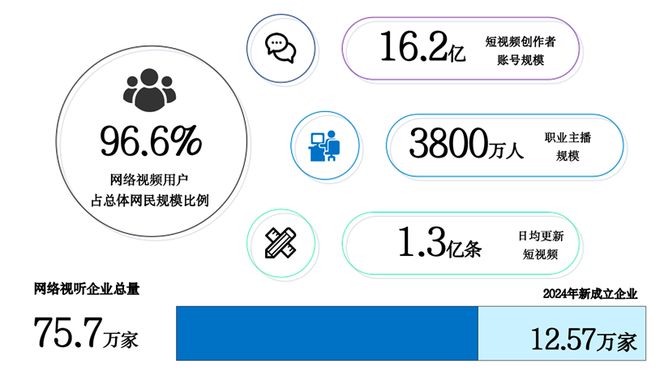
Core Insights - The 2025 Shanghai Internet Audio-Visual Content Creators Conference highlighted the evolving landscape of the internet audio-visual industry, focusing on the theme "Collective Creation for Joy" and emphasizing the need for a robust ecosystem to support creators [1] Group 1: Industry Overview - The internet audio-visual industry is projected to exceed 12.2 trillion yuan by the end of 2024, with over 757,000 related enterprises, marking a 16% increase in new companies in 2024 alone [1] - The number of internet video users has surpassed 1.07 billion, nearly covering the entire online user base, while short video creator accounts have reached 1.62 billion, with daily uploads exceeding 130 million [1][4] Group 2: Technological Impact - The rise of AIGC (Artificial Intelligence Generated Content) is transforming the industry, with predictions that by 2026, up to 90% of online content may be AI-generated, indicating a shift in creator roles and capabilities [20][22] Group 3: Content and Commercialization - The trend is moving from a focus on quantity to quality in content creation, with platforms emphasizing long-form content and community engagement, as evidenced by Bilibili users averaging 102 minutes of daily usage [13][16] - Platforms like Douyin and Xiaohongshu are fostering diverse monetization strategies, with Xiaohongshu's community contributors exceeding 100 million, showcasing a decentralized content ecosystem [23][41] Group 4: Cultural Integration and Globalization - The integration of online and offline cultural products is evident, with creators like Li Ziqi revitalizing traditional culture through modern platforms, indicating a blending of entertainment and cultural heritage [8][10] - The internationalization of Chinese content is shifting from mere export to establishing communities abroad, with creators like Dianxi Xiaoge gaining significant followings on platforms like YouTube [28][30] Group 5: Future Outlook - The future of the internet audio-visual industry is expected to focus on building cultural assets and enhancing creator support systems, with platforms transitioning from traffic-driven models to asset-driven operations [36][40] - The establishment of supportive policies, such as those from Shanghai, aims to create a conducive environment for diverse creators, fostering a sustainable ecosystem for content creation [24][27]