京东物流狼族智能设备集群

Search documents
华金证券:双11全网电商销售额稳增长 零售生态与技术融合深度变革
智通财经网· 2025-11-20 08:40
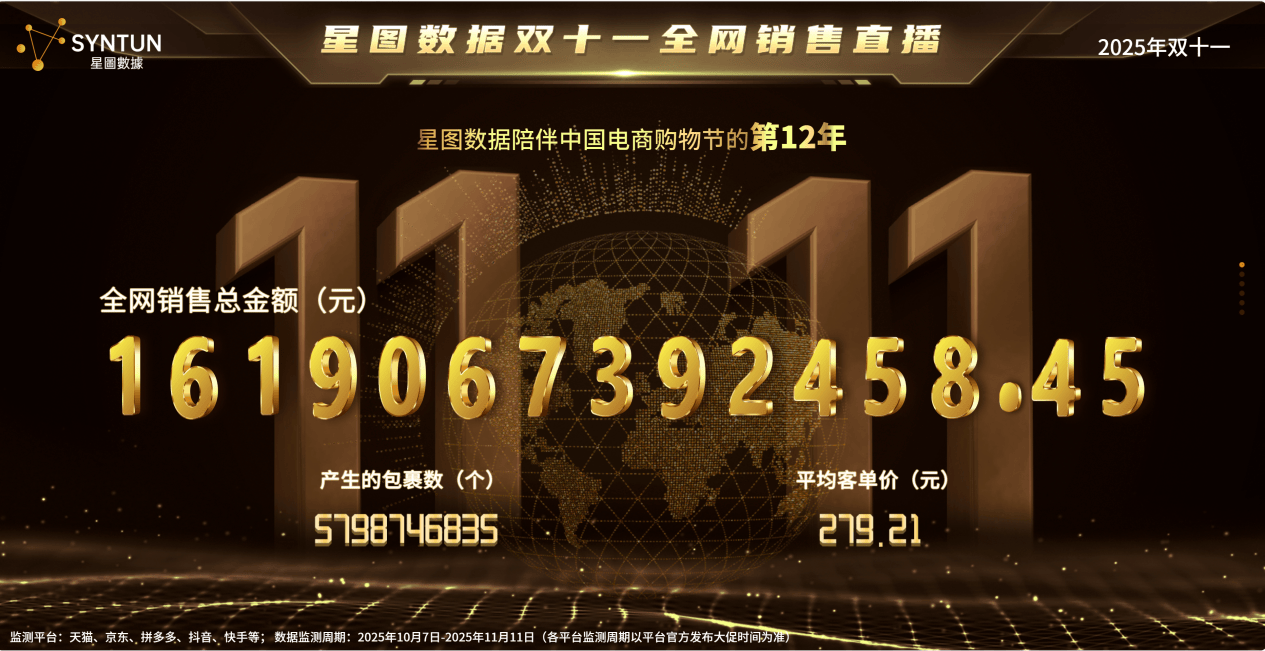
Core Insights - The 2025 Double 11 shopping festival is set to start earlier, showcasing a long-cycle normalization trend, with e-commerce platforms simplifying promotional rules to boost user engagement in October [1][2] - The overall retail sales during the Double 11 period are projected to reach nearly 1.8 trillion yuan, marking a year-on-year growth of over 10%, and a staggering increase of approximately 35,000 times since the inaugural event in 2009 [1] Group 1: E-commerce Growth and User Engagement - The early launch of the Double 11 marketing campaign has led to a synchronized increase in user scale across platforms, with significant growth in monthly active users for major apps like Taobao, Douyin, Pinduoduo, and JD [2] - As of October 2025, the monthly active user counts for these platforms reached 1 billion for Taobao, 948 million for Douyin, 720 million for Pinduoduo, and 648 million for JD, indicating robust user engagement [2] Group 2: Strategic Shifts and AI Integration - E-commerce platforms are transitioning towards a comprehensive ecosystem, integrating AI technologies throughout the consumer journey, with Taobao launching six AI shopping applications and JD implementing advanced logistics solutions [3] - JD's user orders increased by over 117% year-on-year, while the overall order volume grew by more than 125%, reflecting the effectiveness of their new strategies [3] Group 3: Instant Retail and New Consumption Drivers - Platforms are exploring instant retail strategies to drive new consumption growth, with Meituan reporting an average daily order volume of 14 million for its flash purchase service [4] - Taobao's flash purchase initiative has already attracted over 1 million new users during the Double 11 period, with significant sales growth in non-food brands [4] Group 4: Investment Opportunities - Companies to watch include BlueFocus Communication Group, InGravity Media, Tianyu Digital Technology, Chinese Online, Tianxia Show, and Zhidema, indicating potential investment opportunities in the evolving e-commerce landscape [5]




从凑单到决策,AI如何重塑“双十一”新逻辑?
Sou Hu Cai Jing· 2025-11-13 07:05
Core Insights - The application of AI tools, particularly generative AI represented by large models, is reshaping the operational logic of new e-commerce, becoming a highlight of this year's "Double Eleven" shopping festival [2][3] - AI has transitioned from being an auxiliary tool to becoming a core decision-making component for platforms, merchants, and consumers alike [3] Group 1: AI's Strategic Role in E-commerce - Major platforms have placed AI in the spotlight, marking a significant change in this year's "Double Eleven," with JD defining it as the "most technology-integrated edition" and Alibaba claiming it as the "first fully AI-implemented Double Eleven" [4] - Alibaba announced a 3-year investment of 380 billion yuan in cloud and AI infrastructure, focusing on e-commerce and cloud as core business areas [4] - JD has extended AI across its supply chain, utilizing its logistics super brain 2.0 and intelligent device clusters to enhance supply chain services [5] Group 2: AI's Impact on Business Growth - Both JD and Alibaba have made AI tools available for free to merchants, aiming to lower operational barriers and costs for small and medium-sized businesses [7] - AI has transformed the entire e-commerce process from "experience-driven" to "data-intelligent-driven," significantly reducing costs and opening new revenue channels for merchants [7] - Alibaba's AI tools have generated over 2 billion images and 5 million videos monthly, improving product click-through rates by 10% [7] Group 3: Consumer Engagement with AI - E-commerce platforms have launched AI features for consumers, with Alibaba introducing six AI shopping applications to enhance user experience [10] - JD has developed several consumer-facing AI applications, including a digital assistant capable of answering various queries and facilitating shopping [12] - Consumers are beginning to utilize AI tools for creating shopping lists and calculating discounts, although experiences vary widely [13] Group 4: Competitive Landscape and Challenges - The competition in e-commerce is shifting from broad traffic acquisition to deep user engagement and lifecycle value extraction driven by AI [14] - Platforms that effectively leverage AI will gain a competitive edge, while those lagging may struggle to adapt to the evolving landscape [15] - The accuracy of AI-generated information remains a concern, as inaccuracies in product recommendations could undermine consumer trust [16]