人民咖啡馆

Search documents
“人民咖啡馆”更名风波:国潮营销,敬畏之心不可失
Yang Zi Wan Bao Wang· 2025-11-08 09:39
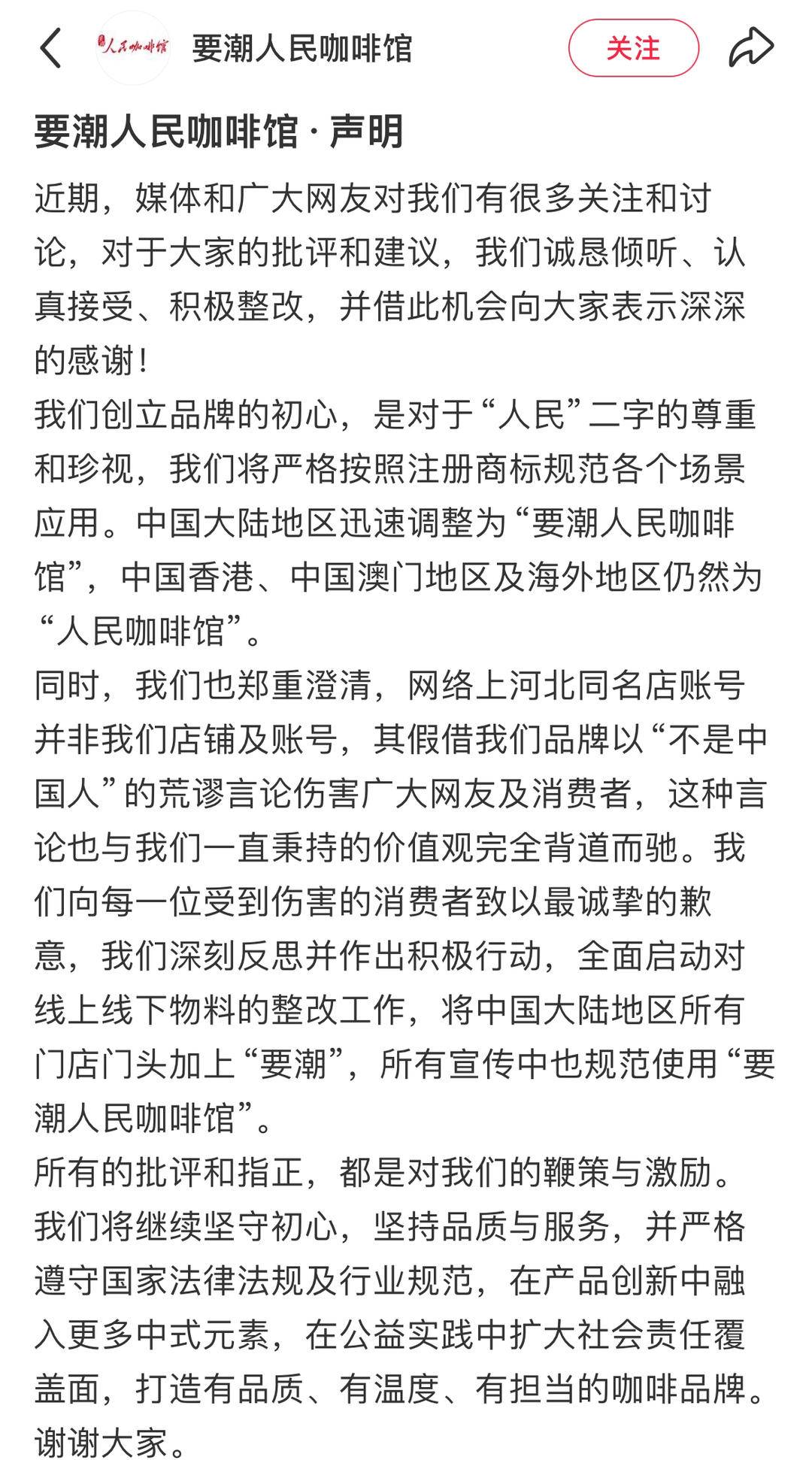
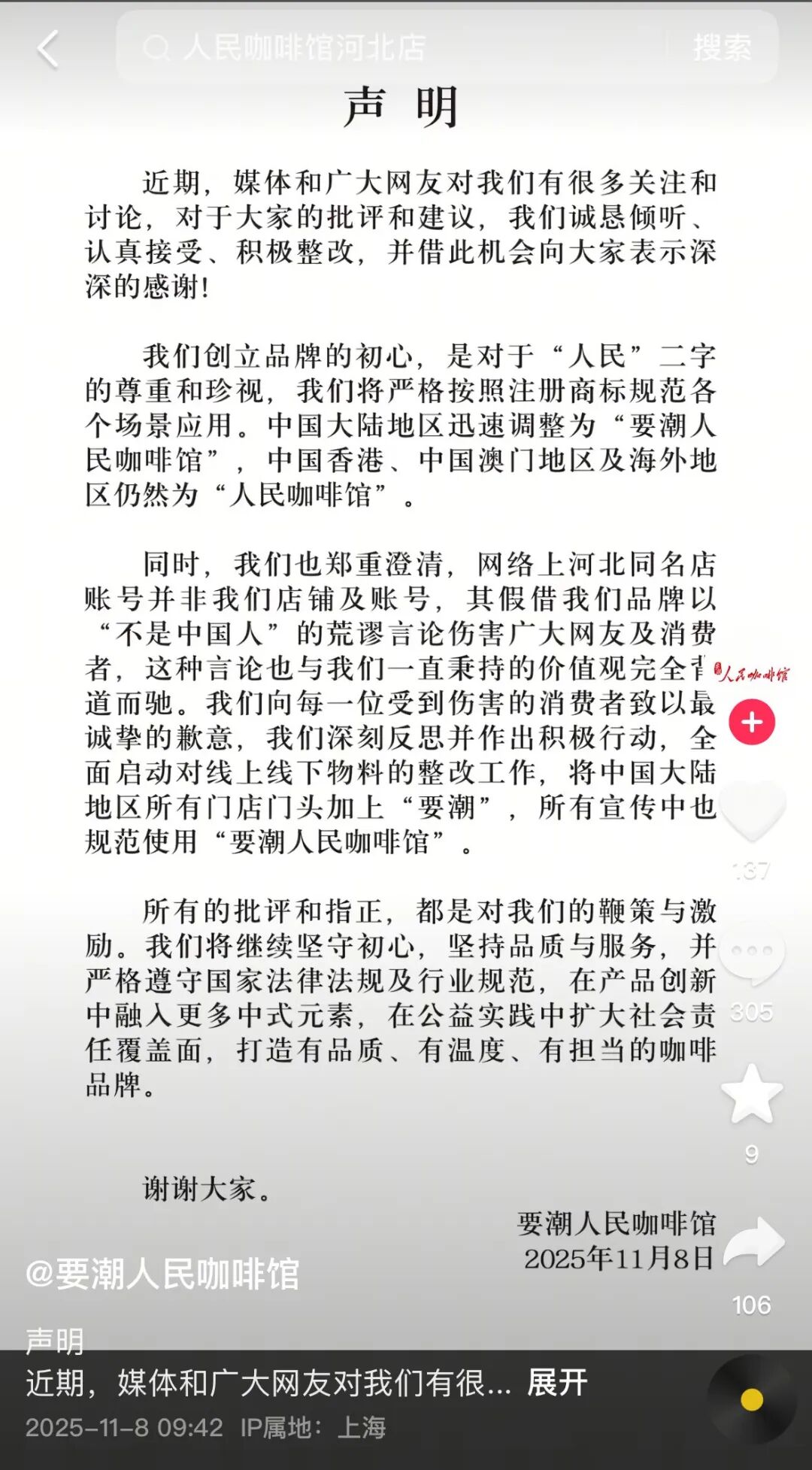
Core Viewpoint - The "People's Coffee Shop" has faced significant public scrutiny due to its name, leading to a rebranding as "Yaochao People's Coffee Shop" in mainland China while retaining the original name in Hong Kong, Macau, and overseas markets [2][3]. Company Response - The company has acknowledged the criticism and suggestions from the public, committing to a thorough rectification process and expressing gratitude for the feedback received [2][3]. - The company clarified that a similarly named establishment in Hebei is not affiliated with them and condemned the inappropriate remarks associated with that account [2]. Brand and Trademark Issues - The brand "People's Coffee Shop" has opened nearly 30 stores across 20 cities in 18 provinces, gaining substantial popularity [3]. - The parent company, Yaochao (Shanghai) Cultural Communication Co., Ltd., has faced trademark challenges, with multiple applications for the "People's Coffee Shop" trademark being rejected [3]. Cultural Sensitivity and Market Trends - The incident highlights the importance of respecting cultural and political connotations associated with the term "People," which carries significant public sentiment and should not be misused [3][4]. - The rise of "Guochao" (national trend) in business emphasizes the need for companies to integrate cultural values with modern aesthetics and quality, rather than merely exploiting cultural symbols for marketing [4]. - The situation serves as a cautionary tale for businesses engaged in "Guochao" marketing, stressing the necessity of genuine respect for cultural sentiments to achieve sustainable commercial success [4].

“人民咖啡馆”道歉
Mei Ri Jing Ji Xin Wen· 2025-11-08 06:23
Core Viewpoint - A coffee shop chain named "People's Coffee Shop" has gained popularity across multiple cities in China, raising concerns about its branding and legal compliance due to the use of the term "People" which carries strong public and political connotations [5][10][12]. Group 1: Company Overview - The "People's Coffee Shop" chain is operated by Yaochao (Shanghai) Cultural Communication Co., Ltd., which was established in 2020 [12]. - The company has attempted to register the "People's Coffee Shop" trademark multiple times but has been unsuccessful; currently, only two related trademarks, "Yaochao People's Coffee Shop" and "Chao People's Coffee Shop," are registered [12][13]. - As of now, the brand has opened 27 physical locations in cities including Shanghai, Beijing, Chongqing, Tianjin, Harbin, Nanchang, and Changchun [13]. Group 2: Legal and Compliance Issues - The use of the term "People" in the coffee shop's branding has raised legal questions regarding its compliance with the Trademark Law of the People's Republic of China, which prohibits marks that may harm socialist moral standards or have other negative impacts [10][16]. - Legal experts have indicated that the branding could mislead the public regarding the nature and source of the services, potentially damaging the public value associated with the term "People" [16]. - The coffee shop's branding significantly differs from its registered trademarks, which raises concerns about compliance with trademark usage regulations [16].
网红“人民咖啡馆”全国爆火,律师指其店名使用涉嫌违规
Jing Ji Guan Cha Wang· 2025-11-05 03:45
Group 1 - The "People's Coffee Shop," featuring the theme "Telling China's Story through Coffee," has opened nearly 30 stores across 20 cities in 18 provinces, becoming a new landmark for social media check-ins [1] - The parent company, Yaochao Culture, has repeatedly applied for the "People's Coffee Shop" trademark but has been rejected, currently holding trademarks such as "Chao People's Coffee Shop" [1] - Legal experts indicate that the term "People" has distinct public attributes and political connotations, and its large-scale use as a commercial identifier may constitute a situation of "other adverse effects" under the Trademark Law, posing legal risks [1]
老城焕发新韵 百姓共沐文脉
Bei Jing Ri Bao Ke Hu Duan· 2025-07-23 21:26
Group 1 - The core idea of the articles revolves around the successful application for UNESCO World Heritage status of Beijing's central axis, which has revitalized cultural heritage and attracted tourists, enhancing social sustainability [2][5][6] - The performance of the orchestral suite "Zhongzhou," created to promote the cultural significance of the central axis, has been showcased multiple times, reflecting the artistic efforts to celebrate this heritage [5][6][7] - The "Cinema in the Hutongs" initiative has brought outdoor movie screenings to cultural spaces along the central axis, engaging the community and enhancing cultural appreciation [9][10][11] Group 2 - The transformation of Qianmen Street into a vibrant area with numerous unique cafes has been noted, indicating a shift in consumer behavior and increased tourism following the heritage status [13][14] - The "Dragon Spine Bus" route, which traverses key landmarks along the central axis, has gained popularity among tourists, showcasing the historical significance of the area while improving public transport [16][17]