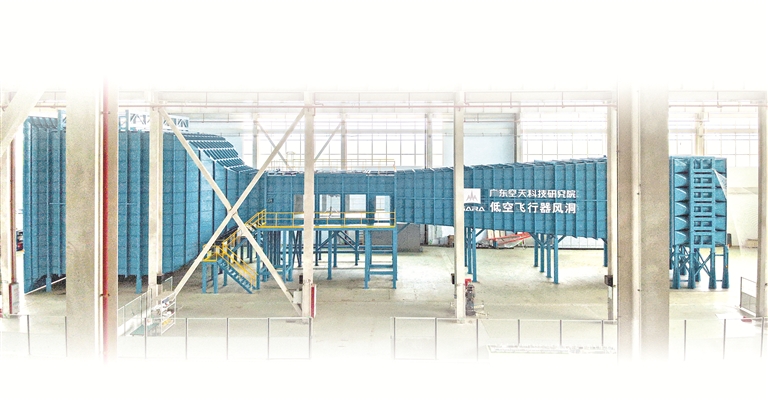
低空飞行器复合型风洞

Search documents
赋能粤港澳大湾区空天产业!大湾区空天科普中心揭幕
Zhong Guo Jing Ji Wang· 2025-10-17 08:01
Core Insights - The Greater Bay Area Aerospace Science Popularization Center has been officially inaugurated, marking a significant addition to the region's science education landscape [1] - The center aims to create a comprehensive science education ecosystem that integrates patriotic education, research display, and industry incubation, thereby empowering the aerospace industry in the Greater Bay Area [1] Group 1 - The center will collaborate with existing facilities like the Shenzhen Space Museum and Zhuhai Space Center to establish a "three-region collaboration, multi-dimensional empowerment" science education network [1] - The Guangdong Aerospace Technology Research Institute, which supports the center, is recognized as a high-level innovation research institute and the only new R&D institution in Guangzhou focused on aerospace technology [1] - The center emphasizes an innovative science popularization model through immersive experiences, integrating research resources and providing access to key exhibition areas [1][2] Group 2 - Visitors can explore real research facilities and observe cutting-edge technologies such as low-altitude flying vehicles and high-speed unmanned aerial vehicles, gaining insights into China's advancements in these fields [2] - Strategic agreements have been signed with various educational and innovation organizations to promote the sharing of aerospace science resources across the Greater Bay Area [2] - The center will collaborate with local schools to enhance science education and improve youth scientific literacy through initiatives like the "Youth π" science brand [2][3] Group 3 - Future plans for the center include partnerships with universities and enterprises to develop new learning environments and educational models, focusing on project-based learning and intelligent training [3] - The goal is to create a closed-loop system that empowers the aerospace industry by cultivating talent with both innovative capabilities and practical experience [3]
走近大国重器丨位于地面的“空中考场”
Zhong Yang Ji Wei Guo Jia Jian Wei Wang Zhan· 2025-08-03 23:49
Core Viewpoint - The establishment of China's first composite wind tunnel for low-altitude flying vehicles at the Guangdong Academy of Aerospace Technology marks a significant advancement in the low-altitude economy, providing essential testing infrastructure for the development and validation of flying cars and drones [10][11][12]. Summary by Sections Wind Tunnel Overview - The wind tunnel is 47 meters long and consists of three main sections: an entrance section (12m high, 14m wide), a closed test section (3.5m high, 4.5m wide, 10m deep), and an outer wind wall (6m high, 8m wide) made up of 48 wind machines [12][13]. - The wind tunnel can simulate wind speeds ranging from 5 m/s to 50 m/s, equivalent to a maximum of 15 on the Beaufort scale, and the wind wall can reach speeds of 17 m/s, suitable for testing against 7-level winds [12][13]. Importance of Wind Tunnel in Low-Altitude Economy - Wind tunnels are critical for the design validation, aerodynamic layout optimization, and aerodynamic parameter measurement of flying vehicles, with the saying "one generation of wind tunnels, one generation of flying vehicles" highlighting their importance [12][13]. - The new wind tunnel addresses the limitations of existing facilities, which are often unsuitable for medium and large low-altitude flying vehicles, thus lowering the barriers for companies to conduct necessary tests [13][14]. Technological Advantages - The wind tunnel integrates the advantages of aviation-grade wind tunnels and industrial-grade wind walls, allowing for diverse testing scenarios including force measurement, flow field visualization, and dynamic disturbance [16]. - It enhances adaptability and scalability for low-altitude flying vehicle testing, capable of simulating complex wind environments and providing comprehensive aerodynamic performance evaluations [16][19]. Collaboration and Future Development - The Guangdong Academy has established partnerships with multiple enterprises and research institutions to facilitate the use of the wind tunnel for various testing needs [13][19]. - Future plans include developing modules for typhoon-level winds and urban turbulence testing, as well as creating a data-sharing platform for low-altitude flying vehicle testing [19]. Regional Economic Impact - The wind tunnel is strategically located in the Guangdong-Hong Kong-Macao Greater Bay Area, providing an ideal testing ground for low-altitude economic development and fostering collaboration among local research institutions and manufacturing enterprises [14][15].