
保护伞

Search documents
前景研判!2026年中国脑血管介入器械行业市场发展概况分析及投资前景预测(智研咨询)
Sou Hu Cai Jing· 2025-12-19 02:15
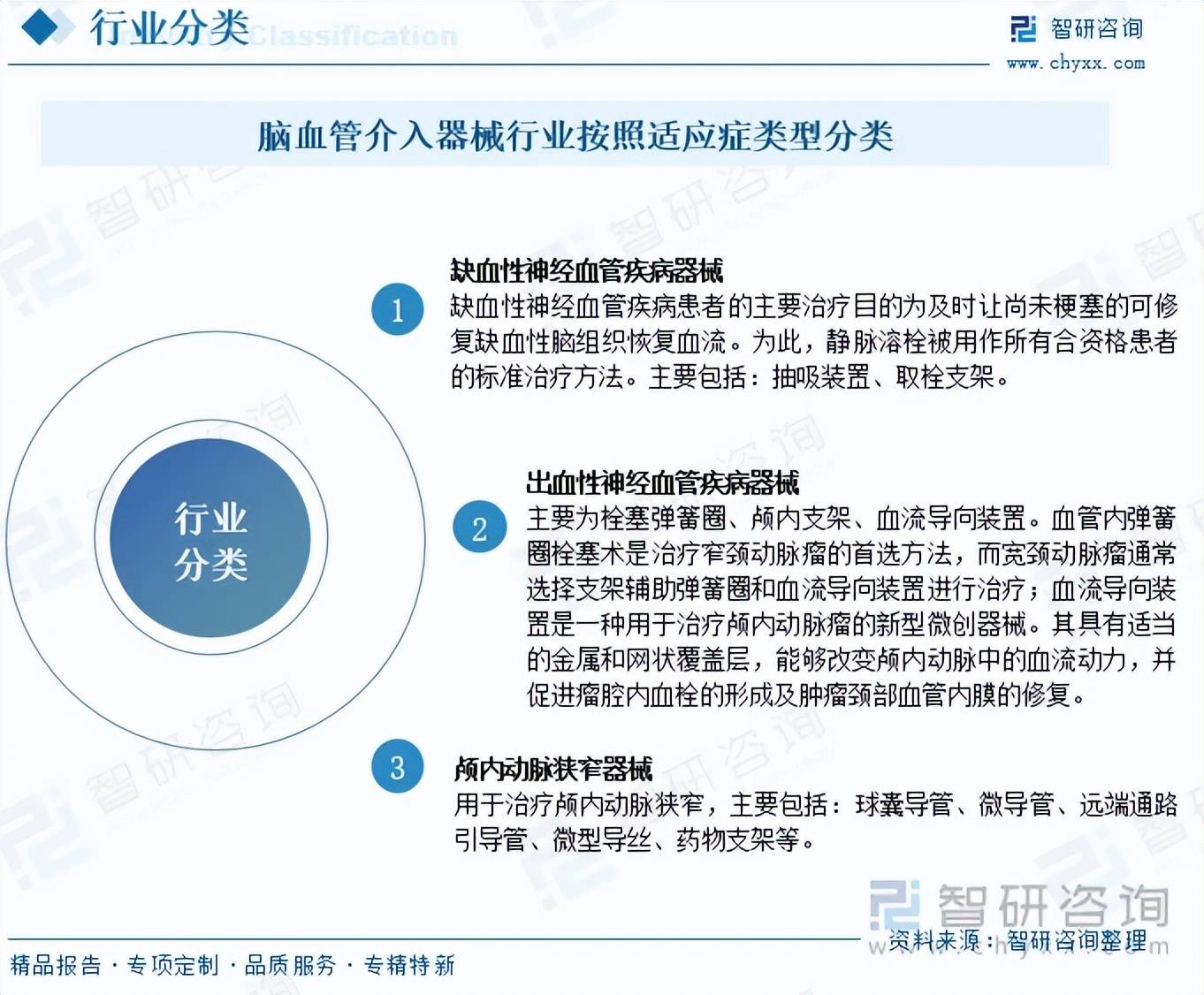
Core Viewpoint - The demand for cerebrovascular interventional devices in China is increasing due to the rising incidence of cerebrovascular diseases, which are among the top three causes of death in the country, with stroke being the leading cause [1][10]. Industry Definition and Classification - Cerebrovascular diseases are conditions affecting blood vessels in the brain, primarily including ischemic and hemorrhagic strokes. Cerebrovascular interventional surgery involves minimally invasive techniques for diagnosing and treating these conditions [2]. - Cerebrovascular interventional devices include medical consumables required for these surgeries, such as embolization coils, thrombectomy stents, and aspiration catheters [2]. Industry Characteristics - The cerebrovascular interventional device industry is characterized by high technical barriers, continuous technological innovation, and favorable industry policies [4]. Current Industry Status Global Market - The global market for cerebrovascular interventional devices is projected to reach USD 3.292 billion in 2024, with North America accounting for 43.04% of the market, Europe 26.56%, and Asia-Pacific 25.27%. The market is expected to grow to USD 3.974 billion by 2025 [7]. Chinese Market - In China, the market for cerebrovascular interventional devices is expected to reach CNY 3.504 billion in 2024, with specific segments such as intracranial thrombectomy stents at CNY 1.584 billion and aspiration catheters at CNY 0.272 billion. By 2025, the market is projected to grow to CNY 4.879 billion [10][13]. Industry Supply Chain - The upstream of the cerebrovascular interventional device industry consists of raw material suppliers, including tubing and alloy materials. The midstream includes manufacturers like Medtronic and Johnson & Johnson, while the downstream consists of distribution channels and end customers, primarily medical institutions [15].


趋势研判!2025年中国脑血管介入器械行业特征、发展历程、产业链、市场现状、竞争格局及发展趋势分析:需求逐渐增加,本土企业仍存在较大替代空间[图]
Chan Ye Xin Xi Wang· 2025-12-09 01:53
Core Viewpoint - The demand for neurointerventional medical devices in China is increasing due to the rising incidence of cerebrovascular diseases, with stroke being the leading cause of death among Chinese residents. The market for neurointerventional consumables is projected to grow significantly in the coming years [1][5]. Industry Definition and Classification - Neurointerventional devices are medical consumables required for neurointerventional surgeries, primarily used to diagnose and treat cerebrovascular diseases through minimally invasive techniques [2][3]. Industry Development Status - The global market for neurointerventional consumables is expected to reach $3.292 billion in 2024, with North America holding a 43.04% market share. The Chinese market for these consumables is projected to grow from 3.504 billion yuan in 2024 to 4.879 billion yuan in 2025 [5][6]. Industry Chain - The upstream of the neurointerventional device industry consists of raw material suppliers, while the midstream includes manufacturers like Medtronic and Johnson & Johnson. The downstream consists of medical institutions that utilize these devices [7]. Industry Development History - The neurointerventional device industry in China has evolved through three stages: the embryonic stage (1980-1999), the initiation stage (2000-2010), and the rapid development stage (2011-present) [8]. Competitive Landscape - The market is primarily dominated by multinational companies such as Medtronic and Johnson & Johnson, while domestic companies like Guichuang Tongqiao and Micron Brain Science are gaining ground through competitive pricing and localized channels [9][10]. Key Enterprises - The leading companies in the Chinese neurointerventional market include Medtronic, Stryker, and Johnson & Johnson, with a significant presence of domestic players like Guichuang Tongqiao and Micron Brain Science [10][11]. Technological Breakthroughs - Domestic companies are achieving technological advancements in core products, allowing them to compete more effectively with international standards while benefiting from cost advantages [12]. Application Scenario Expansion - The application of new technologies such as AI-assisted navigation systems and biodegradable materials is expected to enhance the efficiency and scope of neurointerventional procedures, supported by favorable government policies [13].

趋势研判!2025年中国脑梗死血管内神经介入治疗行业壁垒、产业链、手术量、竞争格局及行业发展趋势分析:市场需求激增,手术量有望达到26.66万台 [图]
Chan Ye Xin Xi Wang· 2025-11-25 01:38
Core Insights - The endovascular neurointervention for cerebral infarction has experienced explosive growth in China, driven by an aging population and lifestyle changes, leading to a continuous rise in the incidence of cerebral infarction [1][4][12] - The number of endovascular neurointervention procedures is projected to increase significantly, reaching 182,500 in 2024 and 266,600 in 2025 [1][5][4] Industry Definition and Barriers - Cerebral infarction, or acute ischemic stroke (AIS), accounts for approximately 80% of all strokes, primarily affecting individuals aged 45 to 70, with an increasing proportion of younger patients [2][4] - The industry has significant talent and brand barriers, as it requires specialized medical knowledge and substantial funding for product development and market entry [3][4] Current Industry Development - The endovascular neurointervention market has seen a rise from 24,100 procedures in 2017 to 182,500 in 2024, with expectations to reach 266,600 by 2025 [4][5] - The breakdown of procedures in 2024 includes intracranial stent retrieval (84,400 procedures, 46.25%), intracranial thrombectomy (66,500 procedures, 36.44%), and other procedures (31,600 procedures, 17.32%) [5] Industry Chain Structure - The industry chain includes upstream raw materials, production and diagnostic equipment, and professional support services, which influence the overall operation of the midstream device manufacturing and downstream clinical treatment [4][6] Major Companies - Key players in the market include Weikang Medical, Xinyi Medical, and Guichuang Tongqiao, among others, with increasing competition as demand grows [8][9] - Microinvasive Brain Science has established a comprehensive product line for stroke intervention, achieving significant revenue growth from 80 million yuan in 2019 to 402 million yuan in 2024 [9] - Guichuang Tongqiao reported a revenue of 780 million yuan in 2024, a 48.3% increase year-on-year, with a gross profit of 560 million yuan [9][10] Industry Development Trends - The market is expected to grow due to rising economic levels, lifestyle changes, and an aging population, with significant opportunities for domestic device manufacturers [12][13] - The industry is expanding its application range, moving beyond ischemic and hemorrhagic strokes to include complex lesions and combinations with other treatment methods [12][13]

