
颅内支架

Search documents
国产创新器械两倍增长,为何仍难迎“创新药时刻”?
3 6 Ke· 2026-02-11 02:46
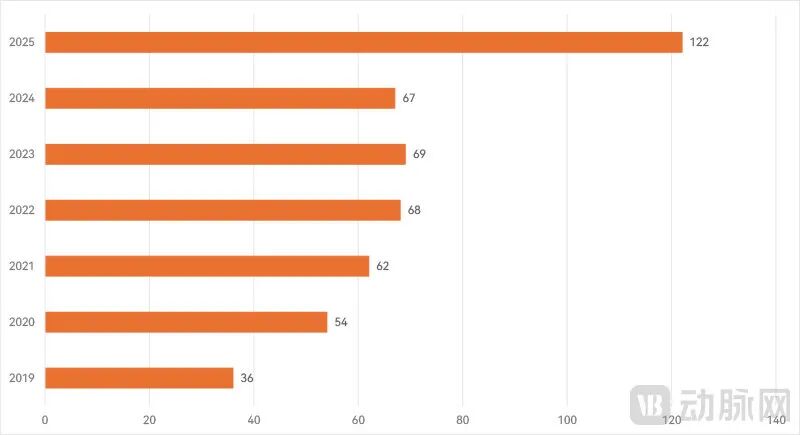
Core Insights - The National Medical Products Administration (NMPA) has approved several innovative medical devices, including a first-of-its-kind disposable peripheral vascular thrombectomy catheter, which meets international advanced standards [1] - In 2025, the NMPA announced that 122 products entered the special approval process for innovative medical devices, nearly doubling from 2024 [1][8] - The Chinese innovative medical device sector is poised for a significant breakthrough, similar to the rise of innovative pharmaceuticals in recent years [2] Group 1: Innovative Medical Device Market Trends - The trend of innovative medical device business development (BD) in China is gaining momentum, with domestic companies increasingly collaborating with local innovative device firms and multinational corporations [3] - Major Chinese companies like Yuan Da Pharmaceutical have formed partnerships with various innovative device firms to expand their product lines [4] - Global giants such as Edwards Lifesciences and Johnson & Johnson are collaborating with Chinese innovative device companies, indicating a narrowing gap in innovation and quality [4] Group 2: Approval Statistics and Comparisons - In 2025, 72 innovative medical devices were approved through the special review process, marking a historical high and a continuous growth trend since 2019 [6] - The number of innovative medical devices entering the special review process in 2025 reached 122, a significant increase compared to previous years [8] - The number of second-class innovative medical devices approved by provincial regulatory bodies also saw a substantial increase, with 131 products entering the special approval process in 2025, up over 30% from 2024 [10] Group 3: Challenges and Future Outlook - Despite the progress, the innovative medical device sector faces challenges in replicating the success of innovative pharmaceuticals due to differences in commercialization and development logic [15][16] - The commercialization of innovative devices is more complex and requires ongoing validation in clinical settings, making it harder to achieve rapid market penetration [17] - To enhance the development of innovative medical devices, systemic adjustments are needed, including faster approval processes, supportive payment structures, and international standard recognition [18][19]

归创通桥董事长赵中:未来三至五年,国产医疗器械市场份额有望过半
Mei Ri Jing Ji Xin Wen· 2026-01-21 13:03
Core Viewpoint - The domestic high-value medical consumables market is undergoing significant changes due to centralized procurement, with domestic companies expected to capture approximately 70% of the mainstream market in the coming years [1][2]. Group 1: Market Dynamics - The sixth batch of national centralized procurement for high-value medical consumables was announced, with 202 companies and 440 products winning bids, indicating a shift towards domestic brands [1]. - Since the implementation of centralized procurement in 2020, the market share of imported brands, which previously dominated over 90%, has been continuously eroded, leading to significant price reductions in products like coronary stents and drug-coated balloons [1][2]. - The average price of joint bone cement dropped by 83.13% due to centralized procurement, significantly reducing the financial burden on patients [2]. Group 2: Competitive Landscape - Domestic companies face a more severe challenge in the medical device sector compared to pharmaceuticals, as the technological gap between domestic products and imported brands is more pronounced [2]. - The centralized procurement model has created a dual-edged sword for domestic companies, allowing them to gain market access while also compressing profit margins due to intense price competition [2][3]. Group 3: Company Performance - Guichuang Tongqiao has actively embraced centralized procurement, resulting in a compound annual growth rate of 50-60% in performance after its products were included in procurement lists [3]. - The company has successfully maintained a gross margin of 71.6% in 2024, only slightly down from 2023, indicating resilience against price pressures [4]. Group 4: Future Outlook - The market for neuro-interventional consumables is expected to slow down after rapid growth, while the peripheral vascular business is projected to maintain a steady growth rate of around 40% [5]. - The company recognizes the need to enhance product quality and build trust among clinicians to facilitate the adoption of domestic brands [5]. Group 5: International Expansion - The international market for medical devices is significantly larger than the domestic market, making global expansion a necessity for companies like Guichuang Tongqiao [6][8]. - The company has entered into an agreement to acquire a stake in the German medical technology company Optimed, aiming to leverage its established R&D and commercialization platform in Europe [8][9]. - Innovation is deemed essential for gaining recognition in mainstream international markets, with the company focusing on both mergers and innovative product development to enhance its global presence [9].
心玮医疗:预计2025年收益约4亿元至4.1亿元,转亏为盈主要因多款产品销售增长
Cai Jing Wang· 2026-01-21 06:36
Core Viewpoint - The company expects to achieve significant revenue growth and profitability by the end of 2025, driven by new product launches and increased sales in various medical segments [1] Financial Performance - The company projects revenue of approximately 400 million to 410 million yuan for the year ending December 31, 2025, representing an increase of at least 43.9% compared to the revenue of 278 million yuan for the year ending December 31, 2024 [1] - The expected pre-tax profit is around 80 million yuan, a substantial improvement from the pre-tax net loss of 12 million yuan for the year ending December 31, 2024 [1] Growth Drivers - The turnaround from loss to profit is primarily attributed to the launch of new products and technologies for ischemic stroke, the commercialization of intracranial stents, increased sales of other hemorrhagic stroke products, and sustained growth in interventional pathway product sales [1]
心玮医疗-B发盈喜 预期2025年收益约4亿元至4.1亿元 同比增加至少43.9%
Zhi Tong Cai Jing· 2026-01-20 14:38
Core Viewpoint - The company, 心玮医疗-B (06609), anticipates significant revenue growth for the fiscal year ending December 31, 2025, projecting earnings between approximately RMB 400 million and RMB 410 million, representing an increase of at least 43.9% compared to RMB 278 million for the fiscal year ending December 31, 2024 [1] Revenue Growth Drivers - The revenue growth is driven by the launch of new products and technologies for ischemic stroke and an increase in market share for ischemic stroke products [1] - The commercialization of intracranial stents and increased sales of other hemorrhagic stroke products contribute to the revenue growth [1] - Continuous growth in sales of interventional access products also supports the revenue increase [1] - Effective cost control measures in sales costs and administrative expenses have reduced the company's expense ratio [1] Profitability Expectations - The company expects to achieve a pre-tax profit of approximately RMB 80 million during the reporting period, a significant improvement compared to a pre-tax net loss of RMB 12 million for the fiscal year ending December 31, 2024 [1]
心玮医疗-B(06609)发盈喜 预期2025年收益约4亿元至4.1亿元 同比增加至少43.9%
智通财经网· 2026-01-20 14:32
Core Viewpoint - The company expects significant revenue growth and a turnaround in profitability for the fiscal year ending December 31, 2025, driven by new product launches and market share gains in the ischemic stroke segment [1] Revenue Forecast - The company anticipates revenue between approximately RMB 400 million and RMB 410 million for the fiscal year ending December 31, 2025, representing an increase of at least 43.9% compared to the revenue of RMB 278 million for the fiscal year ending December 31, 2024 [1] Profitability Outlook - The company projects a pre-tax profit of approximately RMB 80 million for the reporting period, a significant improvement compared to a pre-tax net loss of RMB 12 million for the fiscal year ending December 31, 2024 [1] Growth Drivers - Revenue growth is driven by several factors, including the launch of new products and technologies for ischemic stroke, increased market share in ischemic stroke products, commercialization of intracranial stents, rising sales of other hemorrhagic stroke products, and sustained growth in interventional access product sales [1] - The company has also implemented effective cost control measures, reducing the expense ratio through lower sales costs and administrative expenses [1]
心玮医疗-B(06609.HK):预计年度录得除税前利润约8000万元 同比转亏为盈
Ge Long Hui· 2026-01-20 14:29
Core Viewpoint - The company expects significant revenue growth and a turnaround to profitability for the fiscal year ending December 31, 2025, driven by new product launches and effective cost control measures [1] Group 1: Revenue Expectations - The company anticipates revenue between approximately RMB 400 million and RMB 410 million for the fiscal year ending December 31, 2025, representing an increase of at least 43.9% compared to the revenue of RMB 278 million for the fiscal year ending December 31, 2024 [1] Group 2: Profitability Outlook - The company projects a pre-tax profit of approximately RMB 80 million for the fiscal year ending December 31, 2025, a significant improvement from a pre-tax net loss of RMB 12 million for the fiscal year ending December 31, 2024 [1] Group 3: Growth Drivers - Revenue growth is driven by several factors: 1. Launch of new products and technologies for ischemic stroke and an increase in market share for ischemic stroke products 2. Commercialization of intracranial stents and increased sales of other hemorrhagic stroke products 3. Continued growth in sales of interventional pathway products [1] - The company has effectively controlled costs through measures that reduced the expense ratio [1]
北京最新一批医用耗材集采!将降低心脏病等医疗费用
Xin Lang Cai Jing· 2025-12-21 06:19
Group 1 - The core viewpoint of the article is the announcement of the proposed selection results for centralized procurement of electrophysiological and neuro-interventional medical consumables in Beijing, aimed at reducing medical costs for patients with heart diseases and intracranial aneurysms [1][2] - The procurement covers two main categories of high-value consumables: electrophysiological products such as diagnostic and ablation catheters, and neuro-interventional products including coils and stents for treating cerebrovascular diseases [1] - The procurement process utilizes "volume-based price negotiation" and "volume-based linkage," ensuring that prices for products already recorded in other provinces do not exceed the lowest provincial price in the country [1][2] Group 2 - The procurement is led by six major hospitals, including Xuanwu Hospital and Tiantan Hospital, which will ensure that selected products maintain quality while reducing prices [2] - All public medical institutions in the city are required to participate in the procurement, which will last for two years, with prices dynamically linked to the lowest provincial prices during this period [1] - Hospitals will receive rewards for the savings achieved from the reduced prices of consumables during the first year after the price drop [1]
前景研判!2026年中国脑血管介入器械行业市场发展概况分析及投资前景预测(智研咨询)
Sou Hu Cai Jing· 2025-12-19 02:15
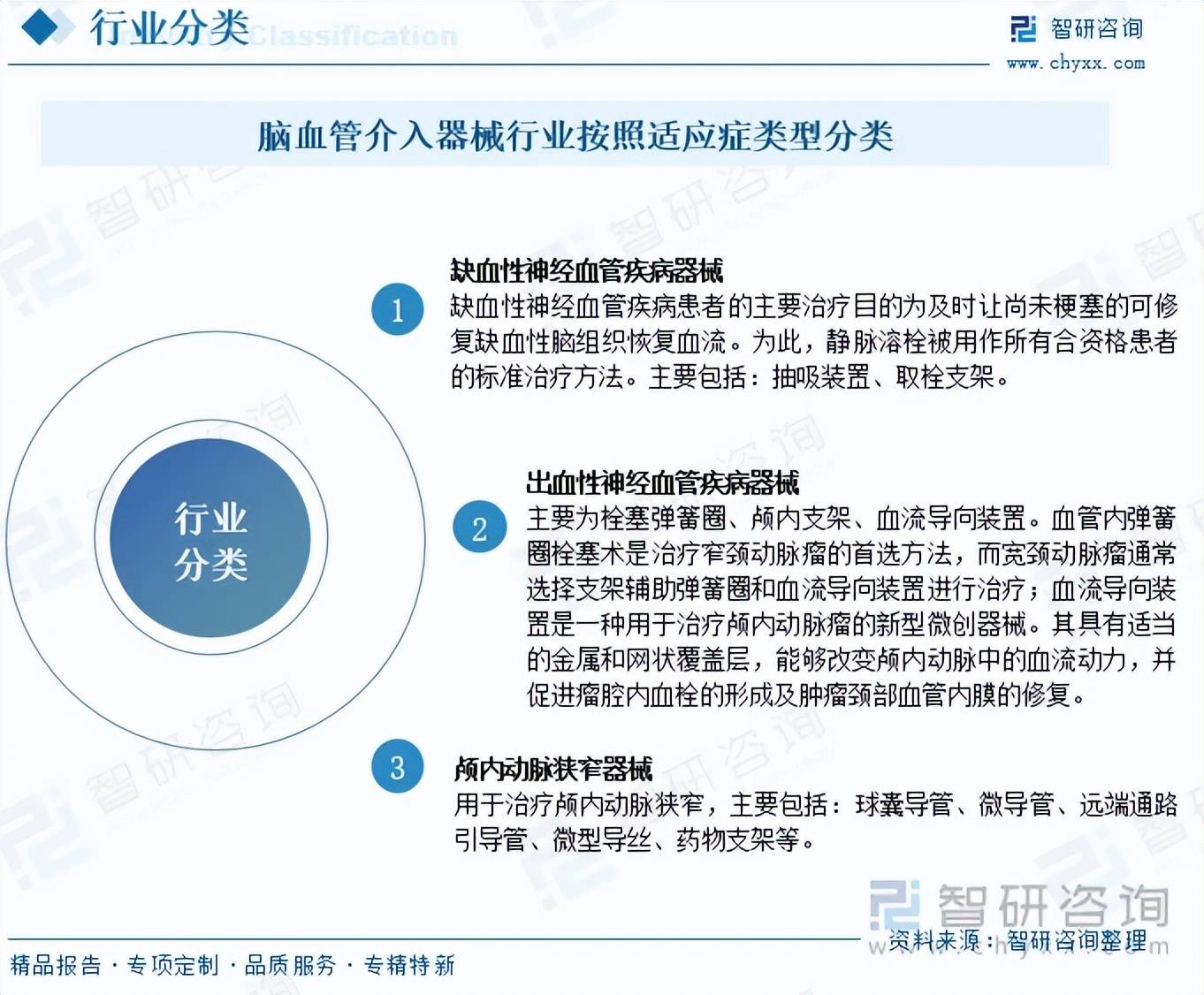
Core Viewpoint - The demand for cerebrovascular interventional devices in China is increasing due to the rising incidence of cerebrovascular diseases, which are among the top three causes of death in the country, with stroke being the leading cause [1][10]. Industry Definition and Classification - Cerebrovascular diseases are conditions affecting blood vessels in the brain, primarily including ischemic and hemorrhagic strokes. Cerebrovascular interventional surgery involves minimally invasive techniques for diagnosing and treating these conditions [2]. - Cerebrovascular interventional devices include medical consumables required for these surgeries, such as embolization coils, thrombectomy stents, and aspiration catheters [2]. Industry Characteristics - The cerebrovascular interventional device industry is characterized by high technical barriers, continuous technological innovation, and favorable industry policies [4]. Current Industry Status Global Market - The global market for cerebrovascular interventional devices is projected to reach USD 3.292 billion in 2024, with North America accounting for 43.04% of the market, Europe 26.56%, and Asia-Pacific 25.27%. The market is expected to grow to USD 3.974 billion by 2025 [7]. Chinese Market - In China, the market for cerebrovascular interventional devices is expected to reach CNY 3.504 billion in 2024, with specific segments such as intracranial thrombectomy stents at CNY 1.584 billion and aspiration catheters at CNY 0.272 billion. By 2025, the market is projected to grow to CNY 4.879 billion [10][13]. Industry Supply Chain - The upstream of the cerebrovascular interventional device industry consists of raw material suppliers, including tubing and alloy materials. The midstream includes manufacturers like Medtronic and Johnson & Johnson, while the downstream consists of distribution channels and end customers, primarily medical institutions [15].

趋势研判!2025年中国脑血管介入器械行业特征、发展历程、产业链、市场现状、竞争格局及发展趋势分析:需求逐渐增加,本土企业仍存在较大替代空间[图]
Chan Ye Xin Xi Wang· 2025-12-09 01:53
Core Viewpoint - The demand for neurointerventional medical devices in China is increasing due to the rising incidence of cerebrovascular diseases, with stroke being the leading cause of death among Chinese residents. The market for neurointerventional consumables is projected to grow significantly in the coming years [1][5]. Industry Definition and Classification - Neurointerventional devices are medical consumables required for neurointerventional surgeries, primarily used to diagnose and treat cerebrovascular diseases through minimally invasive techniques [2][3]. Industry Development Status - The global market for neurointerventional consumables is expected to reach $3.292 billion in 2024, with North America holding a 43.04% market share. The Chinese market for these consumables is projected to grow from 3.504 billion yuan in 2024 to 4.879 billion yuan in 2025 [5][6]. Industry Chain - The upstream of the neurointerventional device industry consists of raw material suppliers, while the midstream includes manufacturers like Medtronic and Johnson & Johnson. The downstream consists of medical institutions that utilize these devices [7]. Industry Development History - The neurointerventional device industry in China has evolved through three stages: the embryonic stage (1980-1999), the initiation stage (2000-2010), and the rapid development stage (2011-present) [8]. Competitive Landscape - The market is primarily dominated by multinational companies such as Medtronic and Johnson & Johnson, while domestic companies like Guichuang Tongqiao and Micron Brain Science are gaining ground through competitive pricing and localized channels [9][10]. Key Enterprises - The leading companies in the Chinese neurointerventional market include Medtronic, Stryker, and Johnson & Johnson, with a significant presence of domestic players like Guichuang Tongqiao and Micron Brain Science [10][11]. Technological Breakthroughs - Domestic companies are achieving technological advancements in core products, allowing them to compete more effectively with international standards while benefiting from cost advantages [12]. Application Scenario Expansion - The application of new technologies such as AI-assisted navigation systems and biodegradable materials is expected to enhance the efficiency and scope of neurointerventional procedures, supported by favorable government policies [13].

电生理等集采开始报量,建议关注国产替代机会
Ping An Securities· 2025-12-01 04:59
Investment Rating - The industry investment rating is "Outperform the Market" [1][31]. Core Viewpoints - The report highlights the initiation of centralized procurement for electrophysiology and neuro-interventional medical consumables in Beijing, which is expected to promote the entry of domestic high-end products and accelerate domestic substitution [4]. - The procurement covers all public medical institutions in Beijing, with a two-year agreement period, and includes various categories of electrophysiology and neuro-interventional products [4]. - The report suggests focusing on leading companies with comprehensive layouts in the electrophysiology field, such as Huatai Medical and Microelectrophysiology [4]. Summary by Sections Industry Overview - The centralized procurement for electrophysiology and neuro-interventional consumables has officially started, with a deadline for submission set for December 1 [4]. - The procurement is led by six top-tier hospitals in Beijing and aims to enhance the availability of domestic products [4]. Investment Strategy - The report recommends attention to innovative drug companies with rich pipeline layouts, such as Heng Rui Medicine, BeiGene, and China Biopharmaceuticals [6]. - It also highlights companies with significant single-product potential and those leading in advanced technology platforms [6]. Market Performance - The pharmaceutical sector saw a 2.67% increase last week, outperforming the CSI 300 index, which rose by 1.64% [9][20]. - In the Hong Kong market, the pharmaceutical sector increased by 3.85%, leading among 11 sectors [30]. Notable Industry News - Abbott announced a $21 billion acquisition of Exact Sciences, enhancing its position in the cancer diagnostics field [13]. - Johnson & Johnson is acquiring Halda Therapeutics for $3.05 billion, focusing on prostate cancer treatments [14]. - A significant ophthalmic drug has been approved for market release, expanding treatment options for age-related macular degeneration [16]. - Novartis received approval for its oral drug Remibrutinib in China, targeting chronic spontaneous urticaria [17].