球囊

Search documents
收入5.25亿,同比增长14.53%,赛诺医疗发布业绩快报
思宇MedTech· 2026-02-27 06:37
Core Viewpoint - The financial performance of Sino Medical Science and Technology Co., Ltd. in 2025 shows significant growth in both revenue and profit, indicating a strong recovery and improvement in the domestic cardiovascular device sector [2][5]. Financial Performance Summary - The company achieved total revenue of 525.41 million yuan, a year-on-year increase of 14.53% [4]. - Net profit attributable to shareholders reached 47.29 million yuan, a substantial year-on-year increase of 3057.05% [5]. - The net profit after deducting non-recurring gains was 33.96 million yuan, up 293.82% year-on-year [5]. - Basic earnings per share increased to 0.11 yuan, reflecting a growth of 2650% [5]. - Total assets at the end of the reporting period were 1.35 billion yuan, up 3.78% year-on-year [5]. Profit Improvement Factors - The significant profit improvement is attributed to a combination of revenue growth and optimized cost structure, rather than a single factor [6]. - Sales of balloon and stent products saw a substantial year-on-year increase, leading to enhanced economies of scale [7]. - The unit cost of products decreased significantly, while total operating costs only increased by 1.37%, well below the revenue growth rate [7][27]. - Sales expenses decreased by 1.81% despite revenue growth, indicating improved efficiency in marketing resource allocation [9]. - Research and development expenses fell by 12.8%, primarily due to certain projects reaching key milestones and reduced material and experimental costs [9]. Structural Changes in Profitability - The growth in net profit, particularly the 293.82% increase in net profit excluding non-recurring items, indicates a transition from a high-investment phase to a commercialization phase [11]. - The industry has shifted from a focus on price differences to cost control and product structure upgrades due to significant price adjustments in the coronary stent sector [11][19]. - The current financial results suggest that the industry is entering a new equilibrium, where companies are adapting to a new cost structure after the price shock [19]. Insights for the Industry - Profitability is becoming more important than revenue growth, with market valuations shifting from story-driven to cash flow-driven [30]. - Manufacturing capability is emerging as a core barrier to entry, as cost control will determine industry differentiation in a transparent pricing environment [30]. - The second phase of competition has begun, focusing on validating scalable profitability rather than just technological breakthroughs [30][31]. - The report indicates a deeper trend of domestic cardiovascular companies transitioning from "substitutes" to "competitors within the system" [32][33].


赛诺医疗(688108.SH):预计2025年度净利润同比增长2767%至3233%
Ge Long Hui A P P· 2026-01-30 08:38
Core Viewpoint - Sino Medical (688108.SH) is expected to report a significant increase in net profit for the fiscal year 2025, with projections indicating a rise of 2,767% to 3,233% compared to the previous year [1] Financial Performance - The company anticipates a net profit attributable to shareholders ranging from 43 million to 50 million yuan, an increase of 41.5 million to 48.5 million yuan year-on-year [1] - The expected net profit after deducting non-recurring gains and losses is projected to be between 30 million and 35.8 million yuan, reflecting a year-on-year increase of 4.752 million to 5.332 million yuan, or 271% to 304% [1] Product Performance - Sales of balloon and stent products have significantly increased year-on-year, demonstrating the scale effect of the products [1] - The reduction in unit product costs has been substantial; however, the savings from lower unit costs are slightly outweighed by the cost increases associated with higher sales volumes, leading to a slight increase in operating costs year-on-year [1]
赛诺医疗股价跌5%,国泰海通资管旗下1只基金重仓,持有44.43万股浮亏损失53.76万元
Xin Lang Cai Jing· 2026-01-15 03:53
Group 1 - The core point of the news is that Sino Medical experienced a 5% drop in stock price, reaching 22.99 CNY per share, with a trading volume of 437 million CNY and a turnover rate of 4.45%, resulting in a total market capitalization of 9.565 billion CNY [1] - Sino Medical, established on September 21, 2007, and listed on October 30, 2019, specializes in the research, production, and sales of high-end interventional medical devices, focusing on cardiovascular, cerebrovascular, and structural heart disease treatment areas [1] - The revenue composition of Sino Medical is as follows: stents account for 59.76%, balloons for 32.68%, and other products for 7.56% [1] Group 2 - From the perspective of fund holdings, one fund under Guotai Haitong Asset Management has a significant position in Sino Medical, with the Guotai Haitong Quantitative Stock Selection Mixed Fund A (016466) holding 444,300 shares, representing 0.89% of the fund's net value, making it the top heavy stock [2] - The Guotai Haitong Quantitative Stock Selection Mixed Fund A was established on August 18, 2022, with a current scale of 599 million CNY, and has achieved a year-to-date return of 8.38%, ranking 1383 out of 8840 in its category [2] - The fund manager, Hu Chonghai, has a tenure of 4 years and 33 days, with the fund's total asset scale at 13.684 billion CNY, achieving the best return of 90.54% and the worst return of 0.74% during his tenure [2]

赛诺医疗跌2.06%,成交额3.46亿元,主力资金净流出173.48万元
Xin Lang Zheng Quan· 2025-12-29 02:29
Group 1 - The core viewpoint of the news is that Sino Medical has experienced significant stock price fluctuations and trading activity, with a year-to-date increase of 109.63% and a recent decline of 2.06% on December 29 [1] - As of December 29, Sino Medical's stock price is reported at 20.46 yuan per share, with a total market capitalization of 8.512 billion yuan [1] - The company has seen a net outflow of main funds amounting to 1.7348 million yuan, with large orders showing a buy of 82.0063 million yuan and a sell of 78.5717 million yuan [1] Group 2 - Sino Medical, established on September 21, 2007, specializes in high-end interventional medical devices, with its main revenue sources being stents (59.76%), balloons (32.68%), and others (7.56%) [2] - The company reported a revenue of 364 million yuan for the first nine months of 2025, reflecting a year-on-year growth of 14.24%, and a net profit of 21.118 million yuan, which is a significant increase of 293.46% [2] - As of September 30, the number of shareholders increased by 164.74% to 29,400, while the average circulating shares per person decreased by 62.23% to 14,170 shares [2] Group 3 - Sino Medical has cumulatively distributed 41 million yuan in dividends since its A-share listing, with no dividends paid in the last three years [3]
赛诺医疗股价涨5.12%,国泰海通资管旗下1只基金重仓,持有44.43万股浮盈赚取40.43万元
Xin Lang Cai Jing· 2025-12-25 05:39
Group 1 - The core viewpoint of the news is that Sino Medical has seen a significant increase in its stock price, rising by 5.12% to reach 18.69 CNY per share, with a total market capitalization of 7.776 billion CNY [1] - Sino Medical, established on September 21, 2007, and listed on October 30, 2019, specializes in the research, production, and sales of high-end interventional medical devices, focusing on cardiovascular, cerebrovascular, and structural heart disease treatments [1] - The revenue composition of Sino Medical is primarily from stents (59.76%), followed by balloons (32.68%), and other products (7.56%) [1] Group 2 - From the perspective of fund holdings, Sino Medical is a major investment for the Guotai Haitong Asset Management, with its fund holding 444,300 shares, representing 0.89% of the fund's net value, making it the top heavy stock [2] - The Guotai Haitong Quantitative Stock Mixed Fund A (016466) has achieved a year-to-date return of 33.18%, ranking 2673 out of 8087 in its category, and a one-year return of 30.85%, ranking 2722 out of 8071 [2] - The fund manager, Hu Chonghai, has a tenure of 4 years and 12 days, with the fund's total asset size at 13.684 billion CNY, achieving a best return of 70.69% during his management [3]
赛诺医疗股价涨5.09%,国泰海通资管旗下1只基金重仓,持有44.43万股浮盈赚取39.55万元
Xin Lang Cai Jing· 2025-12-19 03:40
Group 1 - Sino Medical's stock increased by 5.09%, reaching 18.39 CNY per share, with a trading volume of 169 million CNY and a turnover rate of 2.25%, resulting in a total market capitalization of 7.651 billion CNY [1] - Sino Medical, established on September 21, 2007, and listed on October 30, 2019, specializes in the research, production, and sales of high-end interventional medical devices, focusing on cardiovascular, cerebrovascular, and structural heart disease treatment areas [1] - The revenue composition of Sino Medical includes stents (59.76%), balloons (32.68%), and other products (7.56%) [1] Group 2 - The Guotai Haitong Quantitative Stock Mixed Fund A (016466) holds 444,300 shares of Sino Medical, representing 0.89% of the fund's net value, making it the top holding [2] - The fund has achieved a year-to-date return of 29.62%, ranking 2637 out of 8098 in its category, and a one-year return of 26.91%, ranking 2844 out of 8067 [2] - The fund was established on August 18, 2022, with a current size of 599 million CNY and has generated a cumulative return of 43.31% since inception [2]
赛诺医疗涨2.00%,成交额3045.69万元,主力资金净流入5.67万元
Xin Lang Cai Jing· 2025-12-19 02:15
Group 1 - The core viewpoint of the news is that Sino Medical has shown significant stock performance with an 82.89% increase year-to-date, despite recent declines in the short term [1] - As of December 19, the stock price reached 17.85 CNY per share, with a market capitalization of 7.426 billion CNY [1] - The company has experienced a net inflow of main funds amounting to 56,700 CNY, with large orders accounting for 13.22% of total buying and 13.03% of total selling [1] Group 2 - Sino Medical operates in the pharmaceutical and biological industry, specifically in medical devices and consumables, with a focus on high-end interventional medical devices [2] - The company reported a revenue of 364 million CNY for the first nine months of 2025, reflecting a year-on-year growth of 14.24%, and a net profit of 21.118 million CNY, which is a 293.46% increase [2] - The number of shareholders increased by 164.74% to 29,400 as of September 30, while the average circulating shares per person decreased by 62.23% to 14,170 shares [2] Group 3 - Sino Medical has distributed a total of 41 million CNY in dividends since its A-share listing, with no dividends paid in the last three years [3]
前景研判!2026年中国脑血管介入器械行业市场发展概况分析及投资前景预测(智研咨询)
Sou Hu Cai Jing· 2025-12-19 02:15
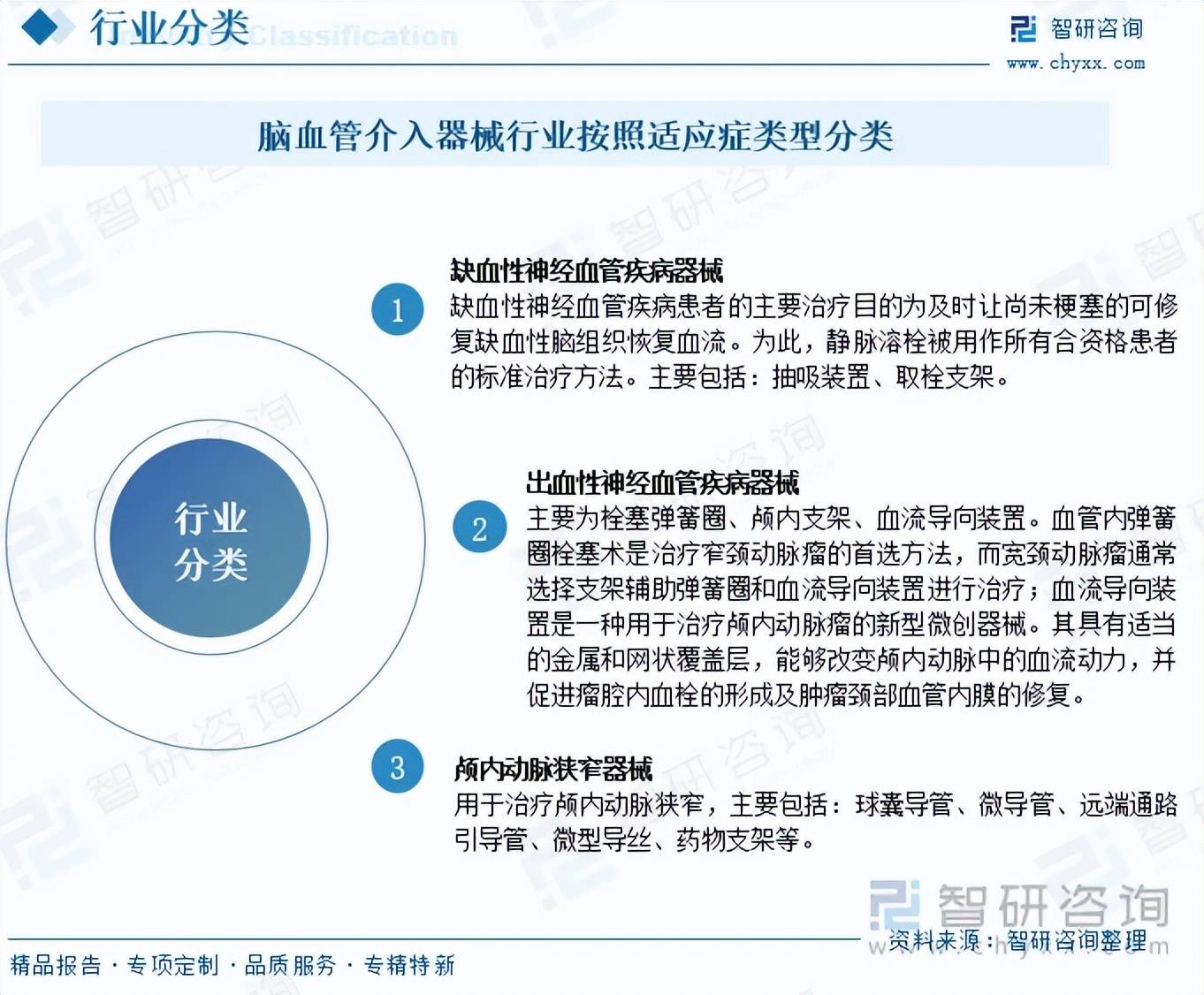
Core Viewpoint - The demand for cerebrovascular interventional devices in China is increasing due to the rising incidence of cerebrovascular diseases, which are among the top three causes of death in the country, with stroke being the leading cause [1][10]. Industry Definition and Classification - Cerebrovascular diseases are conditions affecting blood vessels in the brain, primarily including ischemic and hemorrhagic strokes. Cerebrovascular interventional surgery involves minimally invasive techniques for diagnosing and treating these conditions [2]. - Cerebrovascular interventional devices include medical consumables required for these surgeries, such as embolization coils, thrombectomy stents, and aspiration catheters [2]. Industry Characteristics - The cerebrovascular interventional device industry is characterized by high technical barriers, continuous technological innovation, and favorable industry policies [4]. Current Industry Status Global Market - The global market for cerebrovascular interventional devices is projected to reach USD 3.292 billion in 2024, with North America accounting for 43.04% of the market, Europe 26.56%, and Asia-Pacific 25.27%. The market is expected to grow to USD 3.974 billion by 2025 [7]. Chinese Market - In China, the market for cerebrovascular interventional devices is expected to reach CNY 3.504 billion in 2024, with specific segments such as intracranial thrombectomy stents at CNY 1.584 billion and aspiration catheters at CNY 0.272 billion. By 2025, the market is projected to grow to CNY 4.879 billion [10][13]. Industry Supply Chain - The upstream of the cerebrovascular interventional device industry consists of raw material suppliers, including tubing and alloy materials. The midstream includes manufacturers like Medtronic and Johnson & Johnson, while the downstream consists of distribution channels and end customers, primarily medical institutions [15].
趋势研判!2025年中国脑血管介入器械行业特征、发展历程、产业链、市场现状、竞争格局及发展趋势分析:需求逐渐增加,本土企业仍存在较大替代空间[图]
Chan Ye Xin Xi Wang· 2025-12-09 01:53
Core Viewpoint - The demand for neurointerventional medical devices in China is increasing due to the rising incidence of cerebrovascular diseases, with stroke being the leading cause of death among Chinese residents. The market for neurointerventional consumables is projected to grow significantly in the coming years [1][5]. Industry Definition and Classification - Neurointerventional devices are medical consumables required for neurointerventional surgeries, primarily used to diagnose and treat cerebrovascular diseases through minimally invasive techniques [2][3]. Industry Development Status - The global market for neurointerventional consumables is expected to reach $3.292 billion in 2024, with North America holding a 43.04% market share. The Chinese market for these consumables is projected to grow from 3.504 billion yuan in 2024 to 4.879 billion yuan in 2025 [5][6]. Industry Chain - The upstream of the neurointerventional device industry consists of raw material suppliers, while the midstream includes manufacturers like Medtronic and Johnson & Johnson. The downstream consists of medical institutions that utilize these devices [7]. Industry Development History - The neurointerventional device industry in China has evolved through three stages: the embryonic stage (1980-1999), the initiation stage (2000-2010), and the rapid development stage (2011-present) [8]. Competitive Landscape - The market is primarily dominated by multinational companies such as Medtronic and Johnson & Johnson, while domestic companies like Guichuang Tongqiao and Micron Brain Science are gaining ground through competitive pricing and localized channels [9][10]. Key Enterprises - The leading companies in the Chinese neurointerventional market include Medtronic, Stryker, and Johnson & Johnson, with a significant presence of domestic players like Guichuang Tongqiao and Micron Brain Science [10][11]. Technological Breakthroughs - Domestic companies are achieving technological advancements in core products, allowing them to compete more effectively with international standards while benefiting from cost advantages [12]. Application Scenario Expansion - The application of new technologies such as AI-assisted navigation systems and biodegradable materials is expected to enhance the efficiency and scope of neurointerventional procedures, supported by favorable government policies [13].

国家医保局连发案例剑指医药贪腐,多家名企被卷入
Jing Ji Guan Cha Wang· 2025-11-30 06:08
Group 1 - The article highlights a series of corruption cases involving pharmaceutical companies and agents bribing hospital personnel, with the National Healthcare Security Administration (NHSA) stating that such bribery disrupts normal medical practices and shifts sales from clinical value to high rebates and kickbacks [2][6] - Multiple companies, including Medtronic and A-share listed companies like Qianhong Pharmaceutical and Dezhan Health, have been named in recent court rulings related to these corruption cases [2][5] - Specific cases include Medtronic's agents bribing hospital officials with kickbacks of 5,000 yuan per stent and varying amounts for balloons, leading to a total bribe exceeding 14 million yuan [3][4] Group 2 - The case involving Qianhong Pharmaceutical and Dezhan Health reveals that from January 2013 to May 2019, a hospital's pharmacy director received over 116,000 yuan in bribes from various pharmaceutical representatives, including 4,100 yuan from Qianhong Pharmaceutical [5] - The NHSA has established a credit evaluation system for pricing and procurement to address the inflated prices revealed by these cases, aiming to protect patients and healthcare funds [6]