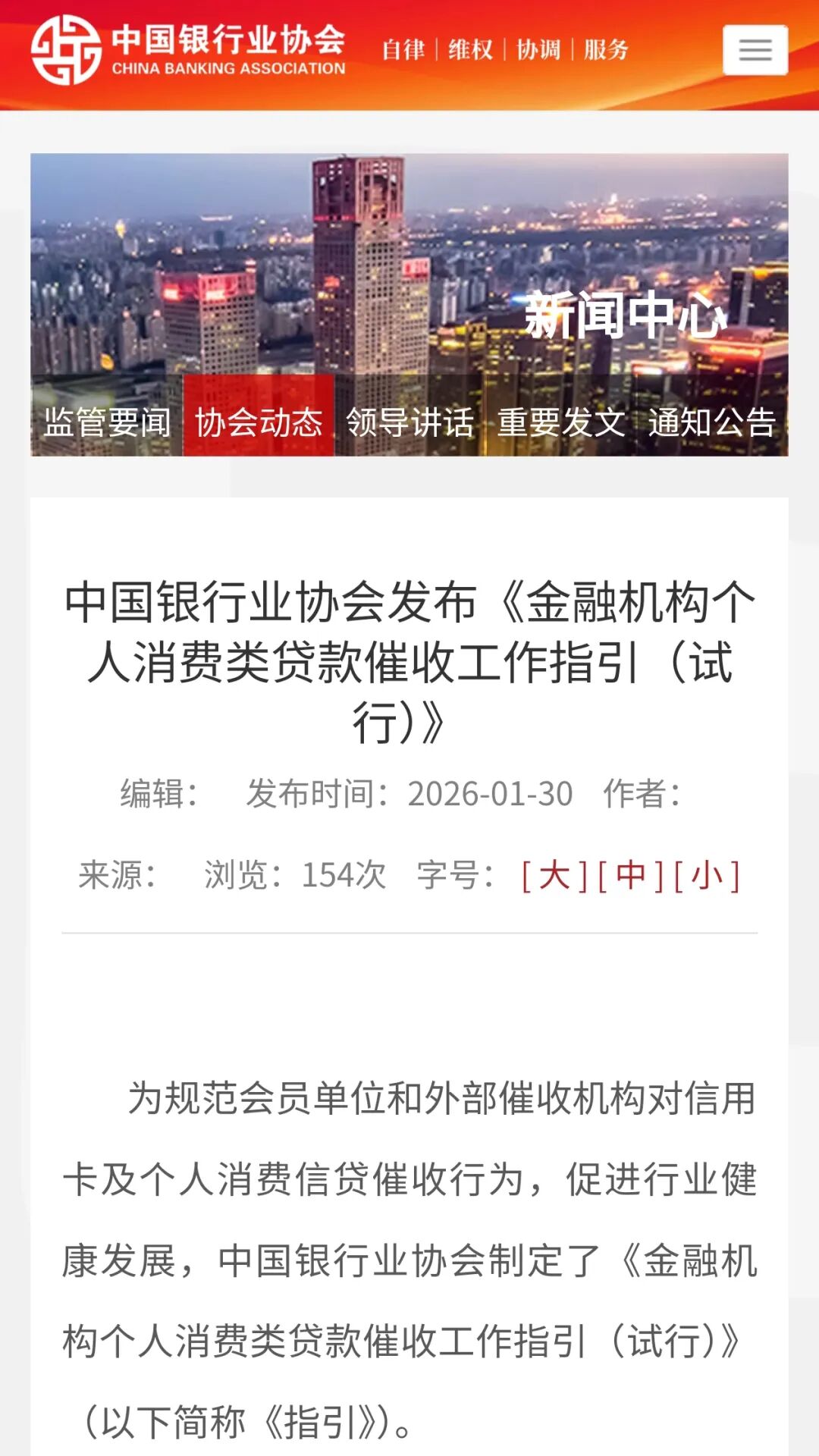
信用卡及个人消费信贷

Search documents
消费贷催收告别野蛮生长 迈向规范发展
Xin Lang Cai Jing· 2026-02-02 20:06
Core Viewpoint - The introduction of the "Guidelines for the Collection of Personal Consumer Loans by Financial Institutions" marks a significant shift from unregulated to standardized debt collection practices in the financial sector, aiming to protect consumer rights and enhance industry credibility [1][2]. Group 1: Guidelines Overview - The guidelines establish a comprehensive governance framework addressing collection behaviors, regulatory requirements, and external agency management, transitioning from principle-based to quantifiable standards [2]. - A core principle of the guidelines is the protection of debtors' legal rights, explicitly opposing all forms of illegal and violent collection practices [2]. - The guidelines align with the national standard issued in March 2025, ensuring consistency between industry and national regulations [2]. Group 2: Specific Regulations - The guidelines specify that collection activities are prohibited between 10 PM and 8 AM without debtor consent, and limit the number of calls to six per day for the same contact if the debtor does not answer [2]. - It distinguishes between "debt-related third parties" and "unrelated third parties," generally prohibiting contact with unrelated parties unless the debtor is unreachable [2]. - Clear prohibitions are set against impersonating government or judicial authorities, spreading personal information, and using intimidation or violence in collection efforts [2]. Group 3: Technological and Management Aspects - The guidelines include forward-looking regulations on the use of AI in debt collection, emphasizing the need to prevent unfair discrimination and ensure the reliability of technology applications [3]. - A "white list" system is proposed for external collection agencies, requiring financial institutions to publicly disclose the information of outsourced collection agencies to enhance social oversight [3]. Group 4: Implementation and Industry Impact - The guidelines are expected to provide clear operational references, reduce compliance risks, and improve the industry's negative image, while also ensuring stronger protection for consumer rights [3]. - Financial institutions are encouraged to integrate collection governance into their corporate governance, establishing a comprehensive management system for collection processes [4]. - A reasonable assessment mechanism should be established, incorporating compliance and consumer complaint rates into performance evaluations, rather than solely focusing on recovery amounts [4]. Group 5: Industry Self-Regulation - The banking association is tasked with promoting the guidelines, ensuring member institutions understand and implement them accurately [4]. - A mechanism for sharing information on illegal activities by external collection agencies is to be established, enhancing industry transparency [4].


中国银行业协会发布催收新规 严设“红线”打击金融黑灰产
Zhong Guo Jing Ying Bao· 2026-01-31 04:00
Core Viewpoint - The China Banking Association (CBA) has officially released the "Guidelines for the Collection of Personal Consumer Loans by Financial Institutions (Trial)" to standardize credit card and personal consumer loan collection practices, protect the legal rights of debtors, and promote healthy industry development [1]. Summary by Sections Section 1: Definition of Collection Behavior - The guidelines provide clear definitions for various collection behaviors within the industry [1]. Section 2: Establishment of Collection Behavior Norms - The guidelines comprehensively address key issues such as collection timing, frequency, and the acquisition of contact information, emphasizing clarity and enforceability while setting prohibitive red lines [1]. Section 3: Strengthening External Agency Governance - The guidelines specify requirements for member units regarding the management of external collection agencies, establishing a constraint mechanism [1]. Section 4: Enhancing Internal Control Management - Financial institutions are required to improve their internal management capabilities to achieve a combination of governance and management [1]. Section 5: Promoting Industry Self-Regulation - The CBA encourages self-collection, technological innovation, and the governance of black and gray market activities, while promoting the establishment of a shared information system for illegal activities by external collection agencies [1]. Next Steps - The CBA will enhance tracking and guidance to ensure the effective implementation of the guidelines, aiming for continuous progress in promoting high-quality industry development [1].

设置禁止红线,中银协发布指引规范贷款催收→
Jin Rong Shi Bao· 2026-01-30 14:35
Core Viewpoint - The China Banking Association has released the "Guidelines for the Collection of Personal Consumer Loans by Financial Institutions (Trial)" to standardize the collection practices of credit cards and personal consumer loans, promoting healthy industry development [1]. Group 1: Definition and Scope - The guidelines consist of seven chapters and fifty-four articles, focusing on self-regulation and business development within the industry [4]. - The guidelines clearly define various collection behaviors within the industry [4]. Group 2: Collection Behavior Standards - The guidelines establish norms for collection practices, addressing public concerns regarding collection timing, frequency, and information acquisition, emphasizing clarity and enforceability while setting prohibitive boundaries [5]. - Prohibited behaviors during the collection process include impersonating government or judicial authorities, using illegal means to obtain personal information, and employing intimidation or threats [6][7]. Group 3: External Collection Agency Management - The guidelines strengthen the governance of external collection agencies, requiring member units to manage these agencies and establish a whitelist system, along with public disclosure of outsourced collection agencies [11]. - Specific prohibitions for external collection agencies include unauthorized contact with debtors and the use of personal devices for collection communications [9][10]. Group 4: Internal Control and Self-Regulation - The guidelines call for enhanced internal management capabilities within institutions to ensure compliance and effective governance [12]. - The China Banking Association will continue to monitor and guide the implementation of these guidelines to ensure adherence and promote industry health [13].