债务重组

Search documents
金融时报 | 中国东方上海市分公司:服务区域战略 谱写高质量发展新篇章
Xin Lang Cai Jing· 2026-02-05 12:25
Core Viewpoint - China Orient Asset Management Co., Ltd. (China Orient) is actively contributing to the financial high-quality development in Shanghai, focusing on risk mitigation, asset revitalization, and service upgrades in alignment with national strategies and local urban development [5][16]. Group 1: Strategic Collaboration and Ecosystem Building - China Orient Shanghai Branch emphasizes strategic cooperation through various mechanisms such as party-building initiatives, high-level interactions, and specialized task force connections to integrate deeply into the local economic ecosystem [6][17]. - The company is enhancing communication and collaboration with relevant government departments, exchanges, financial institutions, and large enterprises in Shanghai to build a robust and interactive ecological collaboration mechanism [6][17]. Group 2: Core Business Development and Asset Management - The Shanghai branch is committed to deepening its core business in financial non-performing assets, achieving significant market performance [7][18]. - By 2025, the company plans to continue expanding its financial non-performing asset ecosystem, with acquisition amounts exceeding 1.8 billion yuan, maintaining a leading market share among peers [8][18]. - The company has maintained a high cash recovery rate over the years, with a cumulative recovery of nearly 50 billion yuan over five years, contributing positively to regional financial stability [8][18]. Group 3: Supporting State-Owned Enterprise Reform and Economic Empowerment - China Orient Shanghai Branch leverages its expertise in asset revitalization and capital operations to support the reform and transformation of state-owned enterprises [9][19]. - The company has provided nearly 3 billion yuan in financial support to listed companies through various instruments such as stocks, bonds, and convertible bonds, focusing on key industries like integrated circuits, biomedicine, and artificial intelligence [9][19]. - The branch aims to continue its commitment to core business and professional excellence, contributing to financial risk mitigation and the enhancement of Shanghai's international financial center capabilities [9][19].


中国东方上海市分公司:服务区域战略 谱写高质量发展新篇章
Jin Rong Shi Bao· 2026-02-05 02:29
Core Viewpoint - China Orient Asset Management Co., Ltd. (China Orient) is strategically positioned in the Yangtze River Delta, focusing on risk mitigation, asset revitalization, and service upgrades to contribute to high-quality financial development in Shanghai [1] Group 1: Collaborative Ecosystem - China Orient Shanghai Branch emphasizes strategic cooperation through various mechanisms such as party-building initiatives, high-level interactions, and specialized task forces to integrate deeply into the local economic ecosystem [2] - The company actively enhances communication and collaboration with relevant government departments, exchanges, financial institutions, large enterprises, and various market entities to build a robust and interactive ecological collaboration mechanism [2] Group 2: Core Business Development - China Orient Shanghai Branch is committed to deepening its core business in financial non-performing assets, achieving significant market performance with over 1.8 billion yuan in acquisitions projected by 2025, maintaining a leading market share [3] - The company employs diverse methods such as asset restructuring, debt restructuring, and market-oriented debt-to-equity swaps to enhance asset value, achieving nearly 50 billion yuan in cash recovery over five years [3] - The branch is innovating by integrating equity investment as a key driver for transformation, exploring innovative models around technology finance and green finance [3] Group 3: Supporting State-Owned Enterprise Reform - China Orient Shanghai Branch leverages its expertise in asset revitalization and capital operations to support the reform and transformation of state-owned enterprises [4] - The company has provided nearly 3 billion yuan in financial relief to listed companies through various instruments, focusing on advanced industries such as integrated circuits, biomedicine, and artificial intelligence [4] - The branch aims to continue contributing to the development of Shanghai's modern industrial system and enhancing its international financial center capabilities [4]
【锋行链盟】上市公司资产重组方式及详细流程
Sou Hu Cai Jing· 2025-12-31 16:34
Group 1: Main Methods of Asset Restructuring - Asset acquisition involves purchasing other companies' assets through cash, stock issuance, or a combination, aimed at expanding business scale or entering new fields. It allows for quick access to quality assets but carries integration risks [3] - Asset disposal refers to the transfer of part or all of a company's assets, such as non-core or inefficient assets, to focus on core business, recover funds, or improve financial status [4][5] - Asset swap entails mutual exchange of assets between companies, typically of equal or near-equal value, to achieve complementary benefits, often seen in scenarios like "shell protection" or strategic transformation [6] - Mergers and demergers involve consolidating companies to integrate supply chains or eliminate competition, or separating parts of a business to focus on core operations or resolve legacy issues [7] - Debt restructuring involves negotiating with creditors to adjust debt terms, such as principal reduction or debt-to-equity swaps, to alleviate financial pressure, commonly in high-debt or bankruptcy scenarios [8] - Equity acquisition or transfer involves acquiring or divesting stakes in other companies, fundamentally shifting control or adjusting ownership [9] Group 2: Detailed Process of Asset Restructuring - The asset restructuring process is governed by regulations such as the "Management Measures for Major Asset Restructuring of Listed Companies" and can be divided into four main stages: preparation, internal decision-making, external approval, and implementation & integration [10] - The preparation phase includes defining the restructuring objectives and designing the plan [10] - The internal decision-making phase involves board review, strategic direction determination, intermediary selection, due diligence, and valuation [11][12] - The external approval phase requires compliance with regulatory procedures, which may involve multiple departments depending on the restructuring type and control changes [13] - The implementation phase includes signing formal agreements, information disclosure, business integration, financial integration, personnel and cultural integration, and performance commitments [15][16] Group 3: Key Considerations - Compliance with relevant regulations is essential to avoid insider trading and ensure transparency [16] - Protection of minority shareholders' rights is crucial, requiring thorough justification of restructuring necessity and independent board approval for related transactions [16] - Valuation rationality is important, especially for high-premium acquisitions, necessitating clear explanations and executable performance commitments [16] - Integration risks must be managed proactively to avoid conflicts and cultural differences that could undermine expected synergies [16]

攀枝花个体户与上班族,你的“融资身份证”大不同!这样规划更省钱
Sou Hu Cai Jing· 2025-11-10 07:09
Core Insights - The article discusses different financing paths for individuals based on their identity, specifically focusing on employees and individual business owners [1][3]. Group 1: Employees - Employees are viewed as low-risk by financial institutions due to their stable and predictable cash flow [4]. - The core recommendation for employees is to maximize their credit value and avoid using collateral-based loans unnecessarily [5]. - The best financing tools for employees include salary statements and public housing fund contributions, with credit loans being the preferred option for their low interest rates and no collateral requirement [8]. Group 2: Individual Business Owners - Individual business owners often have fluctuating incomes but possess tangible assets such as real estate, vehicles, and inventory, which can be leveraged for financing [5]. - The primary recommendation for individual business owners is to convert fixed assets into liquid funds to support business growth [6]. - The best financing tools for individual business owners include real estate, vehicles, and business licenses, with mortgage loans being the main method for obtaining large amounts of low-cost funds [8].

高薪扩张!精心设计的“债务规划”黑洞
Bei Jing Shang Bao· 2025-08-14 08:40
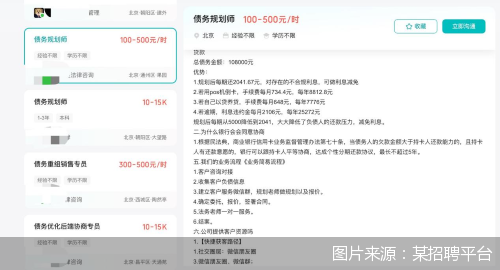
Core Viewpoint - The article highlights the emergence of a predatory debt planning industry that exploits individuals in financial distress, despite regulatory crackdowns and previous rejections by loan platforms [1][8]. Group 1: Industry Practices - Numerous companies are hiring debt planners and credit management specialists, offering salaries as high as 500 RMB per hour, to attract a large pool of indebted individuals [2][5]. - The recruitment process emphasizes finding clients through social media, short videos, and other online platforms, while also utilizing illegal data acquisition methods to target potential victims [2][4]. - The industry has developed a modular approach, with organized operations that include creating fake legal documents and using deceptive marketing tactics to lure clients [3][5]. Group 2: Risks to Consumers - Consumers are often misled into paying high service fees for ineffective debt solutions, which can lead to further financial distress and potential identity theft [6][10]. - The article notes that some organizations may disappear after collecting fees, leaving clients with unresolved debts and damaged credit records [6][10]. - There is a growing trend of using fraudulent practices, such as identity theft to secure new loans, exacerbating the debt crisis for individuals [6][10]. Group 3: Regulatory Response - Regulatory bodies and law enforcement agencies are increasing efforts to combat the rise of fraudulent debt optimization schemes, emphasizing the need for collaboration among financial institutions, platforms, and regulators [7][9]. - New measures include stricter advertising regulations on social media platforms and enhanced scrutiny of debt-related services to protect consumers from scams [9][10]. - Experts suggest that clearer regulations and better consumer education are essential to mitigate the risks associated with these predatory practices [10][11].
起底网贷黑产(下)|高薪扩张!精心设计的“债务规划”黑洞
Bei Jing Shang Bao· 2025-08-14 08:24
Core Viewpoint - The article highlights the emergence of a predatory debt planning industry that exploits individuals in financial distress, despite regulatory crackdowns and previous rejections by loan platforms [1][4][8] Group 1: Industry Practices - Numerous companies are aggressively recruiting debt planners and credit management specialists, offering hourly wages as high as 500 yuan, to target a large pool of indebted individuals [3][4] - The recruitment process emphasizes minimal experience requirements, with training provided to new hires on negotiation tactics and debt optimization strategies [3][4] - The operational model of these companies is highly structured, involving multiple stages from client consultation to contract signing, utilizing social media and online platforms for customer acquisition [3][4] Group 2: Exploitation Tactics - The debt planning black market has developed a systematic approach, utilizing illegal data acquisition and deceptive advertising to lure clients [4][5] - Fraudulent entities often promise unrealistic debt solutions, such as complete debt forgiveness or extended repayment terms, while charging high service fees of 5% to 10% of the debt amount [5][6] - There are reports of these organizations disappearing after collecting fees, leaving clients with unresolved debts and potential identity theft risks due to the sensitive information shared [6][8] Group 3: Regulatory Response - Regulatory bodies and platforms are intensifying efforts to combat the rise of fraudulent debt optimization schemes, emphasizing the need for collaboration among financial institutions, platforms, and regulators [8][9] - Recent actions include stricter advertising regulations on social media and short video platforms, limiting promotions to licensed legal entities and banning misleading content [9][10] - Experts suggest that clearer regulations and enhanced consumer education are essential to mitigate the risks associated with these predatory practices [10]