光大耀钱包C

Search documents
收益率“破1”进行时 货基规模为何能逆势创高
Sou Hu Cai Jing· 2025-12-23 17:07
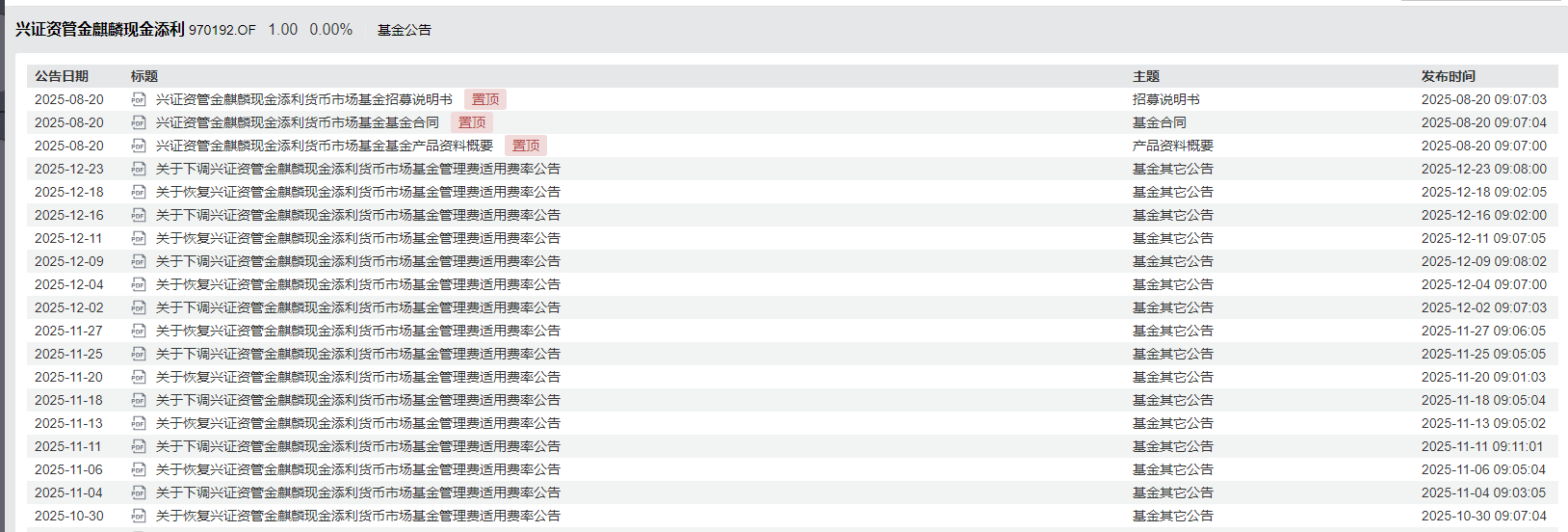
Core Insights - The average 7-day annualized yield of money market funds has dropped to 1.24%, with nearly 100 products yielding below 1%, raising questions about their investment value [1][5] - Despite declining yields, the scale of money market funds has surpassed 15 trillion yuan, increasing by over 1 trillion yuan since the beginning of the year, indicating continued investor interest [1][5] - The number of accounts holding money market funds has exceeded 2 billion, with an increase of nearly 70 million accounts in the past six months, reflecting their ongoing appeal [1][5] Yield Trends - The overall yield of money market funds has shown a downward trend, with the average 7-day annualized yield falling from 1.6% last year to 1.24% this year, a decrease of 0.36 percentage points [1][2] - Currently, no money market fund has a yield exceeding 2%, with the highest being 1.86%, compared to 57 funds exceeding 2% last year [2] - A significant number of funds, 93, have yields below 1%, a 2.4-fold increase year-on-year [2] Fee Adjustments - Several funds have adjusted their management fees in response to declining yields, with some reducing fees to 0.3% when yields fall below certain thresholds [3][4] - A total of 17 funds have implemented similar fee adjustments recently, indicating a trend among funds transitioning from asset management products to money market funds [3][4] - High management fees have been noted in some funds, with 21 funds having fees exceeding 0.5%, which is relatively high compared to the average [3][4] Value Proposition of Money Market Funds - Industry experts assert that despite lower yields, money market funds remain essential for cash management, providing liquidity and stability for investors [5][6] - Money market funds are viewed as a foundational asset for both novice and experienced investors, offering a safe entry point into investment [6][7] - The integration of money market funds with consumer payment scenarios has solidified their role as a fundamental financial infrastructure, making them less replaceable [7]
“破1”潮下规模逆势增超万亿!货基靠什么“圈粉”?
Di Yi Cai Jing· 2025-12-23 12:03
Core Viewpoint - The decline in average 7-day annualized yield of money market funds (MMFs) to 1.24% has raised questions among investors about the value of investing in these funds, especially as nearly 100 products yield below 1% [1][7] - Despite the low yields, the total scale of MMFs has increased, surpassing 15 trillion yuan, indicating a continued demand for these funds as cash management tools [1][7] Group 1: Yield Trends - The average 7-day annualized yield for MMFs has decreased significantly from 1.6% last year to 1.24%, marking a decline of 0.36 percentage points [1][2] - No MMFs currently yield over 2%, with the highest yield being 1.86%, compared to 57 funds yielding over 2% last year [2] - A significant number of funds, 93, now have yields below 1%, a 2.4 times increase year-on-year [2] Group 2: Fund Size and Investor Behavior - The total scale of MMFs has grown by over 1 trillion yuan since the beginning of the year, reaching 15.05 trillion yuan, which constitutes 40.73% of the total market [7] - The number of accounts holding MMFs has exceeded 2 billion, with an increase of nearly 7 million accounts in the first half of the year [8] - The growth in MMF size is attributed to funds being redirected from bond funds and the inclusion of MMFs in some wealth management products [8] Group 3: Fee Adjustments and Management - Several MMFs have adjusted their management fees in response to declining yields, with some lowering fees to 0.3% when yields fall below certain thresholds [3][5] - A trend of passive fee reductions has been observed, with 17 funds making similar adjustments in the past month [4][5] - High management fees are prevalent in some MMFs, particularly those designed for institutional clients, which may not align with the general market fee levels [6] Group 4: Value Proposition of MMFs - Industry experts assert that despite declining yields, MMFs retain their core value as essential cash management tools, particularly in a low-interest-rate environment [1][9] - MMFs are viewed as suitable for risk-averse investors and as foundational assets for more sophisticated investors, providing liquidity and flexibility [9][10] - The integration of MMFs with consumer payment scenarios has solidified their role as a fundamental financial infrastructure, making them less replaceable [9][10]