光芯屏端网

Search documents
产业大脑|2025各省份外贸成绩出炉:谁狂飙?谁承压?
Sou Hu Cai Jing· 2026-01-23 10:13
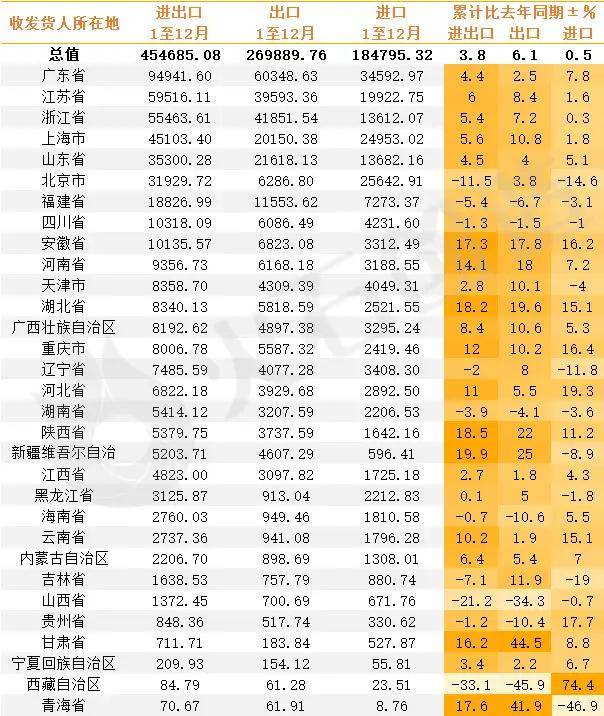
从增速看,动力源正深刻重构。安徽(+17.3%)、湖北(+18.2%)、陕西(+18.5%)、新疆 (+19.9%)等中西部省份增速全面领跑,形成一条强劲的"内陆增长带"。这不仅是产业梯度转移的结 果,更是深度融入"一带一路"、培育本土产业集群的主动作为,标志着中国外贸的地理格局正在从"单 极牵引"向"多极共振"演进。 表:2025年各地区进出口数据 | 收发货人所在地 | 进出口 | HH | 讲口 | | 累计比去年同期±% | | | --- | --- | --- | --- | --- | --- | --- | | | 1至12月 | 1至12月 | 1至12月 | 进出口 | HD | 进口 | | 总值 | 454685. 08 | 269889. 76 | 184795. 32 | 3.8 | 6.1 | 0.5 | | 广东省 | 94941.60 | 60348.63 | 34592. 97 | 4. 4 | 2. 5 | 7.8 | | 江苏省 | 59516. 11 | 39593. 36 | 19922. 75 | 6 | 8. 4 | 1.6 | | 浙江省 | 55463. 6 ...

2025年中国31省GDP预测:四川远超福建,江西第15,内蒙古第20
Sou Hu Cai Jing· 2026-01-03 22:56
Core Insights - The economic landscape of China is transitioning from a phase of "catching up" to one of "coordinated development," reflecting profound structural adjustments and strategic transformations across regions [1] Group 1: Regional Economic Performance - Sichuan leads with a GDP of 68,033.11 billion, benefiting from a fundamental shift in development momentum and its strategic position as a hub for the "Belt and Road" initiative and the Yangtze River Economic Belt [3] - Jiangxi, with a GDP of 35,838.69 billion and a growth rate of 4.78%, demonstrates the vitality of central provinces through clear industrial strategies and integration into major regional economic chains [4] - Inner Mongolia ranks 20th with a GDP of 27,141.88 billion and a low growth rate of 3.14%, highlighting the challenges faced by resource-dependent economies amid the dual carbon goals and price volatility [6] Group 2: National Economic Trends - The total predicted GDP for 2025 is 1,409,234.56 billion, with a growth rate of 4.46%, indicating a shift from simple scale competition to a focus on quality and coordination [8][10] - Regions like Tibet (8.65%), Hubei (6.09%), and Xinjiang (5.63%) are leading in growth, benefiting from policy support, industrial upgrades, and resource value enhancement [8] - The overall trend shows that central and western provinces are generally experiencing higher growth rates, reflecting the effectiveness of national regional coordination strategies [8]