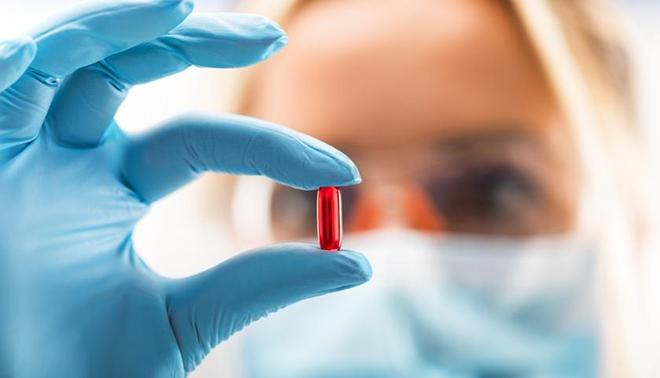
克莱罗韦单抗

Search documents
呼吸道合胞病毒进入流行期,国内多家企业布局相关药物研发
Xin Jing Bao· 2025-10-14 10:13
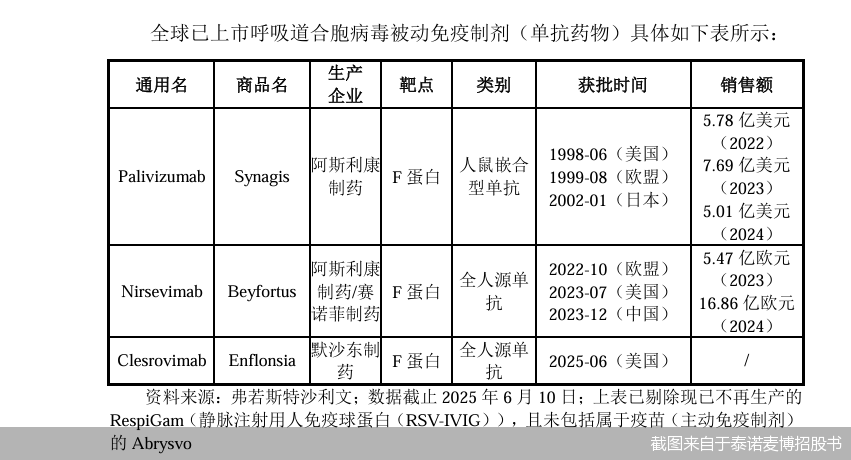
Core Insights - The respiratory syncytial virus (RSV) is currently in an epidemic phase in China, with a significant number of children being hospitalized, including cases in the ICU [1] - There is no specific treatment for RSV in infants, making prevention crucial, and several companies are developing RSV-related drugs [1][2] - The global market for passive immunization agents for RSV prevention in infants is projected to grow at a compound annual growth rate (CAGR) of 78.4% from 2024 to 2028, reaching 2.99 billion yuan [2] Drug Development Landscape - Three monoclonal antibodies (mAbs) for RSV have been approved globally: Palivizumab, Nirsevimab, and Clonabivimab, with Nirsevimab being the first long-acting mAb approved in China [3] - Six additional mAbs are in clinical trials, with TNM-001 from Zhuhai Tenomab Pharmaceutical progressing to Phase III trials [3] Vaccine Development - There are 188 RSV vaccines in development globally, with three approved: GSK's Arexvy, Pfizer's Abrysvo, and Moderna's mRESVIA, none of which are available in China yet [4] - Several Chinese companies, including Chengdu Huarenkang and Beijing Kexing Zhongwei, are actively developing RSV vaccines, with some in Phase III clinical trials [4] Innovative Drug Research - Currently, there are no approved specific treatments for RSV, but notable progress is being made in small molecule drug development [6] - Aikobaf's Qiruisuo is the first targeted RSV fusion protein inhibitor to complete Phase III trials and is recognized as a breakthrough therapy in China [6] - Shionogi's oral antiviral S-337395 is in Phase II trials and has shown promising results in reducing viral load [6] Future Outlook - The ongoing development of vaccines, monoclonal antibodies, and therapeutic drugs is expected to lead to more effective prevention and treatment options for RSV [7]

国内外药企竞相布局合胞病毒疫苗
Bei Jing Shang Bao· 2025-10-13 15:39
Core Insights - The pharmaceutical industry is actively developing and launching products for the prevention and treatment of Respiratory Syncytial Virus (RSV), with three RSV prevention drugs already approved globally, including the monoclonal antibody Nirsevimab, developed by AstraZeneca and Sanofi [1][3][4] Group 1: Market Overview - The World Health Organization (WHO) has prioritized RSV prevention products for global development [3] - The market for passive immunization agents against RSV for infants aged 0-1 in China is projected to grow at a compound annual growth rate (CAGR) of 78.4%, reaching 2.99 billion yuan by 2028, and further growing at a CAGR of 23.68% to 6.99 billion yuan by 2032 [3] Group 2: Approved Products - Three RSV prevention drugs have been approved globally: Palivizumab by MedImmune, Clonrava by Merck, and Nirsevimab by AstraZeneca and Sanofi [3][4] - Nirsevimab is the first long-acting monoclonal antibody approved for RSV prevention, with approvals from the European Medicines Agency (EMA) in 2022 and the U.S. Food and Drug Administration (FDA) in 2023, and is set to be available in China in December 2023 [4] Group 3: Pricing and Administration - Nirsevimab is priced at 2,369 yuan for infants under 5 kg and 3,677 yuan for those over 5 kg [4] - Palivizumab requires monthly injections during the RSV season, making it less suitable for widespread use due to its high cost and limited target population [4] Group 4: Ongoing Research and Development - Domestic companies are actively developing RSV-related products, with Tanomab's TNM001 injection showing significant progress in clinical trials [5][6] - TNM001 is a recombinant human monoclonal antibody targeting the RSV F protein, designed to neutralize the virus and prevent cell fusion [5] - Other companies, including RuYang Biotech and Aikobaf, are also in the clinical stages of developing RSV treatments [6]

进口单抗最高超3000一针!呼吸道合胞病毒进入高发期,国内外药企竞相布局
Bei Jing Shang Bao· 2025-10-13 12:13
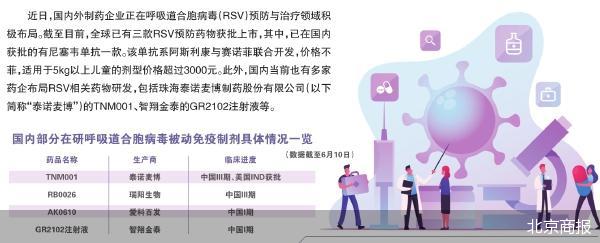
Core Insights - The Respiratory Syncytial Virus (RSV) is experiencing a surge in infections, particularly among infants and the elderly, leading to increased public health concerns and discussions on social media [1][3] - Currently, there are limited treatment options for RSV, with only one monoclonal antibody, Nirsevimab, approved for use in China, while several other pharmaceutical companies are actively developing RSV-related therapies [1][5] Industry Overview - RSV is a leading cause of respiratory infections in children under five globally, with no specific antiviral treatments available, primarily relying on symptomatic care [1][4] - The global market for passive immunization against RSV in infants is projected to grow significantly, with an estimated compound annual growth rate (CAGR) of 78.4% from 2024 to 2028, reaching approximately 2.99 billion yuan [5] Drug Development - Three RSV preventive drugs have been approved globally: Palivizumab, Nirsevimab, and Clesrovimab, with Nirsevimab being the only one currently available in China [5][6] - Nirsevimab is priced at over 3,000 yuan for children weighing over 5 kg, with two formulations available based on weight [6] - Domestic companies like TaenoMabo are developing their own RSV treatments, such as TNM001, which is currently in clinical trials [7][8] Market Demand - The demand for effective RSV prevention and treatment is expected to rise due to the increasing population of infants and the aging population in China, highlighting a significant market opportunity [8] - Companies are encouraged to focus on innovation and differentiation in drug development to meet diverse patient needs and improve drug accessibility [8]


现金状况吃紧的爱科百发再度冲击IPO
Xin Lang Cai Jing· 2025-10-09 09:02
Core Viewpoint - The innovative pharmaceutical company Aikobai has submitted a new IPO application to the Hong Kong Stock Exchange, marking its second attempt in five years, following previous rejections and withdrawals from both the Hong Kong and STAR Market listings [1][3]. Financial Summary - As of mid-2023, Aikobai reported cash and cash equivalents of less than 100 million RMB, while its R&D costs and administrative expenses were 86.138 million RMB and 19.434 million RMB, respectively, leading to a loss exceeding 100 million RMB for the period [3][4]. - The company has experienced significant losses, with a pre-tax loss of 269.799 million RMB for the year ending December 31, 2023, and a projected loss of 197.419 million RMB for the year ending December 31, 2024 [4][12]. Product Development and Market Position - Aikobai is focusing on the development of Qiruisuo Wei (齐瑞索韦), a treatment for Respiratory Syncytial Virus (RSV), which is nearing market approval after submitting a new drug application to the National Medical Products Administration [5][8]. - The global market for RSV treatments is limited, with only three approved drugs for prevention, highlighting the potential market opportunity for Qiruisuo Wei as it is the only product close to approval in this category [8][9]. Industry Context - The company’s reliance on the licensing-in model for drug development is increasingly seen as outdated, especially as domestic innovation capabilities grow [10][11]. - The overall market for RSV treatments is expected to evolve, with new vaccines being approved, which may impact the commercial prospects for Aikobai's products [8][9][13]. - The challenges faced by Aikobai reflect broader issues within the biotech sector, particularly for companies that depend heavily on licensing models and have not yet achieved profitability [13].