准备金管理购买

Search documents
美联储经济学家警告央行面临“资产负债表不可能三角”:规模、干预与利率稳定难兼顾
Zhi Tong Cai Jing· 2026-01-15 23:28
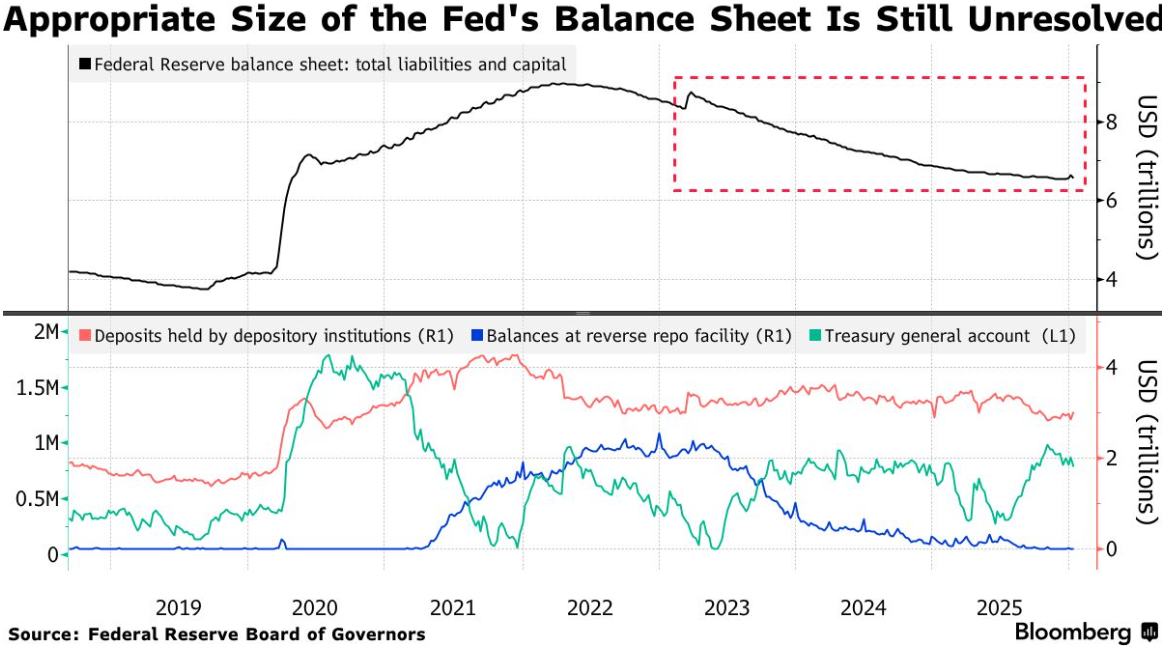
Group 1 - The Federal Reserve faces the challenge of determining the optimal size of its balance sheet after halting the reduction of its $6.5 trillion asset portfolio, balancing smaller size, low interest rate volatility, and limited market intervention [1] - The concept of the "impossible trinity" highlights that the Federal Reserve can only achieve two of three goals at a time, which stems from the financial sector's demand for reserves and the frequency of sudden changes in liquidity supply and demand [1][4] - The Federal Reserve's balance sheet expanded from approximately $800 billion nearly 20 years ago to a peak of $8.9 trillion in June 2022 due to large-scale asset purchase programs during the 2008 financial crisis and the COVID-19 pandemic [4] Group 2 - There is a divergence among central bank officials regarding how low bank reserves can be reduced to return the balance sheet to pre-crisis levels, with some advocating for the smallest possible balance sheet size [4] - The Federal Reserve's recent decision to begin "reserve management purchases" aims to maintain an adequate level of reserves in response to high money market rates [4] - The large balance sheet creates a structural impact on financial markets, providing a buffer of safe and liquid assets that prevents short-term interest rate volatility without regular Federal Reserve intervention [6] Group 3 - Operating with fewer reserves increases volatility in the money market, complicating the transmission of monetary policy, especially during unexpected shocks [6] - Policymakers may choose to tolerate some interest rate volatility at certain times, such as quarter-end reporting dates, while managing this through additional market operations and a slightly larger balance sheet [6] - The appropriate steady-state size of the balance sheet remains an open question, as economists and policymakers have yet to reach a consensus on this issue [6]