
充足准备金机制

Search documents
美联储经济学家警告央行面临“资产负债表不可能三角”:规模、干预与利率稳定难兼顾
Zhi Tong Cai Jing· 2026-01-15 23:28
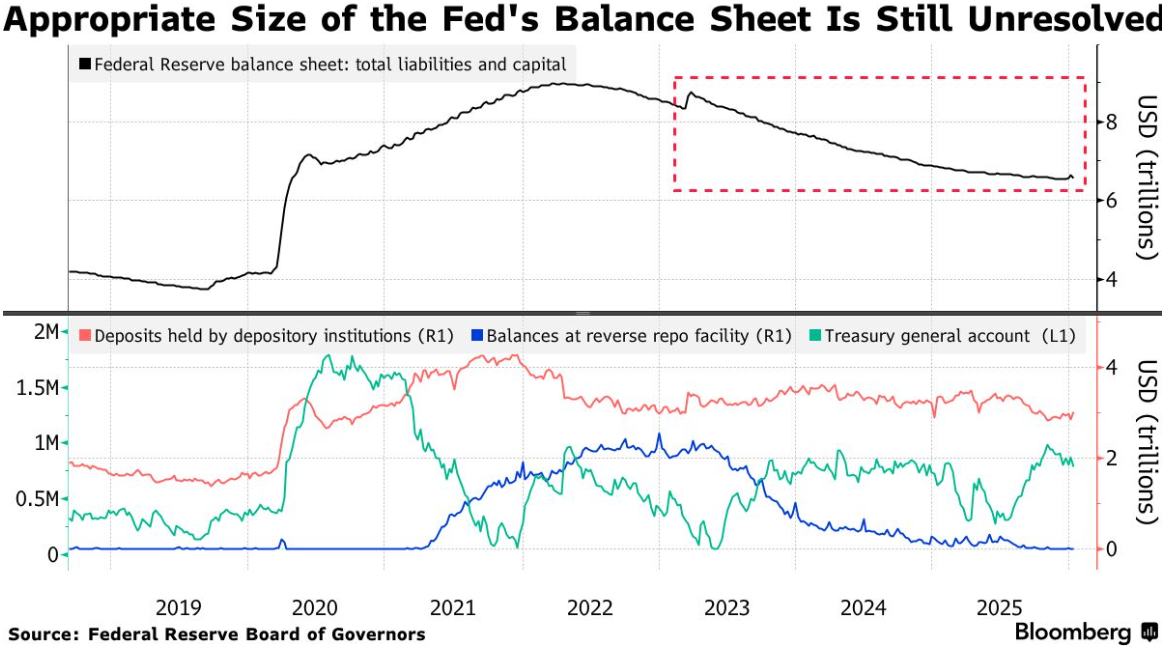
Group 1 - The Federal Reserve faces the challenge of determining the optimal size of its balance sheet after halting the reduction of its $6.5 trillion asset portfolio, balancing smaller size, low interest rate volatility, and limited market intervention [1] - The concept of the "impossible trinity" highlights that the Federal Reserve can only achieve two of three goals at a time, which stems from the financial sector's demand for reserves and the frequency of sudden changes in liquidity supply and demand [1][4] - The Federal Reserve's balance sheet expanded from approximately $800 billion nearly 20 years ago to a peak of $8.9 trillion in June 2022 due to large-scale asset purchase programs during the 2008 financial crisis and the COVID-19 pandemic [4] Group 2 - There is a divergence among central bank officials regarding how low bank reserves can be reduced to return the balance sheet to pre-crisis levels, with some advocating for the smallest possible balance sheet size [4] - The Federal Reserve's recent decision to begin "reserve management purchases" aims to maintain an adequate level of reserves in response to high money market rates [4] - The large balance sheet creates a structural impact on financial markets, providing a buffer of safe and liquid assets that prevents short-term interest rate volatility without regular Federal Reserve intervention [6] Group 3 - Operating with fewer reserves increases volatility in the money market, complicating the transmission of monetary policy, especially during unexpected shocks [6] - Policymakers may choose to tolerate some interest rate volatility at certain times, such as quarter-end reporting dates, while managing this through additional market operations and a slightly larger balance sheet [6] - The appropriate steady-state size of the balance sheet remains an open question, as economists and policymakers have yet to reach a consensus on this issue [6]

贝森特呼吁简化美联储运作机制,称其是时候退居幕后了
Jin Shi Shu Ju· 2025-11-26 05:19
Core Viewpoint - The U.S. Treasury Secretary, Yellen, emphasizes the need to simplify the Federal Reserve's complex operations during interviews for the next Fed Chair position, highlighting concerns over the current monetary policy management [1][2]. Group 1: Federal Reserve's Current Mechanism - The Federal Reserve has adopted a "sufficient reserves mechanism" to control policy rates, which requires holding a large amount of government bonds on its balance sheet [1]. - As part of this operational framework, the Fed pays interest on reserves held by banks and also pays interest on funds temporarily deposited by money market funds [1]. - The Fed decided to halt the reduction of its balance sheet starting December 1 to ensure liquidity remains "sufficient" [2]. Group 2: Tools and Operations - There are various tools and operations in place, such as the Standing Repo Facility (SRF), which allows eligible institutions to borrow cash against government and agency securities [2]. - The usage of the SRF has surged recently, reaching a record high of $50.4 billion on October 31, marking the highest since the tool became permanent in 2021 [2]. Group 3: Complexity in Policy Interactions - There is a complex interplay between monetary policy, balance sheet management, and regulatory policies, which was a recurring theme in the interviews for the Fed Chair position [3]. - The Treasury Secretary suggests that the Fed should take a step back and reduce the frequency of public statements from regional Fed presidents, indicating a need for less redundancy in communication [3]. Group 4: Regional Fed Presidents - The Treasury Secretary expresses differing opinions on certain regional Fed presidents, noting that some have been hired from outside their respective districts and do not reside in their jurisdictions [4]. - The Federal Open Market Committee (FOMC), responsible for setting interest rates, consists of 7 board members and 5 regional Fed presidents, with the New York Fed president being a permanent member [4]. - The current regional Fed presidents are due for reauthorization by the Fed Board in February, with indications that some may resign [4].