资产负债表不可能三角

Search documents
东海证券晨会纪要-20260323
Donghai Securities· 2026-03-23 02:26
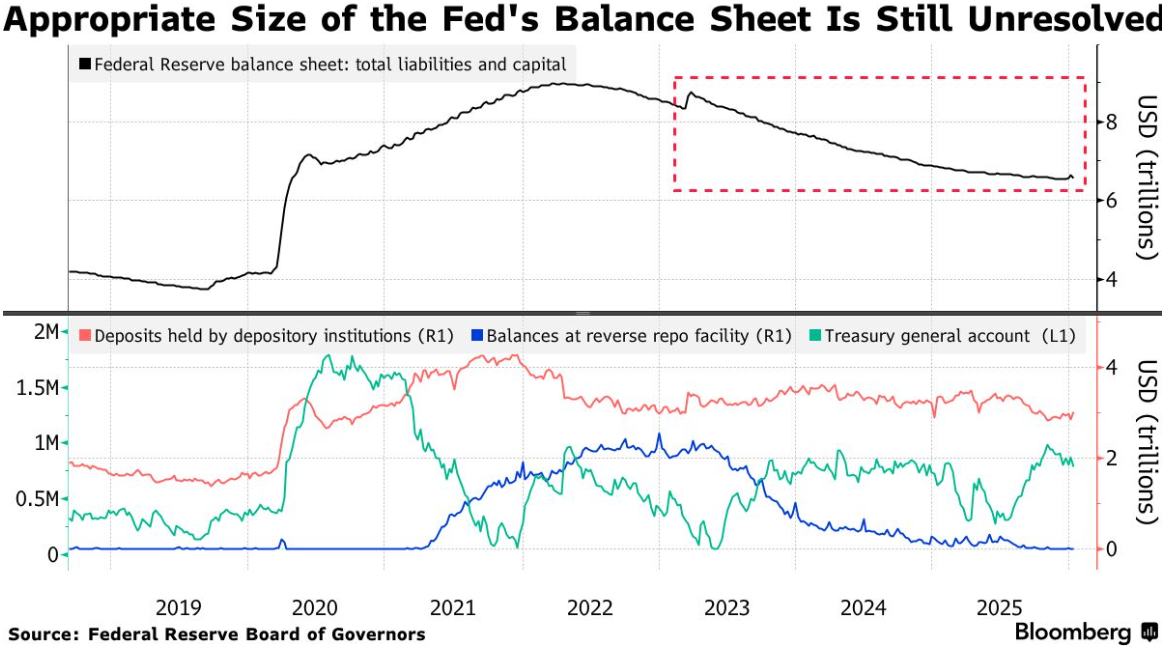
Group 1: Key Recommendations - The report provides a comprehensive analysis of the "Wash Path" in the context of the U.S. reserve framework, highlighting the transition from a scarce reserve framework to an ample reserve framework post-2008 financial crisis [5][6][7] - The "Wash Path" aims to return to a scarce reserve framework, allowing the Federal Reserve to control reserve supply through open market operations, thus flexibly managing the federal funds rate [7][8] - The report outlines a three-step process under the "Wash Path": interest rate cuts, easing bank regulations, and balance sheet reduction, with a focus on promoting technological advancements and increasing bank lending [8][10] Group 2: Market Overview - Global equity markets experienced a general decline, while Hong Kong stocks rose; major commodity futures such as gold, oil, aluminum, and copper saw price drops [11] - The report notes a significant supply gap in the oil market, potentially exceeding 10 million barrels per day, due to ongoing tensions in the Middle East, which could impact downstream demand for other commodities [12] - The domestic equity market showed mixed performance, with financial and consumer sectors leading, while the industrial sector faced declines; the average daily trading volume was 21,972 billion yuan [12][19] Group 3: Economic Indicators - The latest Loan Prime Rate (LPR) remained unchanged for ten consecutive months, with the one-year LPR at 3.00% and the five-year LPR at 3.50% [15] - The report highlights the People's Bank of China's commitment to maintaining a moderately loose monetary policy to ensure liquidity and balance between short-term and long-term economic health [16] - The report indicates that the U.S. Treasury yields have shown upward trends, with the 2-year yield rising to 3.88% and the 10-year yield to 4.39% [24]
美联储专题深度研究:从美国准备金框架对“沃什路径”的全景扫描
Donghai Securities· 2026-03-22 14:24
Group 1: Monetary Policy Framework Evolution - Before the 2008 financial crisis, the U.S. operated under a scarce reserve framework, primarily using open market operations to manage liquidity, with the discount rate as the upper limit of the interest rate corridor[2] - Post-2008, the Federal Reserve adopted a plentiful reserve framework, significantly increasing reserve supply through quantitative easing (QE), which rendered previous interest rate control methods ineffective[2] - The introduction of the Interest On Excess Reserves (IOER) in 2008 established a theoretical lower bound for interest rates, but it failed to constrain the Federal Funds Rate (FFR) due to excess liquidity in the market[2] Group 2: "Warsh Path" and Its Implications - The "Warsh Path" aims to revert to a scarce reserve framework by reducing the Fed's balance sheet, which would decrease bank reserves and allow for more effective open market operations to control the FFR[2] - The proposed three-step process under the "Warsh Path" includes: lowering interest rates, relaxing bank regulations, and then reducing the balance sheet[2] - The potential impact of the "Warsh Path" includes a focus on maintaining a small balance sheet, low interest rate volatility, and limited market intervention, which may lead to increased volatility in asset prices[2] Group 3: Risks and Market Dynamics - Relaxing bank regulations could increase operational risks for regional banks, particularly if the balance sheet reduction exceeds expectations, complicating liquidity support efforts[2] - The current liquidity conditions indicate that the U.S. remains in a relatively tight liquidity environment, with the need for careful monitoring of market dynamics as the Fed considers policy adjustments[2] - The expected reduction in reserves could require the Fed to withdraw approximately $520 billion, representing about 17.3% of the current reserve size, to achieve a return to a scarce liquidity state[2]
美联储经济学家警告央行面临“资产负债表不可能三角”:规模、干预与利率稳定难兼顾
Zhi Tong Cai Jing· 2026-01-15 23:28
Group 1 - The Federal Reserve faces the challenge of determining the optimal size of its balance sheet after halting the reduction of its $6.5 trillion asset portfolio, balancing smaller size, low interest rate volatility, and limited market intervention [1] - The concept of the "impossible trinity" highlights that the Federal Reserve can only achieve two of three goals at a time, which stems from the financial sector's demand for reserves and the frequency of sudden changes in liquidity supply and demand [1][4] - The Federal Reserve's balance sheet expanded from approximately $800 billion nearly 20 years ago to a peak of $8.9 trillion in June 2022 due to large-scale asset purchase programs during the 2008 financial crisis and the COVID-19 pandemic [4] Group 2 - There is a divergence among central bank officials regarding how low bank reserves can be reduced to return the balance sheet to pre-crisis levels, with some advocating for the smallest possible balance sheet size [4] - The Federal Reserve's recent decision to begin "reserve management purchases" aims to maintain an adequate level of reserves in response to high money market rates [4] - The large balance sheet creates a structural impact on financial markets, providing a buffer of safe and liquid assets that prevents short-term interest rate volatility without regular Federal Reserve intervention [6] Group 3 - Operating with fewer reserves increases volatility in the money market, complicating the transmission of monetary policy, especially during unexpected shocks [6] - Policymakers may choose to tolerate some interest rate volatility at certain times, such as quarter-end reporting dates, while managing this through additional market operations and a slightly larger balance sheet [6] - The appropriate steady-state size of the balance sheet remains an open question, as economists and policymakers have yet to reach a consensus on this issue [6]