创业板主题ETF

Search documents
【金工】被动资金显著加仓大盘宽基ETF,国防军工主题基金表现占优——基金市场与ESG产品周报20251215(祁嫣然/马元心)
光大证券研究· 2025-12-16 23:03
Market Performance Overview - The domestic equity market showed mixed performance during the week of December 8 to December 12, 2025, with the ChiNext Index rising by 2.74% [4] - In terms of sectors, telecommunications, national defense and military industry, and electronics sectors led the gains, while coal, oil and petrochemicals, and steel sectors experienced the largest declines [4] Fund Product Issuance - A total of 28 new funds were established in the domestic market this week, with a combined issuance of 18.218 billion units. This includes 9 bond funds, 10 stock funds, 4 FOF funds, 3 mixed funds, 1 international (QDII) fund, and 1 money market fund [5] - Overall, 38 new funds were issued across the market, categorized as 13 stock funds, 8 FOF funds, 8 bond funds, 8 mixed funds, and 1 international (QDII) fund [5] Fund Product Performance Tracking - The defense and military industry theme funds outperformed this week, while cyclical theme funds saw a net value correction. As of December 12, 2025, the net value changes for various theme funds were as follows: defense and military industry (3.39%), TMT (3.17%), industry balanced (1.08%), industry rotation (0.50%), new energy (0.12%), pharmaceuticals (-0.42%), financial real estate (-0.66%), consumption (-0.67%), and cyclical (-1.12%) [6] ETF Market Tracking - Stock ETFs experienced a slight outflow of funds this week, primarily from TMT, financial real estate, and ChiNext theme ETFs, while large-cap broad-based ETFs saw significant inflows from passive funds. Hong Kong stock ETFs also experienced notable inflows [7] - The median return for stock ETFs this week was 0.19%, with a net outflow of 2.974 billion yuan. In contrast, Hong Kong stock ETFs had a median return of -1.42% and a net inflow of 8.865 billion yuan. Cross-border ETFs had a median return of -0.11% with a net inflow of 1.115 billion yuan, while commodity ETFs had a median return of 0.81% and a net inflow of 241 million yuan [7] Broad-based ETF Insights - Broad-based ETFs saw a significant net inflow of 9.058 billion yuan this week. Additionally, the new energy theme ETFs also experienced notable net inflows totaling 778 million yuan [8] ESG Financial Products Tracking - This week, 28 new green bonds were issued, with a total issuance scale of 29.152 billion yuan. The domestic green bond market has steadily developed, with a cumulative issuance scale of 5.12 trillion yuan and a total of 4,396 bonds issued as of December 12, 2025 [8] - As of December 12, 2025, there were 211 ESG funds in the domestic market, with a total scale of 150.981 billion yuan. The median net value changes for various ESG fund types this week were as follows: active equity funds (0.60%), passive stock index funds (-0.01%), and bond funds (0.05%). Funds focused on low-carbon economy, carbon neutrality, and social responsibility performed well [8]


为什么没人愿意认购ETF了?
Sou Hu Cai Jing· 2025-05-15 12:05
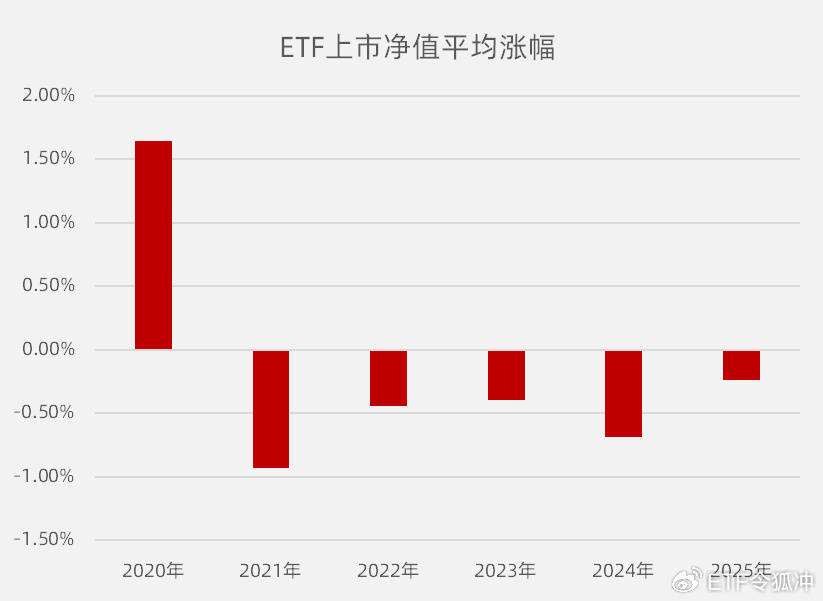
Core Viewpoint - The article discusses the challenges faced by financial institutions in Taiwan and mainland China regarding the practice of "self-funding" to meet ETF sales targets, highlighting the negative returns associated with this practice in recent years [1][2][3]. Group 1: Self-Funding and Negative Returns - The phenomenon of "self-funding" exists across various industries, but negative expected returns in the fund industry are rare [3]. - For example, newly launched stock ETFs in 2020 had an average net value increase of approximately 1.5% from establishment to listing, allowing managers to lock in profits through market transactions [5]. - However, by 2021, self-funding behavior began to yield negative returns, with an average net value performance of -1% for self-funded ETF subscriptions [6]. - In some cases, such as a specific startup board ETF, losses could exceed 10% by the time of listing [8]. Group 2: Accelerated Construction Periods - The article notes that the construction period for ETFs has significantly decreased, from an average of 28 days in 2020 to just 11 days by 2025 [12]. - This rapid construction leaves fund managers with limited opportunities for market timing, leading to a mechanical approach to building positions [13][19]. - The average construction time for ETFs has remained under 15 days from 2021 to 2025, making it challenging for managers to find suitable entry points [18]. Group 3: Successful Timing by Fund Managers - Data shows that certain fund managers have successfully timed their ETF launches, resulting in significant profits for initial investors [20]. - For instance, the "Chip ETF Leader" managed by GF Fund earned nearly 386 million yuan for its initial subscribers [21]. - The timing of these successful launches often coincided with favorable market conditions, such as the semiconductor industry's growth during the trade war [23]. Group 4: Investor Experience and Fund Management - The article emphasizes that while ETF products are primarily tools for market participation, the experience of initial investors is crucial [28]. - It suggests that fund managers should consider the timing of product issuance and the length of the construction period to enhance investor returns [29].