北交所ETF

Search documents
突破10000亿,2026年布局思路来了
Zhong Guo Ji Jin Bao· 2025-11-23 22:55
Core Viewpoint - The public fund issuance market in China has surpassed 1 trillion yuan for the seventh consecutive year, with equity funds becoming the main force, accounting for over 50% of the issuance [1][2][4]. Fund Issuance Scale - The total new fund issuance for the year has reached 10,727.76 billion yuan, indicating a strong market performance [2][7]. - The trend of maintaining a 1 trillion yuan issuance scale is expected to become the norm due to the long-term shift of residents' assets towards financial assets [7][8]. Product Structure - Equity funds (including stock and mixed funds) have overtaken bond funds, with their issuance share dropping from over 70% to 40% [4][5]. - The growth of passive index products, particularly ETFs, has contributed significantly to the increase in equity fund issuance [4][9]. Market Drivers - The strong performance of the A-share market and favorable economic data have boosted investor confidence and profitability expectations [2][3]. - Policy support for equity fund development and the optimization of issuance mechanisms have enhanced market efficiency [2][3]. Future Outlook - The trend of equity fund dominance is likely to continue, supported by regulatory policies and the development of innovative products [6][11]. - The public fund industry is expected to innovate further, with new products like credit bond ETFs and floating rate funds emerging [9][10]. Investment Strategy - Fund companies are focusing on diverse product offerings to meet the varying needs of institutional and individual investors [17][18]. - The emphasis on long-term stable returns and the development of customized products for different investor profiles is becoming a key strategy [17][21].
专精特新指数带来哪些投资机会
Jing Ji Ri Bao· 2025-06-15 22:07
Core Viewpoint - The Beijing Stock Exchange (BSE) will officially launch the Bei Zheng Specialized and Innovative Index on June 30, 2025, to provide multi-dimensional investment targets and performance benchmarks for the market [1][2]. Group 1: Index and Market Overview - The Bei Zheng Specialized and Innovative Index will select the top 50 largest companies from the BSE's "little giant" firms after liquidity screening, reflecting the overall performance of specialized and innovative listed companies [1]. - As of May 30, the BSE has gathered 138 specialized and innovative "little giant" enterprises with a total market capitalization of 423.693 billion yuan, accounting for 53.25% of the BSE's total market value [1]. - The selected sample companies for the index have shown significant growth and innovation, with a total R&D investment of 1.79 billion yuan in 2024, representing 5.6% of their operating revenue, and an average annual compound growth rate of 10.4% in operating revenue over the past three years [1]. Group 2: Importance and Future Developments - The Bei Zheng Specialized and Innovative Index is a significant addition to the BSE's market indices, following the Bei Zheng 50 Index, and aims to enhance the observation dimensions for investors [2]. - The index emphasizes the importance of liquidity for listed companies, encouraging them to focus on their market activity and liquidity [2]. - The BSE plans to continue improving its index system and introduce more specialized indices to meet diverse investment needs [2]. Group 3: Investment Opportunities - The combination of the Bei Zheng Specialized and Innovative Index with the Bei Zheng 50 Index provides greater reference value for potential investment opportunities [3]. - Investors are advised to consider companies that may enter both indices for early investment opportunities, taking into account their semi-annual reports, transaction amounts, and market capitalization [3]. - The BSE is in the process of developing exchange-traded funds (ETFs) that track its indices, which will further facilitate passive investment strategies [3]. Group 4: Market Expansion - The BSE is experiencing high-quality expansion, with 145 companies listed on the New Third Board in the first five months of this year, a year-on-year increase of 49.48% [4]. - Among these new listings, 68 companies are specialized and innovative enterprises, making up 47% of the total [4]. - The average operating revenue of newly listed companies in 2024 is projected to exceed 1 billion yuan, with an average net profit of 65.97 million yuan [4].
北交所ETF将落地?业内寄望!
Zheng Quan Shi Bao Wang· 2025-03-16 07:09
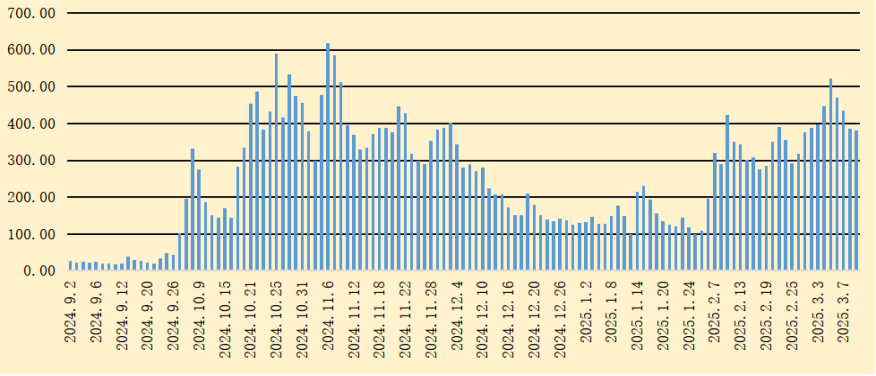
Core Viewpoint - The launch of North Exchange (北交所) ETFs is anticipated to accelerate, potentially debuting in Q3 of this year, supported by favorable policies and improving market liquidity [1][2][3]. Group 1: Market Activity and Performance - As of the end of 2024, there are 264 companies listed on the North Exchange, with a total revenue of 178.46 billion yuan in 2024, reflecting a year-on-year growth of 7.81% [2]. - The North Exchange stock market became active after September 24, 2024, with peak daily trading volumes reaching 61.7 billion yuan, and average trading volumes around 40 billion yuan since March 2025 [1][4][5]. - The proportion of North Exchange stock trading volume relative to the total trading volume of the Shanghai and Shenzhen exchanges has significantly increased, stabilizing above 2% since the beginning of this year [5][6]. Group 2: ETF Development and Regulatory Support - The North Exchange has received substantial policy support since its inception, including the introduction of the North 50 Index, which laid the groundwork for passive index fund investments [3][4]. - The China Securities Regulatory Commission (CSRC) has emphasized the need to enrich the product system and expand index investment, including the development of ETFs and other investment vehicles [3][4]. - The recent government directives aim to enhance the proportion of equity public funds and establish a fast-track approval process for ETFs, indicating a strong push for index investment development [3][4]. Group 3: Challenges and Considerations - Industry experts highlight the necessity of sufficient market liquidity to support the launch and trading of ETFs, with concerns about potential liquidity risks affecting normal operations [4][7]. - The current regulatory environment imposes high qualification requirements for investors in North Exchange stocks, which may evolve as the market matures [8]. - There are ongoing discussions regarding the technical aspects of ETF implementation, including market-making systems and the potential need for adjustments in investor qualifications to enhance trading activity [6][8].