指数化投资

Search documents
精彩观点|中信证券第十四届金融衍生品与量化策略研讨会(上)
Xin Lang Cai Jing· 2026-04-01 03:09
Group 1: Seminar Overview - The 14th Financial Derivatives and Quantitative Strategy Seminar hosted by CITIC Securities took place in Wuhan, Hubei from March 26 to 27, focusing on "Allocation Strategies and Wealth Allocation Solutions" and "Recent Advances and Practices in Quantitative Investment Techniques" [1] Group 2: Allocation Strategies and Wealth Allocation Solutions - The forum featured notable guests including Zhao Yonggang, General Manager of the Research and Development Department at China Securities Index Co., and Xiong Jun, former Deputy Director of the Planning and Research Department of the National Social Security Fund [2] - Analysts from CITIC Securities, including Liu Xiaotian and Tang Dongguo, presented insights on allocation strategies [2] Group 3: Trends in Index Investment - By the end of 2025, the global ETF market is projected to reach $19.85 trillion, with a net inflow of approximately $1.87 trillion for the year, driven by increased recommendations from buy-side advisors and the cost advantages of index products [3] - The average fee for index products is only one-sixth that of active products, with superior long-term performance [3] - In China, the total scale of index investment is expected to exceed 7.2 trillion yuan by the end of 2025, with ETFs surpassing 6 trillion yuan, leading in Asia [4] Group 4: Development of Multi-Asset Indices - The shift towards multi-asset allocation is becoming essential due to frequent asset rotation and low interest rates, with over 80 multi-asset indices already issued domestically [6] - The transition from basic passive tracking to strategic, actively managed, and multi-asset allocation solutions is underway [6] Group 5: Dynamic Asset Allocation Framework - Dynamic asset allocation is not an independent investment behavior but is anchored by long-term asset allocation, aiming to adjust asset proportions in response to macroeconomic changes [7] - The methodology involves mapping macro variables to asset index trends, focusing on short-term and medium-term predictions [8] Group 6: Wealth Management Market Growth - The domestic wealth management market has been growing steadily, with an average annual growth rate of 10% to 15% over the past decade, potentially reaching 300 trillion yuan by 2025 [13] - The demand for allocation products is expected to rise as risk-free returns decline and investor acceptance of allocation strategies increases [13] Group 7: "Fixed Income+" Product Development - The "Fixed Income+" products are anticipated to see significant growth in 2025 due to strong demand from both institutional and individual investors in a low-interest-rate environment [18] - The relative performance of assets is also favorable for "Fixed Income+" investments, enhancing their appeal compared to pure bond products [18] Group 8: Quantitative Fund Growth - By the end of 2025, the total scale of public quantitative funds is estimated to be around 420 billion yuan, with significant growth in index-enhanced and quantitative stock selection funds [21] - The private equity quantitative fund industry is projected to reach 7.55 trillion yuan, with quantitative managers accounting for 36% of the industry [21] Group 9: Tactical Asset Allocation Insights - The tactical asset allocation framework incorporates high-frequency macro factors to adjust asset weights based on market conditions, with a focus on growth and inflation factors [23] - Recent adjustments have favored bond assets while reducing exposure to equity assets, indicating a strategic shift in asset allocation [24]



中信证券(600030):综合实力强劲的龙头券商
Hua Yuan Zheng Quan· 2026-03-17 07:11
Investment Rating - The report assigns a "Buy" rating for the company, indicating strong confidence in its performance and growth potential [5][7]. Core Insights - The company is positioned as a leading securities firm, benefiting from policies aimed at creating "carrier-level securities firms" and increasing industry concentration [6][9]. - The company has demonstrated strong strategic foresight, actively enhancing core capabilities during market upturns and pursuing business integration during downturns [6][9]. - The company has a comprehensive financial service platform, covering a wide range of products and services, and maintains a leading position in investment banking, asset management, and wealth management [6][9]. Financial Performance and Forecast - Revenue and profit forecasts for the company are as follows: - Revenue (in million RMB): 60,068 in 2023, 63,789 in 2024, 74,829 in 2025E, 84,450 in 2026E, and 98,770 in 2027E, with growth rates of -7.7%, 6.2%, 17.3%, 12.9%, and 17.0% respectively [5]. - Net profit (in million RMB): 19,721 in 2023, 21,704 in 2024, 30,054 in 2025E, 33,761 in 2026E, and 39,876 in 2027E, with growth rates of 1.0%, 10.1%, 38.5%, 12.3%, and 18.1% respectively [5]. - Earnings per share (in RMB): 1.33 in 2023, 1.46 in 2024, 2.03 in 2025E, 2.28 in 2026E, and 2.69 in 2027E [5]. Business Segments Overview - Brokerage Business: The company expects a significant increase in brokerage income due to a rise in market trading activity, with projected growth rates of 35%, 11%, and 8% for 2025-2027 [8][30]. - Investment Banking: The company anticipates a recovery in investment banking revenues, with expected growth rates of 18%, 25%, and 15% for 2025-2027 [8][30]. - Proprietary Trading: The company projects a strong performance in proprietary trading, with expected investment income growth of 61%, 2%, and 20% for 2025-2027 [8][30]. - Asset Management: The asset management segment is expected to grow by 13%, 25%, and 15% for 2025-2027, benefiting from favorable market conditions and the growth of passive investment strategies [8][30]. Competitive Positioning - The company maintains a strong competitive position, with its total assets, revenue, and net profit consistently ranking first in the industry [13][20]. - The company has a diversified business structure, with significant contributions from brokerage, investment banking, asset management, and proprietary trading [30][64]. - The company has established a robust international presence, with overseas business contributing significantly to its growth [6][25].
小白初上路:一个真实的攻守平衡案例
雪球· 2026-03-14 04:46
Core Viewpoint - The article discusses a case study of a novice investor's portfolio, highlighting the importance of systematic asset allocation in the current low-interest-rate environment, where index investing has become a common choice [4]. Defensive Players - The investor selected the CSI Dividend Index as a defensive player, which is a stable single-factor index focusing on dividends, despite lacking more attractive factors [7]. - Other defensive strategies include dividend, low volatility, value, fundamental, and cash flow strategies, with various indices available for selection [9]. - It is emphasized that defensive indices cannot replace the role of bonds or money market funds in a multi-asset allocation [10]. Midfield Players - The investor chose the CSI A500 as a core broad-based index, which offers a more balanced distribution across industries, sizes, and styles compared to the CSI 300 [11]. - The CSI 500 was also included to enhance the allocation of mid-cap companies, providing further style rebalancing [12]. - A diverse selection of core broad-based indices is suggested, including the CSI 50, CSI 100, CSI 800, and global indices like the Hang Seng Index and S&P 500, to improve overall portfolio diversification [12][13]. Offensive Players - The investor opted for the ChiNext 50, which represents leading companies in China's technology innovation sector, providing a balanced exposure to both the ChiNext and Sci-Tech boards [14]. - For those looking to expand their offensive strategy, options include the Nasdaq 100, Hang Seng Tech, and various thematic or sector indices [15][16]. Conclusion - The portfolio represents a well-structured approach for novice investors, combining simplicity and effectiveness, demonstrating that a straightforward strategy can be beneficial for long-term investment [17]. - Additionally, the inclusion of a small allocation to oil indices lays the groundwork for future multi-asset diversification [18].

【银行理财】银行理财大事记:监管出手整治“收益打榜”,理财公司加速业绩基准“换锚”——2026年2月银行理财市场月报
华宝财富魔方· 2026-03-13 09:15
Regulatory and Industry Dynamics - The regulatory authorities have taken action to address the "yield ranking" phenomenon in the wealth management sector, penalizing related institutions to correct distorted behaviors driven by short-term performance competition, shifting focus towards long-term investment research and service capability development [3][5] - Major wealth management companies, including Xingyin, Puyin, and Zhaoyin, are actively promoting a transition from traditional fixed-value benchmarks to more market-linked and explainable benchmarks, such as market interest rates or index-linked benchmarks, in response to new regulations and the low interest rate environment [3][6] Market Trends and Performance - As of February, the total outstanding scale of wealth management products reached 31.65 trillion yuan, reflecting a month-on-month increase of 0.34% and a year-on-year increase of 5.35%. The market is characterized by a seasonal pattern of "quarter-end contraction and quarter-beginning recovery" due to regulatory requirements [4][9] - The average annualized yield for cash management products recorded 1.28%, a decrease of 0.06 basis points month-on-month, while pure fixed-income products saw an annualized yield of 2.30%, down by 0.38 percentage points [4][11] New Product Launches and Innovations - In February, new product issuance by wealth management companies decreased, but the product spectrum remains dominated by fixed-income plus products, closed-end products, and 1-3 year term products. The performance benchmarks for newly issued products generally continued to decline [4][8] - Ningyin Wealth Management successfully participated in the IPO of "Electric Science Blue Sky," marking a significant move into the commercial aerospace sector, while Suyin Wealth Management launched the "Arbitrage+" series of products, upgrading arbitrage as a core strategy to capture pricing discrepancies in the market [3][7] Product Characteristics and Strategies - The closed-end product compliance rate reached 87.41%, while the open-end product compliance rate was 69.49%, indicating a slight improvement in product performance standards [5][8] - Wealth management companies are increasingly focusing on alternative asset allocations, with Zhongyou Wealth Management successfully investing in a real estate ABS project backed by power battery charging rights, aiming for stable cash flow from equity assets [3][7]

2025年中国ETF市场资金流全景——规模屡创新高,资金流结构更趋均衡
Morningstar晨星· 2026-03-12 01:05
Core Insights - The Chinese ETF market experienced explosive growth in 2025, surpassing 5 trillion yuan in assets under management, making it the largest ETF market in Asia, overtaking Japan [1][4] - The total net inflow of funds into the ETF market was approximately 1.38 trillion yuan, slightly down from the peak of 1.43 trillion yuan in 2024 [1][6] - By the end of 2025, the total assets under management for ETFs reached about 5.85 trillion yuan, with 1,375 products available, including 1,305 equity ETFs, 53 bond ETFs, and 17 commodity ETFs [1][4] ETF Market Development Overview - The asset management scale of equity ETFs reached approximately 4.77 trillion yuan by the end of 2025, marking a 44% year-on-year increase [4] - Bond ETFs saw a significant surge, with assets growing from 180 billion yuan at the end of 2024 to 829.2 billion yuan by the end of 2025, increasing their market share from 5% to 14% [5] - Commodity ETFs, primarily driven by soaring gold prices, saw their assets rise from 761 million yuan at the end of 2024 to 2.51 billion yuan by the end of 2025 [5] Fund Flow Analysis - In 2025, bond ETFs became the largest asset category for net inflows, achieving a net inflow of 642.1 billion yuan, surpassing equity ETFs which had a net inflow of 619.5 billion yuan [6] - The total net inflow for the ETF market exceeded 1 trillion yuan, supported by policy initiatives and favorable market conditions [6] - The rapid growth of bond ETFs was attributed to the issuance of 32 new credit bond ETFs, which significantly boosted their market presence [6][12] New Product Overview - A record 363 new ETFs were launched in 2025, with 331 being equity ETFs and 32 bond ETFs, marking the highest number of new launches in history [10] - The number of ETFs that were liquidated was notably low, with only 7 funds being closed, all of which were equity ETFs [10] - The majority of new bond ETFs were credit bond ETFs, which attracted substantial capital inflows, accounting for over 70% of the total funds raised from new products [12] Competitive Landscape - The top 20 ETF products in 2025 included new entrants from the Hong Kong stock and credit bond categories, reflecting a more balanced inflow of funds across different product types [25] - Major ETF providers like Huaxia Fund, E Fund, and Huatai-PB maintained their positions at the top, but the market saw a shift towards more diversified fund flows [27] - The market concentration among the top three ETF providers decreased from 48.4% to 42.1%, indicating a trend towards increased competition and diversification in the ETF market [27][28]

中证指数“上新”构建跨境配置新坐标
Zheng Quan Ri Bao· 2026-02-27 16:10
Core Insights - The launch of the CSI Hong Kong Stock Connect Robotics Theme Index and the CSI US Stock 30 Index marks a significant step in the globalization and diversification of index investment in China, providing investors with new opportunities in cutting-edge technology and global market participation [1][2]. Group 1: CSI Hong Kong Stock Connect Robotics Theme Index - The index selects 30 companies from the Hong Kong Stock Connect that cover robotics, core components, intelligent algorithms, and computing power, including industry leaders like Midea Group and BYD Electronics, as well as tech firms like Tencent and SMIC [2]. - The introduction of this index serves as a precise guide for investors to strategically allocate resources within the "robotics matrix" in Hong Kong, establishing a "value coordinate" for the robotics industry and directing funds towards companies with core technologies [2][3]. Group 2: CSI US Stock 30 Index - The CSI US Stock 30 Index targets 30 large-cap, liquid stocks listed on the NYSE and NASDAQ, including globally recognized companies such as Apple, Tesla, and Netflix, reflecting China's deepening capital market openness [2]. - This index allows domestic investors to access global markets through qualified domestic institutional investor channels, promoting a rational long-term investment philosophy [2]. Group 3: Market Impact and Future Directions - The simultaneous launch of these indices enhances the index matrix covering A-shares, Hong Kong stocks, and US stocks, creating a complementary investment landscape that balances emerging industries with core assets from mature markets [3]. - To maximize the effectiveness of these indices, the market should expedite the introduction of linked ETFs and flexible adjustment mechanisms in index compilation to adapt to rapid technological changes and market volatility, thereby supporting a virtuous cycle of "technology-capital-industry" for high-quality economic development in China [3].

A股重要指数,调样在即
Zhong Guo Zheng Quan Bao· 2026-02-27 14:56
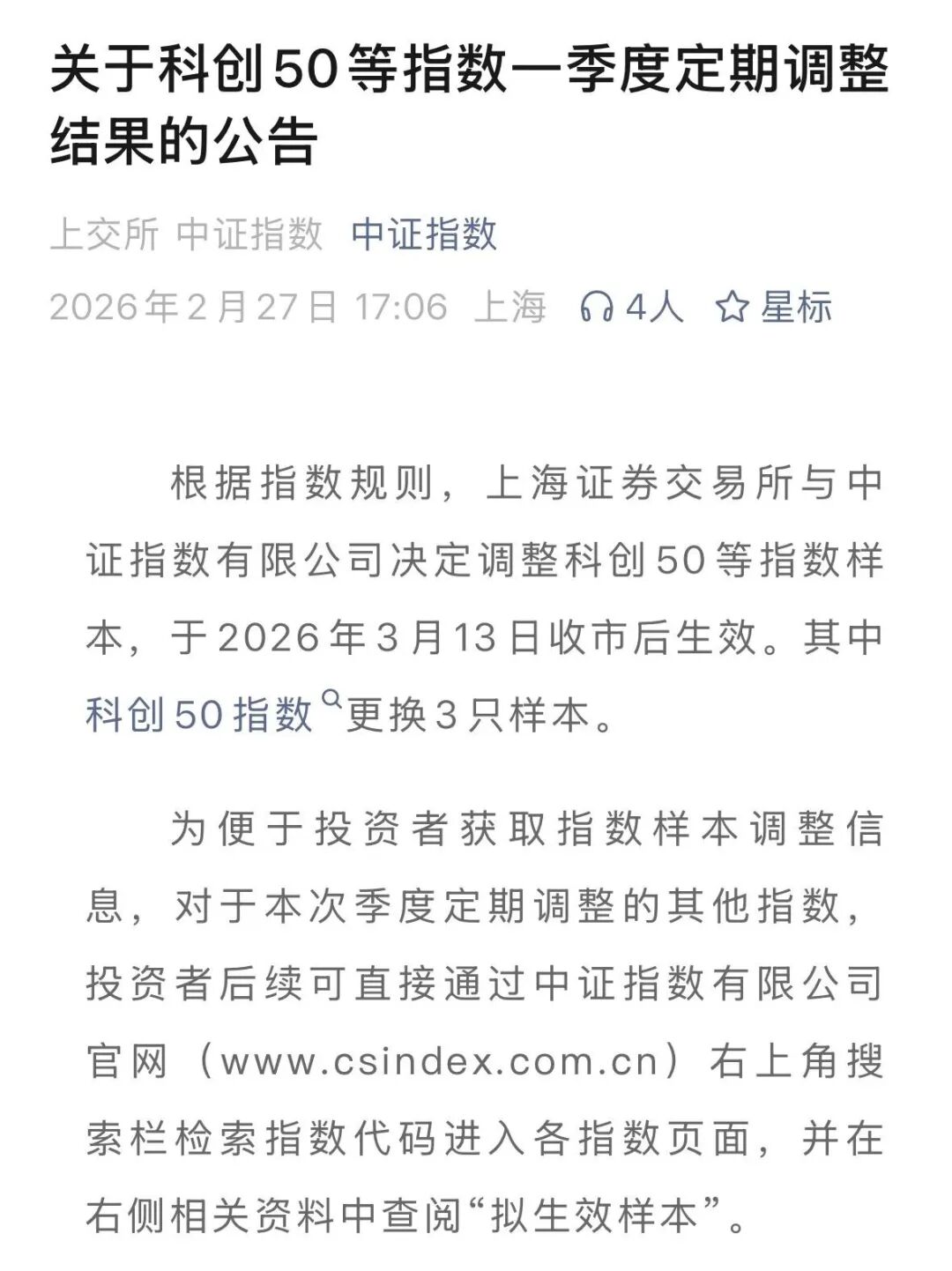
Group 1 - The core viewpoint of the news is the periodic adjustment of the sample stocks in the Sci-Tech Innovation Board indices, which enhances the representativeness of the indices and supports the development of new productivity in China [2][3]. - After the adjustment, the total market capitalization coverage of the Sci-Tech 50 Index and the Sci-Tech 100 Index over the entire Sci-Tech Board increased to 63%, up by 1.1% from before the adjustment [2]. - The adjustment allows for an orderly exchange of sample stocks between the Sci-Tech 50 Index and the Sci-Tech 100 Index, with the former incorporating stocks from the latter, thereby enhancing the representation of large and medium-cap securities on the Sci-Tech Board [3]. Group 2 - The Sci-Tech 50 Index saw an approximate 2% increase in the weight of the new generation information technology sector, while the Sci-Tech 100 Index experienced a 4% increase in sectors such as new materials and biomedicine [3]. - The Shanghai Stock Exchange is continuously improving its index system to enhance quality and diversity, which supports long-term capital inflow and aligns with national strategic goals [3]. - As of February 27, the Sci-Tech 50 Index, Sci-Tech 100 Index, and North Exchange 50 Index have recorded increases of 10.7%, 14.22%, and 6.71% respectively since the beginning of the year [5][6]. Group 3 - The adjustment of indices is part of a routine process, reflecting the ongoing trend of index-based investment in the A-share market, which is gaining momentum [7]. - The overall improvement in the quality of listed companies and the favorable economic conditions are seen as strong support for the development of domestic indices and index investment [7].
银行理财周度跟踪(2026.2.9-2026.2.22):监管整治“收益打榜”,理财行业或告别短期业绩竞争-20260225
HWABAO SECURITIES· 2026-02-25 11:32
Investment Rating - The report does not explicitly provide an investment rating for the banking wealth management industry [2]. Core Insights - Regulatory actions in February 2026 target the "yield ranking" practices in the banking wealth management sector, indicating a shift away from short-term performance competition [3][11]. - The emergence of "yield ranking" practices is attributed to investor expectations for "high returns and low volatility," which are reinforced by the performance-based assessment mechanisms of wealth management companies [12]. - The report highlights the need for wealth management firms to transition towards research and service-oriented models, moving away from short-term yield chasing [12]. Summary by Sections Regulatory and Industry Dynamics - In February 2026, regulatory scrutiny on "yield ranking" practices led to penalties for two wealth management companies, emphasizing the need for compliance and ethical practices [3][11]. - The report discusses the detrimental effects of "yield ranking" on investor interests and the overall market, suggesting that such practices undermine long-term investment strategies and trust in the industry [12]. Innovations in the Industry - Zhongyou Wealth Management successfully invested in a green asset-backed securities project, marking a significant innovation in the industry [13]. - BOC Wealth Management and China Chengxin Index jointly launched two strategy indices aimed at enhancing investment strategies and risk management [15]. Yield Performance - For the week ending February 15, 2026, cash management products recorded an annualized yield of 1.28%, remaining stable, while money market funds saw a slight increase to 1.19% [17]. - The following week, cash management products yielded 1.26%, a decrease of 2 basis points, while money market funds dropped to 1.14%, down 5 basis points [17]. Net Asset Value Tracking - The report indicates that the net asset value (NAV) ratio for banking wealth management products was 0.41% for the week before the Spring Festival, reflecting a decrease of 0.53 percentage points [26][27].
【银行理财】监管整治“收益打榜”,理财行业或告别短期业绩竞争——银行理财周度跟踪(2026.2.9-2026.2.22)
华宝财富魔方· 2026-02-25 09:56
Core Viewpoint - The article discusses the regulatory actions taken against the "yield ranking" practices in the banking wealth management industry, indicating a shift away from short-term performance competition towards a more sustainable investment approach [3][7][8]. Regulatory and Industry Dynamics - In February 2026, regulators penalized two wealth management companies for engaging in "yield ranking" practices, which involved artificially adjusting yields to create temporary high returns [3][7]. - The root cause of such practices lies in investors' expectations for "high yield, low volatility" and their reliance on recent performance, which, combined with the scale-oriented assessment mechanisms of some wealth management companies, has led to a short-term competitive environment [8]. - The regulatory penalties serve as a warning for the industry, emphasizing the need for wealth management firms to transition towards research and service-oriented models, moving away from short-term yield chasing [8]. Innovations in the Industry - China Post Wealth Management successfully invested in the "CITIC Securities-NIO Battery Phase 1 Holding Type Real Estate Green Asset-Backed Special Plan," marking a significant innovation in the asset-backed securities (ABS) space [9]. - The project, with an initial scale of 501 million yuan, utilizes a framework that allows for institutional investor participation and aims to provide stable cash flows to support wealth management product yields [10]. - BOC Wealth Management and China Chengxin Index jointly launched two strategy indices, focusing on credit bonds and multi-asset risk parity, which aim to achieve stable excess returns while controlling risks [11][12]. Yield Performance - In the last trading week before the Spring Festival (February 9-15, 2026), cash management products recorded a 7-day annualized yield of 1.28%, remaining stable, while money market funds saw a slight increase to 1.19% [4][13]. - The following week (February 16-22, 2026), cash management products' yields decreased to 1.26%, and money market funds fell to 1.14%, indicating a downward trend in yields [4][13]. - The bond market showed a strong performance before the Spring Festival, with the 10-year government bond yield decreasing by 2 basis points to 1.78% [5][14]. Net Value and Credit Spread Tracking - The net value ratio of banking wealth management products was 0.41% before the Spring Festival, a decrease of 0.53 percentage points, with credit spreads also tightening by 0.46 basis points [5][18]. - The relationship between net value ratios and credit spreads is generally positive, with significant changes in credit spreads potentially leading to upward pressure on net value ratios [18].

全球资本紧盯中国,巴菲特:未来10年,抓住AI时代最确定财富机会
Sou Hu Cai Jing· 2026-02-24 16:54
Core Insights - The article discusses the transformative impact of AI on industries, likening it to a historical wealth era comparable to the reform and opening-up period in China, emphasizing that many individuals are unaware of how to capitalize on these opportunities [1][3] - It highlights the disparity between the potential of AI-driven markets and the performance of active management funds, with only 21.9% of such funds outperforming the market in 2025, marking the worst record in 26 years [3][9] - The article argues that AI represents a fundamental shift in business models from selling tools to selling results, fundamentally altering the way industries operate [5][12] Industry Trends - By 2025, a tech bull market centered around AI is expected to see significant gains in indices such as the A-share ChiNext Index, which rose nearly 50%, and the Sci-Tech 50 Index, which increased by over 35% [3] - The article notes that the AI revolution is not merely about efficiency but is a complete overhaul of human information processing, with AI acting as an "external brain" capable of rapid knowledge assimilation and decision-making [6][12] - The investment landscape is shifting, with a focus on index-based investment strategies to ensure participation in the AI era, rather than attempting to emulate successful investors like Warren Buffett [12][14] Investment Strategies - The article suggests constructing a diversified investment portfolio that includes AI-themed index funds, such as AI ETFs, to capture the overall growth of the AI industry [14] - It recommends a balanced approach to investing, including both foundational positions in broad market indices and tactical positions in sector-specific ETFs, such as chip and software ETFs, to capitalize on market rotations within the AI sector [14][15] - The strategy emphasizes regular investment through dollar-cost averaging to mitigate risks associated with market volatility, ensuring that investors remain engaged with the evolving AI landscape [16]