
市场秩序规范

Search documents
有色金属行业两会政策解读:资源安全·绿色转型·材料升级
联合资信评估· 2026-03-19 12:24
Investment Rating - The report indicates a positive outlook for the non-ferrous metals industry, emphasizing the strengthening of the industry's credit fundamentals due to supportive policies released during the 2026 Two Sessions [3][17]. Core Insights - The 2026 Two Sessions policies provide comprehensive support for the non-ferrous metals industry, focusing on resource security, green low-carbon transformation, high-end and digital upgrades, market order regulation, and macroeconomic policy support [3][17]. - The policies aim to reduce operational uncertainties in the industry, enhance profitability stability, and ensure sustainable cash flow [3][17]. Policy Guidance and Interpretation Resource Security Assurance - The 2026 government work report highlights the importance of securing critical mineral resources amid rising geopolitical risks and emphasizes the need for enhanced security capabilities in energy and resource sectors [6][8]. - The report outlines a four-pronged approach to improve mineral resource security, including domestic exploration, overseas cooperation, strategic reserves, and recycling [8]. High-end New Materials and Digital Empowerment - The "14th Five-Year Plan" emphasizes the development of strategic emerging industries, including advanced manufacturing and new materials, to support the modernization of the industrial system [9][10]. - The report suggests that digital technology will play a crucial role in upgrading the non-ferrous metals industry, enhancing efficiency in exploration, processing, and production [10]. Market Order and Industry Standards - Policies aim to regulate market order through capacity governance and quality supervision, addressing issues of excessive competition and improving industry concentration [11][12]. - The report indicates that improved market order will enhance the bargaining power of smelting enterprises and support their profitability [12]. Green Low-Carbon Transformation - The "14th Five-Year Plan" sets a strategic goal for carbon peak and outlines specific tasks for promoting green transformation in the non-ferrous metals industry [13]. - Policies will facilitate energy-saving and pollution-reduction upgrades in sectors like aluminum and copper smelting, promoting the development of low-carbon product brands [13]. Macroeconomic Policy Support and Demand Structure Optimization - The macroeconomic policy for 2026 focuses on stable growth, expanding domestic demand, and ensuring security, with a GDP growth target of 4.5%-5% [14][15]. - The report highlights that active fiscal policies will support traditional demand for non-ferrous metals while driving the transition towards low-carbon and high-end manufacturing [15][16].
有色金属行业两会政策解读:资源安全绿色转型材料升级
Lian He Zi Xin· 2026-03-19 11:20
Investment Rating - The report indicates a positive outlook for the non-ferrous metals industry, emphasizing the strengthening of the industry's credit fundamentals due to supportive policies released during the 2026 Two Sessions [3][17]. Core Insights - The 2026 Two Sessions policies provide comprehensive support for the non-ferrous metals industry, focusing on resource security, green low-carbon transformation, high-end and digital upgrades, market order regulation, and macroeconomic policy support [3][17]. - The policies aim to reduce operational uncertainties in the industry, enhance profitability stability, and ensure sustainable cash flow [3][17]. Policy Direction and Interpretation Resource Security Assurance - The 2026 government work report highlights the importance of securing critical mineral resources amid rising geopolitical risks and emphasizes the need for enhanced security capabilities in energy and resource sectors [6][8]. - The report outlines a four-pronged approach to improve mineral resource security, including domestic exploration, overseas cooperation, strategic reserves, and recycling [8]. High-end New Materials and Digital Empowerment - The "14th Five-Year Plan" emphasizes the development of strategic emerging industries, including new materials and advanced manufacturing, to enhance the competitiveness of rare metals and establish a self-sufficient materials industry [9][10]. - Policies will guide technological upgrades in the non-ferrous metals industry, promoting the application of AI in resource exploration and processing [10]. Market Order and Industry Norms - The government aims to regulate market order through capacity governance and quality supervision, which will help alleviate "involution" competition and improve the bargaining power of smelting enterprises [11][12]. - Standardization efforts will accelerate the development of high-end materials and promote resource allocation towards leading enterprises [12]. Green Low-carbon Transformation - The "14th Five-Year Plan" sets a strategic goal for carbon peak and outlines specific tasks for enhancing resource utilization and promoting green mining practices [13]. - Policies will support energy-saving and emission-reduction transformations in industries like aluminum and copper, fostering the development of low-carbon product brands [13]. Macroeconomic Policy Support and Demand Structure Optimization - The 2026 macroeconomic policy focuses on "stabilizing growth, expanding domestic demand, and ensuring security," with a GDP growth target of 4.5%-5% [14][15]. - The positive fiscal policies and ongoing major projects will support traditional demand for copper, aluminum, and zinc, while also driving the transition towards low-carbon and high-end manufacturing [15][16].
“非遗奶茶”回归了本真
Xin Lang Cai Jing· 2026-02-24 23:26
Core Viewpoint - The article highlights the importance of protecting intangible cultural heritage in commercial practices, showcasing a case where a tea brand was found to be using "intangible cultural heritage" labels without proper authorization, leading to regulatory actions and a shift towards compliance and respect for cultural heritage [1][2]. Group 1: Regulatory Actions - In November 2025, the Danjiangkou City Procuratorate identified that a tea brand was misleadingly marketing its products as "intangible cultural heritage tea" without proper authorization, which could mislead consumers and disrupt market order [1][2]. - The procuratorate collaborated with relevant administrative departments to address the unauthorized use of "intangible heritage" in marketing, suggesting regulatory inspections and enhanced protection of intangible cultural heritage intellectual property [2]. Group 2: Compliance and Authorization - By December 15, 2025, the tea brand signed an authorization agreement with the rights holder of the intangible cultural heritage, marking a transition from "unauthorized use" to "legitimate authorization" [2]. - The authorization is viewed as a commitment to respect intangible cultural heritage and consumer trust, with clear authorization information now serving as a new trust symbol for the tea brand across all its stores [2]. Group 3: Market Impact - The case illustrates the collaborative efforts between procuratorial and administrative bodies to protect intangible cultural heritage and regulate market practices, emphasizing the responsibility and commitment associated with the use of "intangible heritage" labels [2]. - Customers now perceive the "intangible heritage" label not just as a unique feature but as a responsibility and promise from the brand [2].
《汽车行业价格行为合规指南》发布
Xin Jing Bao· 2026-02-12 03:04
Core Viewpoint - The release of the "Automotive Industry Price Behavior Compliance Guidelines" aims to regulate pricing behaviors in the automotive industry, promoting healthy and orderly market development [1][2]. Group 1: Overview of the Guidelines - The guidelines consist of five chapters and 28 articles, outlining the purpose, basis, and scope of application, while encouraging industry associations to enhance self-discipline [2]. - The guidelines specify compliance requirements for pricing behaviors of automotive production enterprises, emphasizing full-process price management and the regulation of promotional and pricing behaviors [2]. - The guidelines address pricing behavior requirements for automotive sales enterprises, focusing on issues like failure to clearly mark prices and false promotions, and establishing a risk warning mechanism [2]. Group 2: Internal Compliance and Industry Association Role - The guidelines encourage automotive production and sales enterprises to establish internal price compliance management mechanisms, covering price decision-making, sales contract management, internal supervision, emergency response, risk prevention, and compliance training [2]. - The guidelines highlight the role of industry associations in guiding the development of detailed implementation measures based on the guidelines [2].
江西省新余市市场监管局全力守护市场安全底线
Xin Lang Cai Jing· 2026-02-10 04:36
Group 1 - The Jiangxi Province's Xinyu City Market Supervision Administration is focusing on maintaining fair trade and ensuring public safety through targeted special rectification actions to effectively regulate market order [1] - A crackdown on "unfair clauses" is being implemented, particularly in seven key industries closely related to public life, including extracurricular training for students, catering, housekeeping, property services, utilities, cultural tourism, and e-commerce [1] - A total of 169 business entities were inspected, resulting in 27 rectification notices issued and 17 cases of illegal format clauses being investigated, which has significantly enhanced compliance awareness among operators and improved the market consumption environment [1] Group 2 - Efforts are being made to create orderly agricultural markets, focusing on key areas such as fresh seafood, poultry, and bulk food sales, with strict checks on food purchase records, shelf life, and compliance with documentation requirements [2] - Illegal activities such as selling expired food, unregistered products, and price gouging are being rigorously addressed, with 108 business entities inspected and 6 safety hazards rectified [2] - Enforcement personnel are distributing food safety and consumer rights materials to both operators and consumers to promote relevant laws and consumer knowledge, encouraging lawful business practices and raising public awareness [2]
让“开发票”成为习惯
Sou Hu Cai Jing· 2026-01-27 12:37
Core Viewpoint - The Ministry of Commerce, Ministry of Finance, and State Taxation Administration have announced a pilot program for a prize invoice system in 50 cities, aiming to stimulate consumer spending through a lottery-like incentive for obtaining invoices during purchases [1] Group 1: Prize Invoice System - The prize invoice system is a low-cost, widely applicable tool designed to boost consumption by turning invoices into lottery opportunities, particularly benefiting high-frequency essential spending sectors like dining, retail, and tourism [1][3] - The pilot program requires a minimum invoice amount of 100 yuan, with a maximum prize of 800 yuan, encouraging consumers to request invoices for everyday purchases [3] - The system aims to enhance consumer engagement and create a habit of requesting invoices, potentially leading to a self-regulating market where compliant businesses thrive [3][4] Group 2: Importance of Invoices - Invoices serve as the foundation for tax collection, recording transaction details and enabling tax authorities to track financial flows and prevent tax evasion [2] - Invoice data is crucial for tax risk identification, industry comparisons, and precise audits, reinforcing the importance of invoices in the tax system [2] - Invoices protect consumer rights during transactions, ensuring legal recourse for issues like returns and warranties [2] Group 3: Market Dynamics - The prize invoice initiative could lead to a market environment where businesses that do not comply with invoicing requirements are gradually pushed out, allowing compliant firms to focus on improving product and service quality [3][4] - The initiative fosters a culture of tax awareness and legal compliance, contributing to a transparent market where fair competition prevails [5] - The evolution from traditional tax control to a modernized system utilizing prize invoices reflects a shift towards precision and collaborative governance in tax management [5]
医保便捷支付体系力争3年左右建成 最高法整改上网裁判文书隐去法官姓名做法
Xin Lang Cai Jing· 2026-01-11 05:53
Group 1: Healthcare Payment System - The National Healthcare Security Administration aims to establish a convenient payment system for medical insurance within approximately three years, focusing on reducing long queues and payment difficulties for patients [1] - The initial rollout will include at least two cities from each province, with a target for effective implementation in designated medical institutions by 2026 [1] - By 2027, the plan is to achieve provincial coverage, and by 2028, to fully implement the system in all eligible medical institutions within the province [1] Group 2: Law Enforcement and Crime Reduction - In 2025, the national police reported a 12.8% decrease in criminal cases, reaching a record low for the century, with significant reductions in violent crime and traditional theft cases [4] - The police also reported a 3.5% decrease in public security cases, with no major traffic accidents recorded for the first time since 1990 [4] - A total of 210 police officers and 142 auxiliary police officers sacrificed their lives in the line of duty during the year [4] Group 3: Export Control and Trade - The Ministry of Commerce stated that China's export control measures on dual-use items to Japan will not affect civilian uses, emphasizing the country's commitment to maintaining global supply chain stability [5] - The measures aim to prevent the militarization and nuclear ambitions of Japan, which are deemed legitimate and lawful [5] Group 4: Battery Industry Regulation - The Ministry of Industry and Information Technology is working to regulate the competitive order in the power and energy storage battery industry due to rapid development and irrational competition [6] - The focus will be on enhancing market supervision, enforcing price regulations, and preventing overcapacity risks [6] - The initiative aims to promote fair competition and sustainable development within the industry [6] Group 5: Mineral Resource Exploration - The China Geological Survey announced significant breakthroughs in chromium ore and unconventional oil and gas exploration, with the discovery of 20 new mineral bodies in Xinjiang [6] - The average grade of the newly discovered chromium ore is 30.73%, addressing the strategic mineral shortage in the country [6] - Additionally, a new shale gas resource of 1329.5 billion cubic meters was identified in the western Hubei region, expanding the exploration efforts beyond the Sichuan Basin [6] Group 6: Railway Transportation - In 2025, the national railway system achieved a passenger volume of 4.588 billion, a 6.4% increase year-on-year, and a freight volume of 527.3 million tons, up 2.0% [7] - The railway network expanded to 165,000 kilometers, with high-speed rail exceeding 50,000 kilometers, maintaining a leading position globally in various transport metrics [7] - The modernization of railway infrastructure is seen as a key support for high-quality economic and social development [7] Group 7: Carbon Capture Standards - The National Market Supervision Administration approved 12 national standards for carbon capture, utilization, and storage, set to take effect on July 1, 2026 [8] - These standards will unify key processes and evaluation methods, promoting innovation and application in the carbon capture industry [8] - The implementation of these standards is expected to contribute to deep carbon reduction and high-quality development in the economy [8]


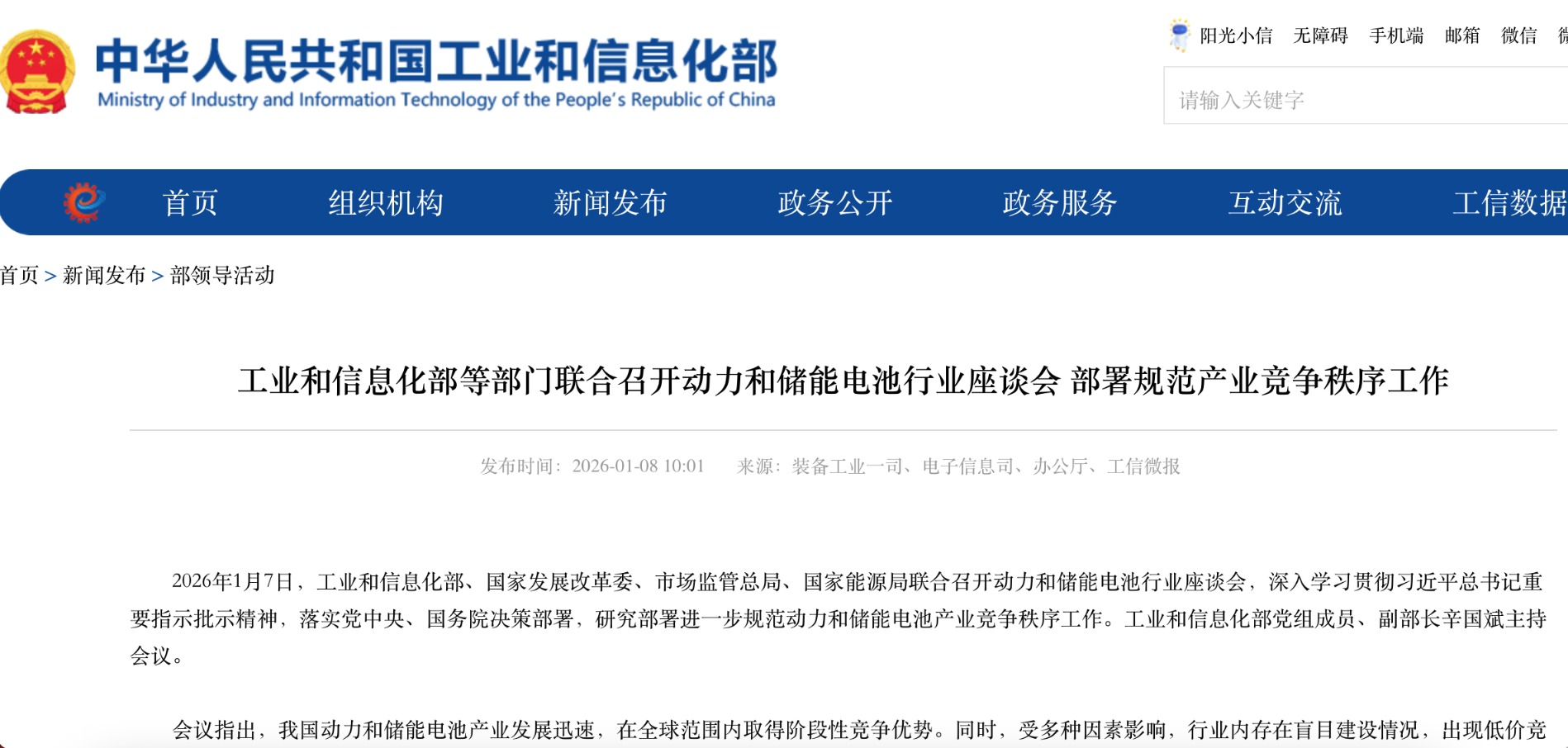
四部门:动力和储能电池产业存在盲目建设、低价竞争现象 行业可持续发展能力被削弱
Zhong Guo Jing Ying Bao· 2026-01-08 05:16
Core Viewpoint - The meeting held by multiple government agencies emphasizes the need to regulate the rapidly developing power and energy storage battery industry in China to address irrational competition and ensure sustainable development [2] Group 1: Industry Development - China's power and energy storage battery industry has developed rapidly and gained a competitive advantage globally [2] - The industry faces issues such as blind construction and irrational low-price competition, which disrupt normal market order and weaken sustainable development capabilities [2] Group 2: Regulatory Measures - There is a call to strengthen market supervision, enhance price enforcement inspections, and increase oversight of production consistency and product quality [2] - The meeting highlights the importance of combating intellectual property violations within the industry [2] Group 3: Capacity Management - The need to optimize capacity management is stressed, including the establishment of capacity monitoring and early warning mechanisms to prevent overcapacity risks [2] - Support for industry self-discipline and the role of industry associations in guiding enterprises to layout capacity scientifically is emphasized [2] Group 4: Regional Coordination - The meeting advocates for enhanced regional collaboration and coordination between central and local governments, along with comprehensive policy measures [2] - There is a focus on guiding local enterprises, controlling redundant construction, and promoting healthy and orderly industry development [2]
规范元旦春节期间市场秩序
Xin Lang Cai Jing· 2026-01-01 19:47
Core Viewpoint - The Xinjiang Production and Construction Corps Market Supervision Administration issued a reminder to regulate market price order, online transactions, advertising compliance, and drug safety during the New Year and Spring Festival period, emphasizing the need for businesses to adhere to pricing norms and protect consumer rights [1][2] Group 1: Pricing Regulations - Catering businesses must implement clear pricing, ensuring consistency across menus, price tags, and ordering tools, with separate pricing for different specifications and transparent delivery fees [1] - Hotels are required to prominently display room types, pricing methods, and adhere to booking price commitments without temporary price increases [1] - Tourist attractions and parking lots must establish clear pricing signs, prohibiting unauthorized fee increases and ensuring all services are transparently priced [1] Group 2: Business Conduct and Compliance - Businesses must ensure legal qualifications and display their information prominently on their main operating pages, while strictly regulating promotional activities to prevent price fraud [2] - Unfair competition practices, such as selling counterfeit products and misleading advertising, are strictly prohibited, with a focus on maintaining ethical marketing practices [2] - Companies must comply with laws regarding drugs, medical devices, and cosmetics, ensuring product quality and safety, and adhering to strict quality management protocols [2]
金融监管总局:深入整治“内卷式”竞争,大力规范市场秩序
Zheng Quan Shi Bao Wang· 2025-12-12 12:45
Core Viewpoint - The meeting of the Financial Regulatory Administration emphasizes the need for enhanced regulatory effectiveness and the implementation of measures in line with the Central Economic Work Conference's directives [1] Group 1: Regulatory Enhancements - The meeting calls for improving the quality and effectiveness of strict regulation [1] - There is a focus on accelerating the establishment of financial legal systems and ensuring precise and efficient law enforcement [1] - The aim is to continuously enhance regulatory capabilities within the financial sector [1] Group 2: Institutional Guidance - Financial institutions are encouraged to adopt correct views on operations, performance, and risk management [1] - The emphasis is on reducing costs and increasing efficiency while honing internal capabilities [1] - Institutions are urged to pursue differentiated and specialized development strategies [1] Group 3: Market Order and Competition - The meeting addresses the need to deeply rectify "involution-style" competition and to significantly regulate market order [1] - There is a strong stance against illegal financial activities to protect the financial interests of the public [1]