
医保基金

Search documents
持续开展医保基金管理突出问题专项整治 今年飞行检查将实现全覆盖
Ren Min Ri Bao· 2026-02-02 22:17
Group 1 - The core viewpoint of the article emphasizes the National Medical Insurance Administration's commitment to strengthening the regulation of medical insurance funds in 2026, focusing on combating illegal use of these funds and maintaining a high-pressure regulatory environment to ensure fund safety [1][3] - A key priority for this year's medical insurance fund regulation is the ongoing special rectification of prominent issues in fund management, particularly targeting fraud and abuse in the medical insurance system, with a firm stance on "reducing existing issues and curbing new ones" [1] - The notification outlines plans for enhanced flying inspections, integrating national, provincial, and municipal checks to ensure comprehensive coverage across all provinces and various stakeholders, including medical institutions and insured individuals, focusing on high-risk areas and specific medical fields [1] Group 2 - The notification also specifies the continuation of special actions to combat illegal activities in the medical insurance sector, particularly those related to drug traceability codes, aiming to crack down on the illegal sale of returned drugs and other related violations [2] - The use of advanced technologies, such as artificial intelligence, is highlighted as a key focus for fund regulation this year, with an emphasis on developing and applying big data regulatory models to enhance oversight of typical illegal behaviors and medical practices [2] - The initiative aims to innovate and expand the practical applications of "artificial intelligence + medical insurance regulation," promoting the transformation of anti-fraud big data regulatory pilot results into actionable applications [2]
以有力监管守护群众“看病钱”
Xin Lang Cai Jing· 2026-01-19 18:10
Core Insights - The article highlights the efforts of Xining City's Chengxi District Discipline Inspection Commission in enhancing the management of medical insurance funds through a special rectification initiative, recovering a total of 2.0127 million yuan in misappropriated funds and penalties by 2025 [1] Group 1: Supervision and Collaboration - The Chengxi District has established a collaborative mechanism between government oversight and social supervision, forming a team of social supervisors for medical insurance funds [1] - Over 2,550 mutual recognitions of inspection results have been conducted, saving the public over 393,000 yuan in costs [1] - An investment of 788,000 yuan has been made to integrate an intelligent medical insurance supervision system into local livelihood projects, ensuring comprehensive oversight of designated medical institutions [1] Group 2: Political Supervision and Coverage - The commission has strengthened political supervision by implementing targeted deployments and leadership responsibilities, successfully including five village health clinics as designated medical insurance providers, achieving full coverage at the village level [1] - The mobilization for insurance participation has been effectively advanced, with 94,700 urban and rural residents enrolled for the 2026 medical insurance, leading to the highest participation rate in Xining City [1] Group 3: Enforcement and Accountability - The Chengxi District maintains a "zero tolerance" approach towards violations, intensifying the investigation of cases to ensure the safety of medical insurance funds [1] - Since last year, 15 problem leads in the medical field have been investigated, resulting in 15 cases filed, nine individuals receiving disciplinary actions, and three disciplinary inspection recommendations issued [1]
四川:坚持办案引领 从严查处医保基金管理领域突出问题
Zhong Yang Ji Wei Guo Jia Jian Wei Wang Zhan· 2025-12-31 01:30
Core Insights - The Sichuan Provincial Commission for Discipline Inspection and Supervision has intensified its efforts to combat corruption and malpractice in the management of medical insurance funds, highlighting the importance of safeguarding public interests [1][2][3] Group 1: Case Highlights - A former deputy director of the Qionglai City Medical Center was implicated in a case of abuse of power, leading to excessive medical examinations and a loss of medical insurance funds [1] - The case of Yang, a former staff member at the Raybo County Medical Security Bureau, revealed significant regulatory loopholes, resulting in the misappropriation of 682,500 yuan in medical assistance funds [3] - The Sichuan Provincial Commission has initiated a dual investigation approach, leading to the accountability of five negligent officials and the recovery of over 3.74 million yuan in medical insurance funds [3] Group 2: Regulatory Measures - The Sichuan Provincial Commission has established a multi-departmental mechanism to investigate and rectify issues in the medical insurance sector, conducting a comprehensive review of problem clues from the past three years [1][2] - A data-driven regulatory model has been developed to identify high-risk behaviors in the use of medical insurance funds, resulting in the detection of 560 abnormal cases and the initiation of 64 investigations this year [2] - The Commission has emphasized the importance of linking case investigations with systemic reforms to enhance governance and prevent future risks [4] Group 3: Overall Impact - Since the launch of the campaign to address issues in medical insurance fund management, a total of 3,542 cases have been filed, with 201 individuals placed under detention [4] - The initiative aims to rectify significant issues affecting public interests and improve the regulatory framework within the medical insurance sector [4]
护好群众“看病钱”!江西一地重拳整治医保基金管理突出问题
Xin Lang Cai Jing· 2025-12-28 01:57
Core Viewpoint - The article emphasizes the importance of strengthening the management of medical insurance funds in Jiangxi Province's Jiujiang City to protect public trust and ensure the proper use of healthcare funds [1][14][25]. Group 1: Issues Identified - Jiujiang City has identified multiple issues in the management of medical insurance funds, including misuse by public officials and irregularities in township health centers [1][15]. - The city has reported a significant number of typical cases of fund misappropriation, highlighting the risks associated with large discretionary powers in fund management [1][15][16]. - Specific problems include excessive payments beyond insurance coverage, improper billing practices, and chaotic management of drug inventories in health facilities [15][16]. Group 2: Actions Taken - The Jiujiang City Discipline Inspection Commission has initiated a comprehensive investigation into the use of medical insurance funds, collaborating with various departments to enhance oversight [1][16]. - A series of recommendations have been made to improve internal controls and decision-making processes within the medical insurance system, aiming to prevent individual misconduct [18][19]. - The city has implemented a cross-departmental coordination mechanism to strengthen the regulatory framework and ensure collaborative efforts in tackling corruption [16][17]. Group 3: System Improvements - Jiujiang City is developing a smart regulatory system for medical insurance funds, utilizing big data to enhance transparency and accountability in fund management [23][24]. - The introduction of electronic systems for reimbursement processes aims to streamline operations and reduce the burden on administrative staff [22][24]. - The city is focusing on proactive service delivery, such as online processing for medical assistance and maternity benefits, to improve accessibility for citizens [24][25]. Group 4: Future Directions - The ongoing reforms are expected to transition from reactive measures to proactive prevention strategies, ensuring long-term sustainability in managing medical insurance funds [23][27]. - Continuous education and awareness programs are being planned to reinforce ethical standards among healthcare providers and public officials [20][26]. - The city aims to maintain a high level of vigilance against corruption while enhancing the quality of healthcare services provided to the public [27][28].

实践故事丨守好群众“看病钱”
Zhong Yang Ji Wei Guo Jia Jian Wei Wang Zhan· 2025-12-23 00:14
Group 1 - The core viewpoint emphasizes the importance of safeguarding the medical insurance fund, which is considered essential for public health and welfare [1] - The local government in Hebi City, Shan District, is focusing on improving the supervision of the medical insurance fund as a key measure to combat corruption and misconduct in the community [1] - A work group has been established to address issues related to the medical insurance fund, including the creation of a supervision checklist and a mechanism for regular updates and reports [1] Group 2 - The local government is conducting embedded supervision in medical institutions and pharmacies to check for irregularities such as project switching, excessive medication use, and duplicate charges [2] - The use of drug traceability codes is being promoted to ensure that every penny of the medical insurance fund is used effectively, with a focus on verifying drug sales against records [2] - Recommendations have been issued to improve internal control mechanisms and optimize review processes in response to identified issues in medical practices and management [2]
找准痛点加大整治力度扎紧医保基金监管“笼子”
Zhong Yang Ji Wei Guo Jia Jian Wei Wang Zhan· 2025-11-25 08:57
Core Viewpoint - The recent efforts by the Qingdao Municipal Commission for Discipline Inspection and Supervision focus on addressing issues related to fraud and improper use of medical insurance funds, emphasizing the importance of strengthening management and oversight in the healthcare sector [1] Group 1: Regulatory Actions - The Qingdao Municipal Commission has established a framework of "task, problem, rectification, and effectiveness" to enhance supervision and accountability among relevant departments [1] - In Hunan Province, the establishment of a task force involving multiple departments aims to promptly address violations by medical institutions and individuals engaged in fraudulent activities [2] - The Heilongjiang Provincial Commission has issued 10 disciplinary recommendations to address systemic issues and enhance governance in the healthcare sector [2] Group 2: Educational Initiatives - The use of typical cases in the healthcare sector serves as a warning and educational tool for party members and officials, promoting awareness and prevention of misconduct [3] - In Nanyang, regular reports and educational meetings are held to inform and deter officials from engaging in corrupt practices, thereby reinforcing the importance of integrity in healthcare management [3] - The analysis of case handling processes aims to extract practical experiences and provide guidance for lower-level disciplinary bodies, enhancing overall effectiveness in managing medical insurance fund issues [3]
全国与省份医保基金、商业健康险月度跟踪专题-20251110
Tianfeng Securities· 2025-11-10 01:52
Investment Rating - The industry investment rating is "Outperform the Market," indicating an expected industry index increase of over 5% in the next six months [39]. Core Insights - From January to September 2025, the national medical insurance fund accumulated revenue of 21,086 billion yuan, a year-on-year increase of 5%, while expenditures totaled 17,280 billion yuan, a decrease of 2% [2][5]. - The commercial health insurance sector reported a cumulative premium income of 8,427 billion yuan during the same period, reflecting a year-on-year growth of 2% [32]. Summary by Sections National Medical Insurance Fund Tracking - Cumulative revenue for the national medical insurance fund from January to September 2025 was 21,086 billion yuan, with a year-on-year growth of 5%. Monthly revenue in September was 2,276 billion yuan, down 11% year-on-year [2][5]. - Cumulative expenditures for the same period were 17,280 billion yuan, showing a decrease of 2% year-on-year, with September expenditures at 1,847 billion yuan, down 1% year-on-year [5]. Provincial Medical Insurance Fund Tracking - In Hunan Province, the employee medical insurance fund accumulated revenue of 340.04 billion yuan (up 4% year-on-year) and expenditures of 221.49 billion yuan (down 6% year-on-year) from January to September 2025 [15][18]. - Guizhou Province reported a cumulative revenue of 573.99 billion yuan (up 12% year-on-year) and expenditures of 474.71 billion yuan (down 1% year-on-year) during the same period [23][26]. - Guangdong Province's employee medical insurance fund had a cumulative revenue of 1,368.41 billion yuan (up 5% year-on-year) and expenditures of 1,072.85 billion yuan (up 4% year-on-year) [27][30]. Commercial Health Insurance Tracking - The national commercial health insurance sector's cumulative premium income reached 8,427 billion yuan from January to September 2025, marking a year-on-year increase of 2% [32].
盐城东台“查、改、治”协同发力,守牢群众“救命钱”
Yang Zi Wan Bao Wang· 2025-10-29 08:10
Core Points - The East Tai City Medical Insurance Bureau is intensifying regulatory measures to safeguard the medical insurance fund, focusing on punishing violations by medical institutions [1][2] - The city is addressing prominent issues in medical insurance fund management, including fraud and illegal practices, through a collaborative approach involving multiple departments [1][2] Group 1 - The East Tai City Discipline Inspection Commission is actively supervising the management of the medical insurance fund, emphasizing the importance of protecting public funds for healthcare [1] - A total of 388 medical institutions have been inspected, with various penalties applied to those found violating regulations, including suspension of payments and administrative penalties [1] - The commission is implementing a "zero tolerance" policy towards violations in the medical insurance sector to ensure the safety of the fund [2] Group 2 - The commission is promoting improvements in complaint handling mechanisms and refined management of the medical insurance system to address systemic shortcomings [2] - Initiatives such as "zero application enjoyment" for medical insurance transfer and expansion of long-term care insurance are being introduced to enhance public service [2] - The focus is on increasing public satisfaction and trust in the medical insurance system while achieving effective regulation and social outcomes [2]
以法之力维护医保基金安全(法治头条)
Ren Min Ri Bao· 2025-08-30 23:20
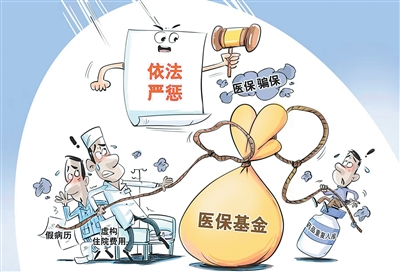
Core Viewpoint - The article highlights the increasing challenges in the regulation of medical insurance funds in China, particularly focusing on the rise of fraudulent activities that threaten the integrity of these funds. The judicial system is actively addressing these issues through stringent legal actions against offenders [5][6][7]. Group 1: Medical Insurance Fraud Cases - In 2024, a total of 1,156 medical insurance fraud cases were concluded in first-instance trials, resulting in 2,299 individuals being sentenced, with a year-on-year increase of 131.2% in case closures, recovering over 402 million yuan in losses [5]. - A specific case involved a hospital in Shanxi where fraudulent activities led to the inflation of medical expenses by over 9.7 million yuan, with 7 million yuan successfully defrauded from the insurance fund [6][7]. - Another case highlighted involved a medical institution where the operator was sentenced to 12 years in prison for defrauding over 3.9 million yuan through false medical records and inflated treatment costs [7]. Group 2: Black Market for Recycled Drugs - The article discusses the illegal trade of drugs purchased through fraudulent medical insurance claims, with individuals forming criminal networks to profit from this activity. One individual was sentenced to six years in prison for selling over 390,000 yuan worth of such drugs [8][9]. - The illegal sale of these drugs not only results in financial losses for the medical insurance fund but also poses health risks due to improper storage and potential contamination of the drugs [9]. Group 3: Responsibilities of Insured Individuals - Insured individuals are warned against illegally selling drugs obtained through medical insurance claims, with one case resulting in a sentence of over three years for the offender who sold drugs worth over 220,000 yuan [10][11]. - The article emphasizes that individuals engaging in such fraudulent activities face severe legal consequences, including fines and imprisonment, as the judicial system intensifies its crackdown on medical insurance fraud [11][12]. Group 4: Characteristics of Medical Insurance Fraud - The article outlines four main characteristics of medical insurance fraud: concentration of crime types (mainly fraud), diverse criminal actors (including insured individuals), varied methods of fraud, and significant financial impact on the insurance fund [12]. - The judicial system is committed to strict enforcement against these crimes, aiming to recover losses and protect the integrity of the medical insurance system [13].
用法治利剑斩断伸向百姓看病钱的黑手
Bei Jing Qing Nian Bao· 2025-08-06 01:13
Core Viewpoint - The article emphasizes the severe nature of medical insurance fraud, which constitutes a significant infringement on public resources and undermines the rational use of medical resources and the legitimate rights of patients [1][2]. Group 1: Medical Insurance Fund Security - The medical insurance fund is crucial for public health and its safety directly impacts the interests of insured individuals and the sustainable development of the medical insurance system [2][4]. - During the "14th Five-Year Plan" period, the national basic medical insurance coverage rate remains stable at around 95%, with nearly 20 billion instances of medical insurance reimbursements expected from 2021 to 2024, marking a 1.6 times increase compared to 2020 [2][3]. - In 2024, the basic medical insurance fund expenditure is projected to reach 2.98 trillion yuan, with a 5% decrease in personal patient burdens year-on-year [2][3]. Group 2: Characteristics of Fraudulent Behavior - Medical insurance fraud is characterized by a wide range of perpetrators, covert methods, and organized features, leading to significant erosion of limited medical insurance funds [2][5]. - The fraudulent behaviors include systematic fraud by medical institutions, fraud by insured individuals, and the illegal sale of medical insurance drugs [3][4]. Group 3: Legal Actions and Case Studies - The Supreme People's Court has published typical cases to demonstrate its commitment to combating medical insurance fraud and protecting the safety of medical insurance funds [1][3]. - A specific case from a private hospital in Shanxi highlights the severity of systematic fraud, where the hospital inflated drug prices and fabricated hospitalization costs, resulting in over 9.7 million yuan in fraudulent claims [4]. - Recent cases show that individuals involved in the illegal acquisition and sale of drugs purchased through fraudulent medical insurance schemes face severe legal consequences, with one individual sentenced to six years in prison for concealing and disguising criminal proceeds [5].