华为AI数据湖解决方案

Search documents
农业科研领域加速AI落地
Zhong Guo Jing Ji Wang· 2025-11-13 03:01
Core Insights - The "Fan - Future Agricultural Intelligence Hub" was jointly launched by the Yazhou Bay National Laboratory and Huawei at the 2025 International Symposium on Plant Phenotyping, aimed at enhancing breeding efficiency in agriculture through AI technology [1][3] - The initiative seeks to standardize and aggregate multimodal agricultural data across multiple centers, facilitating the application of AI in agricultural research [1][2] Group 1 - The "Fan - Future Agricultural Intelligence Hub" is developed on Huawei's AI data lake solution, creating a comprehensive AI technology system that includes breeding agents, datasets, toolsets, and hardware infrastructure [1][2] - The hub aims to reduce the breeding cycle from 20 generations (8-10 years) to 5 generations (3-4 years), achieving a 50% reduction in breeding time and a 30% increase in efficiency [1][3] Group 2 - The Yazhou Bay National Laboratory emphasizes the need for a system that integrates global field and laboratory data to overcome data-related challenges in AI application within agriculture [2] - Huawei's AI data lake solution significantly reduces the complexity of data engineering and model engineering, improving data labeling efficiency by 4 times and shortening the model construction time from 15 days to 5 days [2]
华为联合崖州湾国家实验室发布“繁-未来农业智能枢纽”,使能AI提升育种效率
Xin Lang Ke Ji· 2025-11-12 05:13
Core Insights - The "Fan - Future Agricultural Intelligence Hub" was jointly launched by the Yazhou Bay National Laboratory and Huawei, aimed at enhancing breeding efficiency in agriculture through AI technology [1][2][3] Group 1: AI Integration in Agriculture - The initiative focuses on creating a unified data platform to standardize and aggregate multimodal agricultural data, which will enable AI to improve breeding efficiency and accelerate the industrialization of AI in agricultural research [1][2] - The Yazhou Bay National Laboratory emphasizes the need for a system that integrates global field and laboratory data while providing intelligent analytical capabilities to overcome data-related challenges in agricultural science [2] Group 2: Technological Framework - The "Fan - Future Agricultural Intelligence Hub" is built on Huawei's AI data lake solution, comprising a full-chain technology system that includes breeding intelligence, agricultural datasets, toolsets, and hardware infrastructure [3] - The system aims to create standardized datasets covering genomics, phenomics, and environmentalomics, facilitating automated analysis and intelligent decision-making in breeding processes [3] Group 3: Efficiency Improvements - The new system is expected to significantly shorten the breeding cycle from 20 generations (8-10 years) to 5 generations (3-4 years), achieving a 50% reduction in breeding time and a 30% increase in efficiency [3]

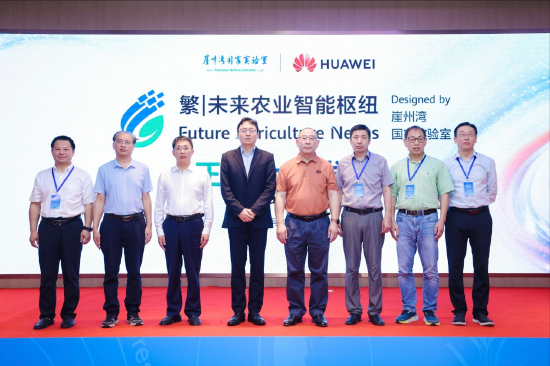
华为联合崖州湾国家实验室发布“繁|未来农业智能枢纽”
Zheng Quan Ri Bao Wang· 2025-11-11 13:47
Core Insights - The "Future Agricultural Intelligence Hub" was jointly launched by the Yazhou Bay National Laboratory and Huawei, aimed at enhancing agricultural breeding efficiency through AI and a unified data platform [1][2] - The initiative is expected to reduce the breeding cycle from 20 generations (8-10 years) to 5 generations (3-4 years), achieving a 50% reduction in time and a 30% increase in efficiency [1] Group 1 - The "Future Agricultural Intelligence Hub" integrates multi-source agricultural data to create standardized datasets covering genomics, phenomics, and environmental studies [1][2] - The AI system can perform data association screening, automated analysis, modeling validation, and intelligent decision-making to identify optimal breeding routes [1] - The project aims to transform the breeding process and facilitate the sharing and interconnectivity of agricultural data across the nation [2] Group 2 - The Yazhou Bay National Laboratory emphasizes the need for a system that integrates global field and laboratory data to overcome data-related challenges in AI application [2] - Huawei's AI data lake solution is designed to address the complexities of data engineering and model engineering, significantly improving data annotation efficiency and reducing model development time [2] - The collaboration aims to convert the expertise of top scientists into AI models and standardized scientific tools, thereby enhancing industry research capabilities and strengthening national food security [2][3]
华为联合崖州湾国家实验室发布“繁
Zheng Quan Ri Bao Wang· 2025-11-11 13:15
Core Insights - The "Future Agricultural Intelligent Hub" was jointly launched by the Yazhou Bay National Laboratory and Huawei, aimed at enhancing breeding efficiency in agriculture through AI and a unified data platform [1][2] - The initiative is expected to reduce the breeding cycle from 20 generations (8-10 years) to 5 generations (3-4 years), achieving a 50% reduction in time and a 30% increase in efficiency [1] Group 1 - The "Future Agricultural Intelligent Hub" integrates multi-source agricultural data to create standardized datasets covering genomics, phenomics, and environmental studies, facilitating the development of industry-specific breeding intelligence [1][2] - The AI-driven system will automate data analysis, modeling, and decision-making processes, significantly improving the identification of optimal breeding routes [1] - The project aims to transform the agricultural research landscape by enabling the interconnection and sharing of agricultural data across the nation [2] Group 2 - The Yazhou Bay National Laboratory emphasizes the need for a system that integrates global field and laboratory data to overcome data-related challenges in AI application within agriculture [2] - Huawei's AI data lake solution is designed to address the complexities of data engineering and model engineering, enhancing the efficiency of data annotation by four times and reducing model development time from 15 days to 5 days [2] - The collaboration aims to convert the expertise of top scientists into AI models and standardized scientific tools, reinforcing the technological foundation for national food security [2][3]
华为:AI+制造不是技术秀场,而是全栈新基建革新
Huan Qiu Wang· 2025-09-15 12:30
Core Insights - The core theme of the event was the deep integration of AI and manufacturing, with Huawei showcasing its comprehensive approach to "AI + Manufacturing" from top-level methodologies to grassroots technical support [1][2]. Group 1: Huawei's Transformation and Industry Empowerment - Huawei has undergone a digital transformation since 2014 and initiated a comprehensive intelligent upgrade strategy in 2018, focusing on integrating data and large models across various operational segments to enhance business efficiency [1][3]. - The company has developed a complete methodology for enterprise digital transformation and data governance, creating 20 solutions across seven major scenarios [3][4]. Group 2: Data Lifecycle and Infrastructure - Data is identified as a critical production factor for the digital upgrade of enterprises, necessitating the construction of new infrastructure around the data lifecycle [5]. - Huawei offers an end-to-end full-stack infrastructure solution covering intelligent connectivity, storage, computing power, and platforms, addressing key data flow points [5][6][7]. Group 3: Industry-Specific Applications - Huawei's intelligent manufacturing systems serve various sectors, including automotive, semiconductor, home appliances, new energy, biomedicine, tobacco, textiles, and robotics [8]. - In the automotive sector, Huawei's collaboration with Seres has set a benchmark by implementing a comprehensive architecture that includes smart security and digital operation centers [8][9]. Group 4: Collaborative Ecosystem - The intelligent upgrade of the manufacturing industry requires collaboration across the supply chain, with Huawei emphasizing the importance of a partner ecosystem [10]. - Huawei has established a collaborative model in Chongqing, focusing on local industries and providing testing resources and technical support through its OpenLab innovation laboratory [10].