华商上游产业股票基金

Search documents
华商上游产业股票A:2025年涨幅82.99% 近5年摘得同类冠军
Xin Lang Cai Jing· 2026-02-06 08:17
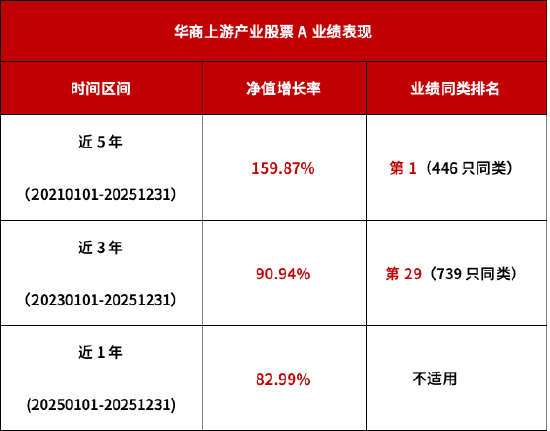
Core Viewpoint - The public fund industry in China is transforming market opportunities into tangible returns for investors, with the Huashang Upstream Industry Equity Fund showing outstanding performance in the medium to long term [1][9]. Performance Summary - As of the end of 2025, the Huashang Upstream Industry Equity Fund A class has achieved a five-year return of 159.87%, ranking first among 446 similar funds [2][10]. - The fund's one-year return is 82.99%, providing a positive holding experience for investors [1][10]. - Over the past three years, the fund has a return of 90.94%, ranking 29th among 739 similar funds [2][10]. Fund Management - Zhang Wenlong, the fund manager since March 2022, has over 7 years of experience in the securities industry, including 5.3 years in research and 2.3 years in investment [11][13]. - Zhang employs a systematic methodology that focuses on the industrial lifecycle and valuation, aiming for absolute returns and selecting quality targets based on brand, channel, and supply chain [11][13]. Market Outlook - Zhang believes that the current domestic economy is stable, with "anti-involution competition" being a key aspect of price governance [13]. - He anticipates that the weak dollar will provide additional yield sources for emerging markets, and the RMB may enter a phase of gradual appreciation [13]. - The long-term performance of the market remains promising due to China's effective risk management and attractive asset valuations [13]. Fund Characteristics - The Huashang Upstream Industry Equity Fund was established on December 27, 2017, and modified its investment scope on December 28, 2020, to include depositary receipts [15]. - The performance benchmark for the fund is a combination of the CSI Upstream Resource Industry Index and the CSI All Bond Index [15].

华商基金张文龙:“百年未有之大变局”底色犹在 市场表现依然可期
Xin Lang Cai Jing· 2026-02-05 07:44
Core Viewpoint - The A-share market experienced a hot 2025, but is currently in a phase of consolidation in early 2026, with significant performance differences across sectors and styles. The future market outlook remains optimistic due to various factors including a weak dollar and the potential for the RMB to appreciate slowly [1][6]. Market Overview - Emerging markets continued to lead the global bull market in Q4 2025, while the A+H market showed signs of volatility. The market experienced a "DeepSeek" moment in Q1, trade war impacts in Q2, an AI and resource boom in Q3, and a consolidation phase in Q4 [3][9]. - The structure of the market in Q4 showed that upstream resources performed well due to price drivers, while consumer and healthcare sectors experienced notable pullbacks. The technology sector presented various structural opportunities amidst the volatility [3][9]. Economic Context - The domestic economy is operating within a stable framework, with "anti-involution competition" becoming a key aspect of price governance. The real estate market remains a weak point, while the financial market benefits from the government's commitment to stabilize asset prices [3][9]. - Internationally, the U.S. faces a shift in national security strategy, leading to a partial vacuum and reconstruction of order. The U.S. economy continues to show resilience supported by AI, with the financial sector in a dual expansion phase of fiscal and monetary policies [3][9]. Industry Insights - AI development has entered a debt-driven phase, with advancements in language and world models. The hardware aspect is seeing a weakening of Moore's Law, necessitating system coupling and iterative synchronization to advance towards AGI and ASI [4][10]. - In the domestic consumption sector, households still face challenges in their balance sheets, and income expectations remain conservative, indicating a necessary transition between old and new growth drivers [4][10]. - In the cyclical sector, supply constraints and changes in demand structure continue to be key sources of yield, with the financial sector's low valuations and evolving demand structure offering promising potential for compounded returns [4][10].