
华安标普全球石油

Search documents
白银基金出台补偿方案!2月26日可办理 1000元以下损失全额补偿
Sou Hu Cai Jing· 2026-02-15 15:01
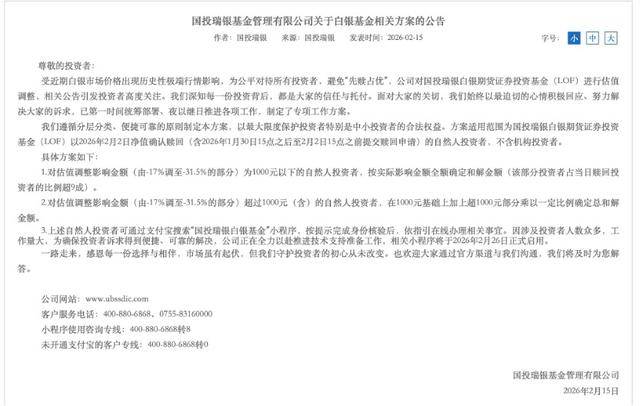
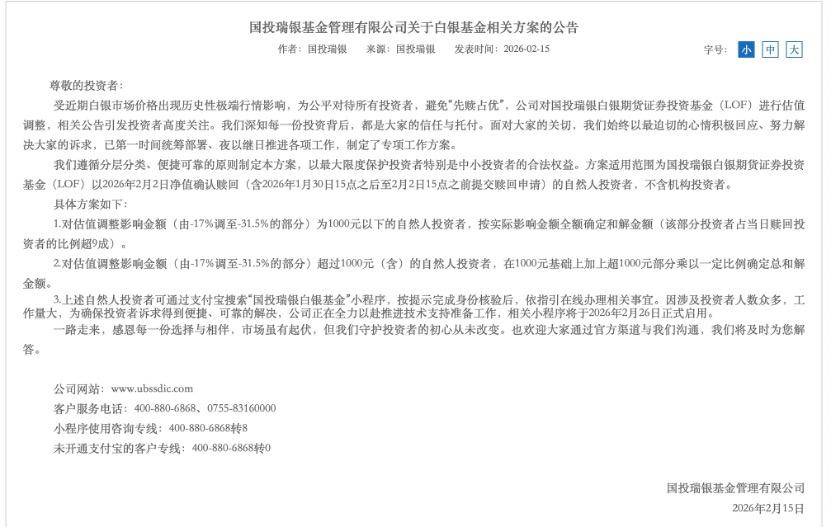
Core Viewpoint - The company, Guotou Ruijin Fund, announced a compensation plan for individual investors affected by the valuation adjustment of the Guotou Silver LOF, aiming to protect the rights of small and medium investors while adhering to a layered and categorized approach [1][6]. Group 1: Compensation Plan Details - The compensation plan is applicable to individual investors who submitted redemption requests between January 30, 2026, at 15:00 and February 2, 2026, at 15:00, with the net asset value confirmed on February 2, 2026 [1][6]. - The compensation is unique as it is not due to any illegal activities but is a proactive measure by the company to address investor concerns and maintain trust [2][8]. - The plan specifically excludes institutional investors, focusing solely on natural person investors [3][6]. Group 2: Compensation Mechanism - A tiered compensation mechanism is established, where investors with losses below 1,000 yuan will receive full compensation, while those with losses exceeding 1,000 yuan will receive compensation based on a specific proportion calculated on the amount exceeding 1,000 yuan [4][7]. - The compensation process will begin on February 26, 2026, and investors can complete the necessary procedures online through a designated mini-program on Alipay [5][7]. Group 3: Investor Concerns and Company Responses - The company clarified that the valuation adjustment was reasonable and necessary to reflect the true value of the underlying assets, which were significantly impacted by extreme market fluctuations [9][10]. - Concerns regarding the lack of prior announcement about the valuation adjustment were addressed, stating that it was based on the need for fairness and to avoid potential panic among investors [10][11]. Group 4: Industry Context - The extreme volatility in the silver market has led to a broader industry reflection, with many fund companies implementing strict purchase limits to protect the interests of fund holders [11][12]. - The trend of limiting purchases in commodity funds has become a preventive measure to ensure stable operations and mitigate risks associated with high volatility [12].

白银基金出台补偿方案!2月26日可办理 1000元以下损失全额补偿
天天基金网· 2026-02-15 14:38
Core Viewpoint - The company announced a compensation plan for individual investors affected by the valuation adjustment of the Guotou Silver LOF fund, aiming to protect the rights of small and medium investors while adhering to a layered and reliable approach [2][4]. Summary by Sections Compensation Characteristics - The compensation is rare as it is not due to illegal activities but is a proactive arrangement by the company to address investor concerns and maintain trust [3]. - The plan is exclusively for individual investors, specifically those who submitted redemption requests between January 30, 2026, 15:00 and February 2, 2026, 15:00, with institutional investors excluded [3][4]. - A tiered compensation mechanism is in place, where investors with losses below 1,000 yuan will receive full compensation, while those with losses exceeding 1,000 yuan will receive compensation based on a specific ratio for the amount over 1,000 yuan [3][5]. - The compensation process will begin on February 26, 2026, and investors can complete the necessary procedures online through a designated app [3][5]. Investor Concerns and Company Responses - The company clarified that the valuation adjustment was reasonable and not a denial of the adjustment itself, but rather a response to investor experience and concerns [6]. - The adjustment was made to reflect the true value of the fund's underlying assets in light of extreme market fluctuations, ensuring that the net asset value does not mislead investors [8]. - The company explained that the timing of the announcement was based on industry practices to avoid misinterpretation that could lead to liquidity issues [9]. Industry Reactions and Measures - The extreme volatility in silver prices has led to complaints from investors and prompted industry reflection on risk management practices [10]. - Several fund companies have implemented strict purchase limits on commodity funds to ensure stable operations and protect investors' interests [10].

白银基金补偿方案解读:1000元以下损失全额补偿
财联社· 2026-02-15 14:18
Core Viewpoint - The company has announced a compensation plan for individual investors affected by the valuation adjustment of the Guotou Silver LOF, aiming to protect the rights of small and medium investors while responding to their concerns and maintaining trust in the investment experience [1][3]. Summary by Sections Compensation Characteristics - The compensation is unique as it is not due to illegal activities but is a proactive measure by the company to address investor concerns and maintain trust [2]. - The compensation plan is exclusively for individual investors, specifically those who submitted redemption requests between January 30, 2026, 15:00 and February 2, 2026, 15:00, with institutional investors excluded [2][3]. - A tiered compensation mechanism is in place, where investors with losses below 1,000 yuan will receive full compensation, while those with losses exceeding 1,000 yuan will receive compensation based on a specific ratio applied to the amount over 1,000 yuan [2][5]. - The compensation process will begin on February 26, 2026, and investors can complete the necessary procedures online through a designated app [2][6]. Valuation Adjustment and Investor Concerns - The valuation adjustment resulted in a significant drop in net value from -17% to -31.5%, raising concerns among investors [5][8]. - The company clarified that the valuation adjustment was necessary due to extreme market fluctuations in international silver prices, which could misrepresent the actual value of the fund if not adjusted [9]. - The company emphasized that the adjustment was a legal and compliant operation aimed at protecting the long-term interests of all fund holders and preventing potential losses from "virtual high" valuations [9]. Exclusion of Non-Redeeming Investors - Non-redeeming investors are not included in the compensation plan as the valuation adjustment did not materially affect them [10]. - The overall decline in net value for the fund was consistent with the market, indicating that the adjustment was necessary for accurate valuation [10]. Industry Response and Risk Management - The extreme market conditions have led to a reflection within the industry, with several fund companies implementing strict purchase limits to mitigate risks associated with volatile commodities [11][12]. - The measures taken by various funds, including complete purchase bans and limits on investment amounts, are aimed at ensuring stable operations and protecting the interests of fund holders [12].

白银基金出台补偿方案!2月26日可办理,1000元以下损失全额补偿
Sou Hu Cai Jing· 2026-02-15 13:44
Core Viewpoint - The company, Guotou Ruijin Fund, announced a compensation plan for individual investors affected by the valuation adjustment of the Guotou Silver LOF, aiming to protect the rights of small and medium investors while adhering to a layered and categorized approach [1][3]. Summary by Relevant Sections Compensation Characteristics - The compensation is rare as it is not due to illegal activities but is a proactive arrangement by the company to address investor concerns and maintain trust [2]. - The compensation plan is exclusively for individual investors, specifically those who submitted redemption requests between January 30, 2026, 15:00 and February 2, 2026, 15:00, based on the net value confirmed on February 2, 2026 [2][3]. - A tiered compensation mechanism is in place, where investors with losses below 1,000 yuan will receive full compensation, while those with losses exceeding 1,000 yuan will receive compensation based on a specific ratio for the amount over 1,000 yuan [2][3]. Compensation Process - The compensation process will officially start on February 26, 2026, and investors can complete identity verification and related procedures online through a designated Alipay mini-program [4]. Company Responses to Investor Concerns - The company clarified that the valuation adjustment was reasonable and aimed at protecting the long-term interests of all fund holders, despite some investors feeling a "gap in experience" due to the adjustment [5]. - The adjustment was necessary to reflect the true value of the underlying assets in the context of extreme market fluctuations, preventing a misleading "overvalued" situation [6]. - Concerns about the lack of prior announcement regarding the valuation adjustment were addressed, stating that it was a standard practice in the industry to announce adjustments only after they are confirmed to avoid misleading investors [7]. Industry Reactions - The extreme fluctuations in silver prices have prompted other fund companies to implement strict purchase limits on commodity LOFs to mitigate risks and protect investors' interests [8][9].
基金投顾产品月报系列(24):基金投顾产品11月调仓一览-20251204
KAIYUAN SECURITIES· 2025-12-04 12:43
- The report categorizes fund advisory products into various types based on equity weight and asset allocation distribution, including pure bond type (0%), fixed income+ type (0%-20%), mixed stock-bond type (20%-70%), stock type (70%-100%), and multi-asset allocation type, with further segmentation of stock-type advisory products into QDII type, industry theme type, and ordinary stock type based on strategy characteristics and income sources[11][17] - Performance statistics show that in November 2025, equity assets performed poorly overall, while pure bond and multi-asset allocation advisory products performed relatively better. Absolute return averages for November were: pure bond type (0.1%), fixed income+ type (-0.2%), mixed stock-bond type (-0.9%), stock type (-1.8%), and multi-asset allocation type (-0.2%). Median absolute returns since 2025 were: pure bond type (1.4%), fixed income+ type (4.2%), mixed stock-bond type (12.3%), stock type (23.0%), and multi-asset allocation type (12.7%)[12][13][16] - Among stock-type advisory products, active selection strategies had the highest relative returns in November 2025, while industry rotation strategies led in returns since 2025. November absolute returns were: active selection (-2.4%), index-driven (-2.6%), and industry rotation (-3.5%). Absolute returns since 2025 were: active selection (23.0%), index-driven (21.7%), and industry rotation (25.6%)[16][21][3] - Fund advisory products with high returns since 2025 include: multi-asset allocation type (e.g., "Global Daily Accumulation" with 28.6% return), stock type (e.g., "Anxin Aggressive 90" with 45.6% return), mixed stock-bond type (e.g., "Peach and Plum Silent" with 25.3% return), fixed income+ type (e.g., "Guotai Idle Money Steady Walk" with 13.3% return), and pure bond type (e.g., "Zhidao AI Stable Type" with 6.0% return)[23][24][26][27][28] - In November 2025, 131 fund advisory products underwent portfolio adjustments. Key allocation changes included increased exposure to A-shares, cash and currency, U.S. stocks, overseas bonds, and emerging markets, while reducing exposure to Hong Kong stocks, gold, other commodities, and bonds[29][33][34] - Sector allocation changes in A-shares for November 2025 included increased exposure to coal, power equipment, basic chemicals, and food and beverages, while reducing exposure to pharmaceuticals, electronics, and non-ferrous metals[36][37][38]