华泰柏瑞纳斯达克100ETF发起式联接(QDII)

Search documents
溢价率集体创新高!什么情况?
Zhong Guo Zheng Quan Bao· 2025-11-23 14:11
Group 1 - Recent tightening of subscription limits for QDII products, with some funds suspending subscriptions altogether [1][2][3] - The Invesco Nasdaq Technology ETF has seen its premium rate reach a historical high, surpassing 21% for the first time [1][4] - Fund managers are warning about premium risks due to high demand and insufficient QDII quotas, which prevent arbitrage opportunities [1][5] Group 2 - Several QDII products have implemented subscription limits, with some reducing the limit from 200,000 RMB to as low as 100 RMB [2][3] - The market for QDII products is characterized by high premiums, with the highest premium rate recorded at 18.28% as of November 21 [4] - Fund companies are issuing warnings against blind investments in high-premium products, emphasizing the risks involved [6]
“关税风暴”来袭,年内已有超七成QDII基金收益率下跌!
Bei Jing Shang Bao· 2025-04-09 13:34
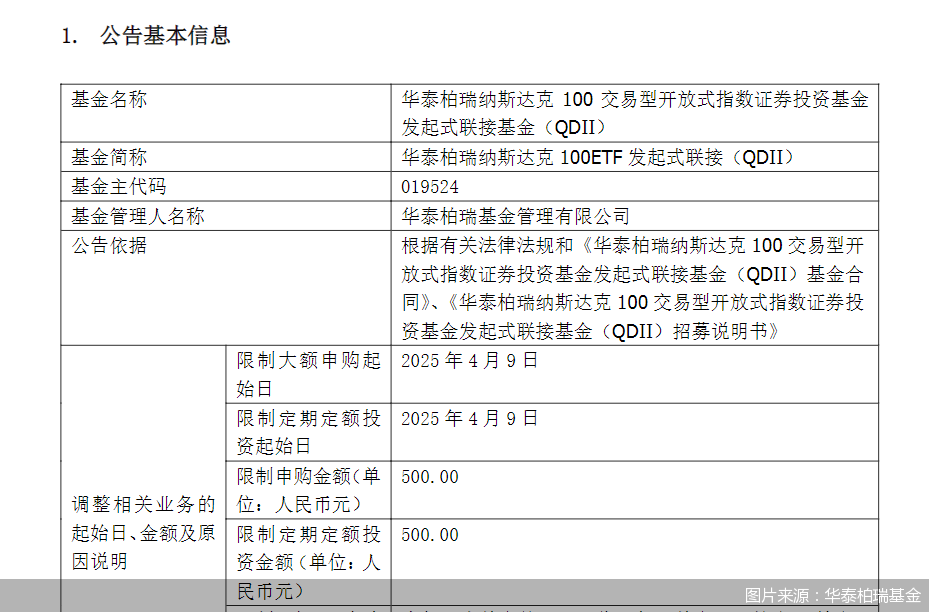
Core Viewpoint - The "tariff storm" has significantly impacted the performance of multiple QDII funds, leading to a majority of them posting negative returns this year, with over 90% of QDII funds losing money since April [1][3]. Group 1: Fund Performance - As of April 7, 2023, out of 661 QDII funds, 469 have reported negative returns since the beginning of the year, accounting for over 70% of the total [3]. - Among these, 260 funds have seen declines exceeding 10% [3]. - Specific funds, such as the Huaxia Global Technology Pioneer Mixed Fund, have experienced declines of over 25.22% [4]. Group 2: Fund Subscription Adjustments - Multiple public funds have lowered the subscription limits for their QDII funds, with Huatai-PineBridge announcing a reduction from 5000 RMB to 500 RMB for its QDII fund [3]. - The adjustments are aimed at ensuring stable fund operations and protecting the interests of fund holders amid increased market volatility [3]. Group 3: Market Conditions - The recent downturn in QDII fund performance is closely linked to the "reciprocal tariffs" that have caused global market turbulence, with the S&P 500 and Nasdaq indices dropping by 11.21% and 12.47% respectively since April [5]. - European and Asia-Pacific markets have also faced declines, with indices such as Germany's DAX and France's CAC40 falling by 8.5% and 8.86% respectively [5]. Group 4: Investment Strategy Recommendations - Analysts suggest that investors should adopt a defensive strategy in the short term due to the significant uncertainty stemming from the tariff situation [7]. - There is an emphasis on focusing on assets with defensive and hedging properties, as well as diversifying asset allocation across different regions [7].