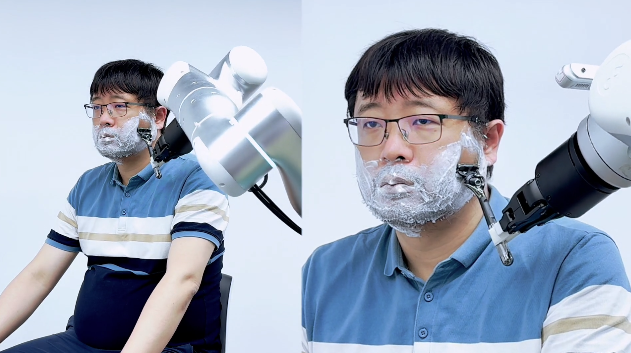
单孔手术机器人

Search documents
精锋医疗-B(2675.HK)上市:国产手术机器人龙头的“破局时刻”
Ge Long Hui· 2026-01-08 03:16
Core Viewpoint - The successful IPO of Precision Medical marks a significant milestone for the company and the domestic high-end medical equipment industry, transitioning from a phase of "following" to "leading" in the surgical robot sector [1][15]. Group 1: Market Response and Performance - Precision Medical's IPO was met with overwhelming demand, achieving a subscription rate of 1,091.94 times during the public offering and 25.18 times in the international placement, with the stock price surging by 39.11% on its debut [1]. - The company's stock continued to rise, reaching HKD 55.7 per share shortly after listing, reflecting strong investor confidence in its growth prospects [1]. Group 2: Industry Landscape - The domestic surgical robot industry is at a pivotal point, shifting focus from obtaining regulatory approvals to scaling production and integrating products into hospital workflows [3]. - The Chinese surgical robot market is projected to reach CNY 102.019 billion by 2033, with a compound annual growth rate (CAGR) of 34.3% from 2024 to 2033 [3]. Group 3: Company Strategy and Innovation - Precision Medical has established a comprehensive business model that integrates product development, market strategy, and clinical ecosystem, creating a "flywheel" effect that drives growth [6][7]. - The company is the first in China to commercialize multi-port, single-port, and natural orifice surgical robots, offering a versatile product matrix that addresses various surgical needs [7]. Group 4: Financial Performance - Precision Medical reported a revenue of CNY 160 million for 2024, a significant increase of 233% year-on-year, with the first half of 2025 nearing CNY 149 million, reflecting a nearly 400% growth compared to the same period last year [8]. - The company maintains a gross margin above 60%, with a gross profit of approximately CNY 93.85 million in the first half of 2025, indicating strong market competitiveness and pricing power [8]. Group 5: Clinical Ecosystem and Long-term Strategy - The company emphasizes the importance of post-sale services, including training and clinical support, to build a robust clinical ecosystem that enhances customer loyalty and creates a sustainable competitive advantage [9]. - Precision Medical aims to evolve from a device manufacturer to an "intelligent surgical solution platform," expanding its offerings to include pre-operative planning, specialized high-end consumables, and post-operative data analysis services [13].


有高校科技成果转化金额年增70倍,上海赋权改革让“纸”变“钱”
Di Yi Cai Jing· 2025-12-24 12:25
Core Insights - Shanghai is developing a "scientist + technology manager + patient capital" triangle model to enhance technology transfer and commercialization of research outcomes [1][15] - The contribution of universities to national basic research growth exceeds 50%, with a significant increase in technology transfer contracts [1] - The reform in technology transfer mechanisms in Shanghai has led to a substantial increase in contract amounts and the establishment of a new rights structure [2][11] Technology Transfer Growth - In 2024, the total contract amount for technology transfer from Shanghai's universities and research institutions is expected to reach 365.93 billion yuan, a 6.7-fold increase since 2014 [1] - The total contract amount for technology transfer in 2025 (January to November) is projected to be 576.40 billion yuan, a 132.6% increase compared to the same period in the previous year [1] - The national technology transfer contract amount from universities and research institutions is projected to reach 226.91 billion yuan in 2024, with a year-on-year growth of approximately 10% [1] Reform Mechanisms - The core of the reform in Shanghai's technology transfer is the separation of ownership and usage rights, allowing universities to transfer rights to research teams [2][4] - Shanghai Jiao Tong University has implemented a "1+5+20" policy framework to support technology transfer, granting 70% ownership of patents to research teams and 30% to faculty [5] - The "complete empowerment" model has been adopted, allowing researchers to retain 100% ownership of their inventions when forming companies [11][14] Case Studies - Shanghai Jiao Tong University has seen significant success, with over 200 faculty-led startups and a total financing amount exceeding 190 billion yuan, with a market valuation of over 1,200 billion yuan [10] - East China Normal University reported a nearly 70-fold increase in technology transfer contract amounts in 2024, reaching 4.76 billion yuan, and a total of 14.9 billion yuan by December 2025 [11][12] - The establishment of a robust support system for faculty entrepreneurship has led to successful commercialization of research outcomes, creating a positive feedback loop between research and application [13][14] Future Directions - The Shanghai government is focusing on deepening the reform of the ownership system for job-related scientific achievements and improving the management of technology transfer assets [15] - The ongoing reforms aim to create a conducive environment for technology transfer, ensuring transparency and compliance in the commercialization process [14][15]