
卫星遥感数据

Search documents
商业航天大消息!北京鼓励对卫星数据上下游企业进行并购重组
Jing Ji Ri Bao· 2026-01-24 14:54
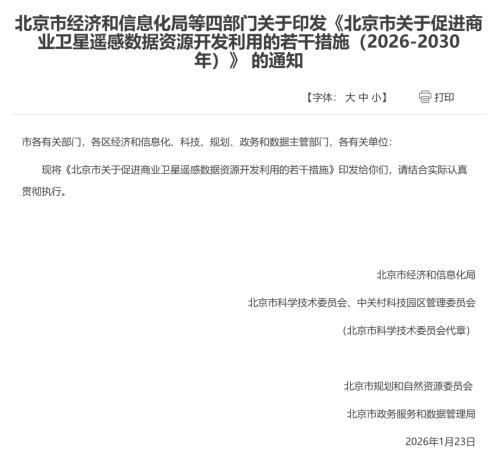
Core Viewpoint - The Beijing Municipal Bureau of Economy and Information Technology has issued measures to promote the development and utilization of commercial satellite remote sensing data resources from 2026 to 2030, aiming to create an innovative service hub for satellite applications and generate new products, services, and business models in the remote sensing data sector [1][6]. Group 1: Strengthening Basic Capability Construction - The measures emphasize the importance of strengthening diverse operational entities and encouraging mergers and acquisitions among satellite data-related companies to create globally competitive leaders in the industry [3][7]. - There is a focus on enhancing space infrastructure and supporting the planning and construction of commercially viable satellite constellations with clear application prospects [7]. Group 2: Enhancing Common Support Capabilities - The initiative supports the construction of multi-source satellite big data platforms to standardize and integrate various types of remote sensing data, improving overall utilization efficiency [4][8]. - Encouragement is given for the development of urban spatial digital bases that integrate various information technologies to create comprehensive urban information models [8]. Group 3: Promoting Technological Innovation - The measures aim to enhance the technological innovation capabilities of remote sensing data resources, encouraging research in key technologies such as agile data acquisition and intelligent interpretation [4][11]. - Funding support will be provided for units undertaking technological research through competitive selection processes [11]. Group 4: Optimizing Development and Utilization Environment - The measures advocate for the assetization of satellite data and the establishment of mechanisms for data sharing and collaboration among government, research institutions, and enterprises [4][12]. - There is a focus on ensuring data security and establishing a robust management system for satellite data [13]. Group 5: Expanding Application Scenarios - The initiative aims to leverage artificial intelligence to enhance the application of remote sensing data in various industries, including urban governance and disaster prevention [4][14]. - Support will be provided for enterprises to create innovative application cases in key sectors, with rewards for solutions that effectively address industry needs [14]. Group 6: Support Measures - The measures emphasize coordination with national policies and encourage financial support for quality projects in the remote sensing data sector [5][15]. - There is a commitment to talent development through industry-education integration and collaboration among various stakeholders to enhance the overall development of the remote sensing data industry [15].

商业航天利好!北京发布!
券商中国· 2026-01-24 11:09
Core Viewpoint - The article outlines measures to promote the development and utilization of commercial satellite remote sensing data resources in Beijing from 2026 to 2030, aiming to create a highland for satellite application services and foster new products, services, and business models in the remote sensing data sector [2]. Group 1: Strengthening Basic Capabilities - The initiative emphasizes enhancing the foundational capabilities of remote sensing data resources, focusing on market support, technical backing, and resource assurance to improve circulation efficiency and application effectiveness [3]. - It encourages internet and geographic information companies to develop value-added services based on commercial satellite data and to foster integrated business entities that combine satellite data with various industries [3]. - The plan supports the construction of differentiated commercial satellite constellations with clear commercial value and application prospects, integrating new information technologies like cloud computing and AI [4]. Group 2: Common Support Capabilities - The article advocates for the establishment of multi-source satellite big data platforms to integrate various data types and enhance overall utilization efficiency by breaking down data silos [5]. - It encourages the construction of urban spatiotemporal digital foundations, promoting the integration of information technologies to create urban information models and support the development of digital twin city systems [5]. Group 3: Technological Innovation Capabilities - The measures aim to enhance the technological innovation capabilities of remote sensing data resources, encouraging the development of key technologies such as agile data acquisition and intelligent interpretation [7]. - It promotes the establishment of innovation platforms and laboratories focused on remote sensing data, facilitating the integration of research and industry [7]. Group 4: Optimizing Development Environment - The article discusses accelerating the assetization of satellite data, encouraging enterprises to manage data assets effectively and promoting data registration and circulation through platforms like the Beijing International Big Data Exchange [9]. - It emphasizes the importance of data security management and the establishment of a comprehensive data security system to protect satellite data throughout its lifecycle [10]. Group 5: Expanding Application Scenarios - The initiative aims to leverage AI to enhance the application of remote sensing data across various industries, promoting the development of industry-specific models and improving service efficiency in areas like natural resources and disaster management [11]. - It supports the creation of innovative application cases in key industries, encouraging the scaling of remote sensing data applications in sectors such as agriculture, urban governance, and financial services [11]. Group 6: Support Measures - The article highlights the need for coordinated efforts with national policies and major projects to ensure the successful implementation of satellite remote sensing data initiatives [12]. - It calls for financial support and investment in high-quality remote sensing data projects, as well as talent development in satellite data governance [12].
商业航天大消息!刚刚,北京发布
Zhong Guo Ji Jin Bao· 2026-01-24 09:41
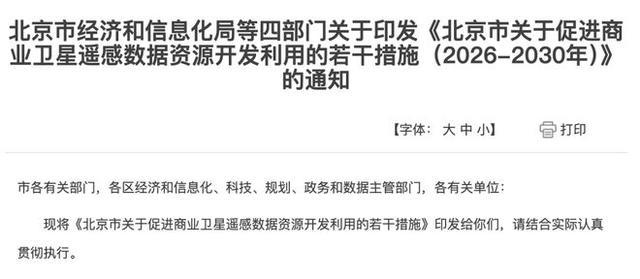
Core Viewpoint - Beijing has released measures to promote the development and utilization of commercial satellite remote sensing data resources from 2026 to 2030, aiming to enhance the satellite application service innovation landscape and support national development strategies [1][3]. Group 1: Infrastructure and Capability Building - The measures focus on five key areas: foundational capability building, common support capability building, technological innovation capability building, optimization of the development and utilization environment, and expansion of application scenarios [3][4]. - Strengthening foundational capabilities involves supporting enterprises in planning and constructing commercial satellite constellations with clear application prospects, enhancing the efficiency of remote sensing data utilization [6][7]. - Encouragement for diverse operational entities, including internet and geographic information companies, to develop value-added services based on commercial satellite data [6][7]. Group 2: Common Support Capabilities - The initiative promotes the standardization and integrated processing of vast remote sensing data resources to break down data silos and improve overall utilization efficiency [8][9]. - Support for the construction of multi-source satellite big data platforms to create a comprehensive data resource system, integrating various data types and enhancing the application of satellite data processing algorithms [8][9]. Group 3: Technological Innovation - The measures aim to enhance technological innovation capabilities by encouraging the development of key technologies related to satellite remote sensing data, such as agile acquisition and intelligent interpretation [10][11]. - Establishment of high-energy innovation platforms, including key laboratories and industry innovation centers, to promote the integration of production, education, and research [10][11]. Group 4: Development Environment Optimization - The measures advocate for the assetization of satellite data, encouraging enterprises to manage data assets effectively and facilitating the registration and circulation of satellite data assets [12][13]. - Emphasis on enhancing data security management systems to ensure the safe acquisition, storage, transmission, and use of satellite data [12][13]. Group 5: Application Scenario Expansion - The initiative aims to leverage artificial intelligence to expand industry-specific applications of remote sensing data, enhancing its value in various sectors such as urban governance and disaster prevention [14][15]. - Support for enterprises to create innovative application cases in key industries, with rewards for solutions that effectively address typical application scenarios [14][15].
商业航天大消息!刚刚,北京发布!
Zhong Guo Ji Jin Bao· 2026-01-24 08:50
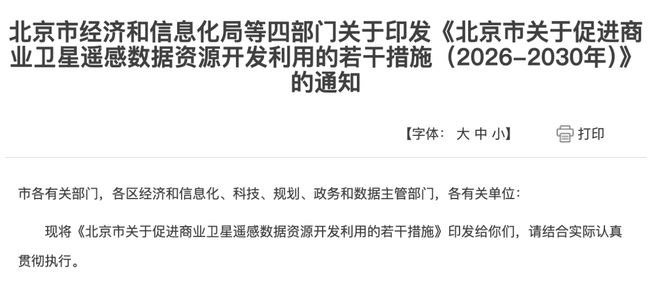
Core Viewpoint - Beijing has released measures to promote the development and utilization of commercial satellite remote sensing data resources from 2026 to 2030, aiming to enhance the satellite application service innovation landscape and support national development strategies [1][5]. Group 1: Basic Capability Construction - The measures emphasize strengthening the basic capabilities of remote sensing data resources by providing market support, technical backing, and resource guarantees for the satellite data industry [3][6]. - Encouragement is given to internet and geographic information companies to develop value-added services based on commercial satellite data, fostering integrated business entities [6]. - Support for the construction of differentiated commercial satellite constellations is highlighted, along with the integration of new information technologies like cloud computing and artificial intelligence [6][7]. Group 2: Common Support Capability Construction - The initiative aims to standardize and integrate the processing and sharing of diverse remote sensing data, breaking down data silos to enhance overall utilization efficiency [4][7]. - Support for the construction of multi-source satellite big data platforms is encouraged, promoting the development of algorithms and models for satellite data processing [7]. - The establishment of urban spatiotemporal digital foundations is promoted to integrate various information technologies and create comprehensive urban information models [7]. Group 3: Technological Innovation Capability Construction - The measures focus on enhancing technological innovation capabilities in remote sensing data, encouraging key technology breakthroughs and strengthening the innovation position of enterprises [9][10]. - Support for agile acquisition, efficient processing, and intelligent interpretation of satellite remote sensing data is emphasized, along with funding for technology research and development [9][10]. Group 4: Optimization of Development and Utilization Environment - The measures promote the assetization of satellite data, encouraging enterprises to manage data assets and facilitating their registration and circulation [11]. - Strengthening inter-departmental sharing of remote sensing data resources and exploring cooperative mechanisms with research institutions and enterprises is encouraged [11]. - The establishment of a robust data security management system is highlighted to ensure the safe handling of satellite data [12]. Group 5: Application Scenario Expansion - The measures advocate for the use of artificial intelligence to expand industry-specific applications of remote sensing data, aiming to convert data into practical productivity [13]. - Support for the development of innovative application cases in key industries such as urban governance, agriculture, and disaster prevention is emphasized, with rewards for exemplary solutions [13][14]. Group 6: Support Measures - Coordination with national policies and major projects is emphasized to ensure the successful implementation of satellite remote sensing data resource development projects [14][15]. - Financial support and investment in quality projects related to remote sensing data resources are encouraged [14].
北京市经济和信息化局等四部门关于印发《北京市关于促进商业卫星遥感数据资源开发利用的若干措施(2026-2030年)》的通知
Jin Rong Jie· 2026-01-24 08:38
Core Viewpoint - Beijing has issued measures to promote the development and utilization of commercial satellite remote sensing data resources from 2026 to 2030, aiming to enhance the integration of satellite applications and foster innovation in the industry [2]. Group 1: Strengthening Basic Capabilities - The measures emphasize building strong market entities and infrastructure to support the satellite data industry, encouraging mergers and acquisitions among companies to create globally competitive leaders [3]. - Companies are encouraged to develop differentiated commercial satellite constellations and enhance space infrastructure, with support for projects that meet specific criteria [3]. Group 2: Enhancing Common Support Capabilities - The establishment of multi-source satellite big data platforms is encouraged to integrate various data types and improve overall utilization efficiency [4]. - The construction of urban spatiotemporal digital foundations is promoted to facilitate the integration of information technologies and create urban information models [5]. Group 3: Promoting Technological Innovation - The measures call for the enhancement of technological innovation capabilities in satellite remote sensing, supporting research in key technologies such as agile data acquisition and intelligent interpretation [6]. - The establishment of innovation platforms and laboratories focused on remote sensing data is encouraged to foster collaboration between academia and industry [6]. Group 4: Optimizing the Development Environment - The promotion of satellite data asset management and the establishment of a data asset registration system are highlighted to facilitate data circulation and trading [7]. - Strengthening data security management and encouraging collaboration with cybersecurity sectors are essential to ensure the safe use of satellite data [8]. Group 5: Expanding Application Scenarios - The integration of artificial intelligence in satellite data applications is emphasized to enhance service efficiency in various sectors such as natural resources and disaster management [9][10]. - Support for the development of industry-specific applications in sectors like agriculture, urban governance, and finance is encouraged to deepen the utilization of satellite data [10]. Group 6: Support Measures - Coordination with national policies and financial support for quality projects in satellite data resources is prioritized to ensure successful implementation [11]. - Talent development initiatives are encouraged to cultivate skills in satellite data governance through industry-education integration [11].
商业航天利好!北京发布!
证券时报· 2026-01-24 07:27
Core Viewpoint - The article outlines measures to promote the development and utilization of commercial satellite remote sensing data resources in Beijing from 2026 to 2030, aiming to enhance the integration of satellite applications and foster innovation in data services [2]. Group 1: Strengthening Basic Capabilities - Enhance the foundational capabilities of remote sensing data resources by supporting diverse business entities and infrastructure to improve market efficiency and application effectiveness [3]. - Encourage internet and geographic information companies to develop value-added services based on commercial satellite data, fostering the integration of "satellite data + industry" [3]. - Support the construction of differentiated commercial satellite constellations with clear commercial value and application prospects, integrating new information technologies like cloud computing and AI [4]. Group 2: Common Support Capabilities - Promote the construction of multi-source satellite big data platforms to standardize and integrate various remote sensing data, breaking down data silos and improving overall utilization efficiency [5]. - Encourage the establishment of urban spatiotemporal digital foundations to integrate various data elements and promote the development of digital twin city systems [5]. - Build incentive mechanisms for data resource integration, encouraging participation in remote sensing data resource pools through platforms like the Beijing International Big Data Exchange [6]. Group 3: Technological Innovation Capabilities - Encourage the development of key technologies related to satellite remote sensing data, such as agile acquisition and intelligent interpretation [7]. - Support the establishment of innovation platforms for remote sensing data, promoting collaboration between industry, academia, and research [7]. Group 4: Optimizing Development Environment - Promote the assetization of satellite data, encouraging companies to manage data assets and facilitating their registration and circulation [8]. - Strengthen inter-departmental sharing of remote sensing data resources and explore new cooperative mechanisms with research institutions and enterprises [8]. - Enhance data security management systems to protect the acquisition, storage, transmission, and use of satellite data [9]. Group 5: Expanding Application Scenarios - Accelerate the integration of AI with remote sensing data to enhance application levels in various sectors, including natural resources and disaster prevention [10]. - Support the development of industry-specific innovative application cases to deepen the scale of remote sensing data utilization in key industries [11]. Group 6: Support Measures - Strengthen coordination with national policies and major projects to facilitate the implementation of significant satellite remote sensing data resource projects [12]. - Optimize financial support for quality projects in remote sensing data resources, encouraging investment from local governments and social capital [12].

国家航天局对地观测与数据中心:探索民商协同、激活卫星数据要素价值
Zhong Guo Xin Wen Wang· 2025-12-22 12:15
Core Viewpoint - The National Space Administration's Earth Observation and Data Center is focusing on the integration of civil and commercial satellite resources to enhance the value of satellite data and improve disaster response capabilities [1][2]. Group 1: Satellite Resources and Capabilities - China currently has over 400 remote sensing satellites in orbit, covering optical, hyperspectral, infrared, and microwave types, enabling all-weather and all-time Earth observation [1]. - The establishment of a virtual satellite constellation and an integrated observation system aims to provide robust data support and technical assurance for disaster prevention and mitigation efforts [1]. Group 2: Achievements and Data Provision - By 2025, the initiative is expected to have conducted 159 domestic and international remote sensing emergency disaster monitoring operations, completing over 5,700 satellite imaging tasks and providing more than 23,000 high-quality remote sensing images domestically and over 1,600 images internationally [1]. - The rapid coordination of multiple civil and commercial remote sensing satellites during emergencies, such as the 2025 earthquake in Tibet and floods in Guizhou and North China, demonstrates the effectiveness of this integrated approach [1]. Group 3: Global Impact and Future Directions - The achievements represent a practical exploration of civil-commercial collaboration and the activation of satellite data value, offering a replicable and scalable model for public data utilization in the field of space remote sensing [2]. - This initiative also provides a reference for global disaster management, showcasing a Chinese solution to disaster governance [2].