台积电N2芯片

Search documents
2nm芯片代工,大乱斗
半导体行业观察· 2026-03-07 03:07
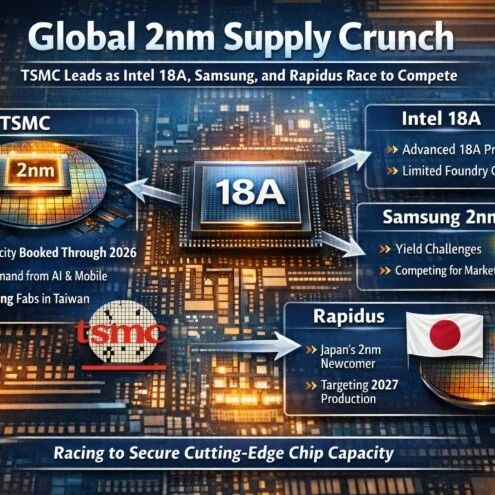
Core Viewpoint - The semiconductor industry is facing structural supply challenges driven by explosive demand for advanced chips, particularly for artificial intelligence and high-performance computing, with the 2nm process technology being a focal point of this transformation [2][11]. Group 1: TSMC and 2nm Capacity Crisis - TSMC's N2 process node is set to begin mass production by the end of 2025, with optimistic forecasts for yield and capacity ramp-up, making it attractive for next-generation AI accelerators and flagship mobile chips [4]. - TSMC's N2 chip capacity is reportedly sold out until 2026, with major clients like Apple, NVIDIA, Qualcomm, and AMD securing most of the initial capacity [4]. - To meet demand, TSMC plans to expand capacity across multiple fabs, targeting a monthly wafer output in the six-figure range between 2026 and 2028, with capital expenditures projected to reach $29.8 billion in 2024, increasing to $40.9 billion in 2025, and potentially hitting $52-56 billion in 2026 [4]. Group 2: Intel's 18A Process - Intel's 18A process node, part of its roadmap, introduces RibbonFET and PowerVia technologies aimed at enhancing performance and efficiency, with mass production expected to start in 2025 [5]. - Despite improvements in yield by mid-2025, Intel's 18A process is still considered to lag behind TSMC's N2 in yield, and its external foundry ecosystem remains smaller compared to TSMC's extensive global customer base [5][6]. - Intel's strategy is shifting to explore external foundry opportunities for its 18A process, indicating a potential competitive challenge to TSMC [6][7]. Group 3: Samsung's 2nm Process - Samsung is among the early adopters of GAA technology, with plans to advance to 2nm production by 2026, but faces challenges in yield stability and customer acceptance [8]. - Despite competitive pricing, Samsung's yield issues and lack of customer trust hinder its ability to serve as a viable alternative to TSMC for large-scale 2nm orders [8]. Group 4: Rapidus and Niche Market - Rapidus, a Japanese startup, aims to enter the 2nm market with government and corporate backing, planning to start production around 2027 and significantly increase monthly wafer output within a year of launch [9]. - The company has raised $1.7 billion, totaling $11.3 billion in government and private investment, but still requires $32 billion to achieve full-scale 2nm production by 2027 [9][10]. - Unlike larger firms, Rapidus focuses on short turnaround times and customized services, potentially appealing to niche markets and smaller tech companies [9]. Group 5: Broader Context - The current supply-demand imbalance in the semiconductor industry is influenced by TSMC's dominance, Intel's internal efforts, Samsung's technological challenges, and Rapidus's niche strategy [11]. - The 2nm capacity crisis is not merely a short-term supply fluctuation but a fundamental outcome of the strategic reshaping of the global semiconductor ecosystem driven by advanced computing and AI [11].