商品有机肥

Search documents
江西新余:秸秆发酵变沼气 发电供气再利用
Yang Shi Wang· 2025-11-05 02:20
Core Viewpoint - The article highlights the innovative approach taken by a company in Xinyu, Jiangxi, to utilize excess straw after harvest, transforming it into clean energy and organic fertilizer, thereby benefiting local farmers and promoting environmental sustainability [1] Group 1: Straw Utilization - The company in Xinyu collects straw from fields after harvest, which was previously left to decompose or burned, causing pollution [1] - The collected straw is processed with livestock manure in anaerobic fermentation tanks, producing biogas for electricity generation and residential gas supply [1][1] - The fermentation process yields 20 million kWh of electricity annually and meets the gas needs of 5,000 households [1][1] Group 2: Organic Fertilizer Production - The company produces 30,000 tons of organic fertilizer and 380,000 tons of liquid fertilizer each year from the fermentation byproducts, which are then returned to the fields [1][1] - This process not only provides organic fertilizer but also supports local agricultural production [1] Group 3: Diversified Utilization Methods - Xinyu has developed multiple pathways for straw utilization, including edible mushroom substrates, beef cattle feed, and fiber processing, creating a comprehensive recycling model [1] - The city recycles 450,000 tons of straw annually, achieving a recycling rate of 95.53% [1]
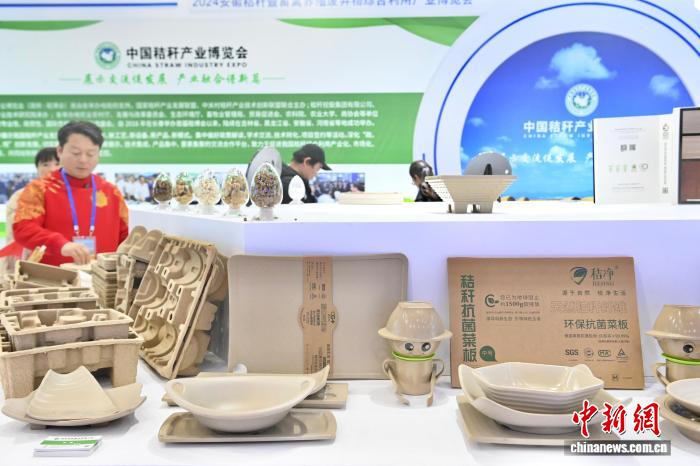
2024年安徽农作物秸秆综合利用量超4600万吨 利用率达95%
Zhong Guo Xin Wen Wang· 2025-10-31 11:28
Core Insights - In 2024, Anhui Province's comprehensive utilization of agricultural straw exceeds 46 million tons, achieving a utilization rate of 95% [1][3] - Nearly 2,300 enterprises utilize over 1,000 tons of straw annually [1] Group 1: Industry Development - Anhui has established a "two-utilization" industry system focusing on the comprehensive utilization of straw and livestock waste, with an annual output value exceeding 45 billion RMB [3] - The province's annual collection capacity of agricultural straw is approximately 49 million tons [3] - The comprehensive utilization models include the production of liquefied biogas, organic fertilizers, and non-food bio-based materials [3] Group 2: Environmental Impact - The province emphasizes a green agricultural model that combines planting and breeding to reduce agricultural waste's impact on rural water environments [3] - The livestock waste management follows a "source reduction, process control, end utilization" approach, implementing a "3+N" model for effective waste treatment [4] - The annual production of commercial organic fertilizers exceeds 2.8 million tons, and biogas generation reaches 10.83 million kilowatt-hours [3][4]