
嘉实瑞和两年持有期

Search documents
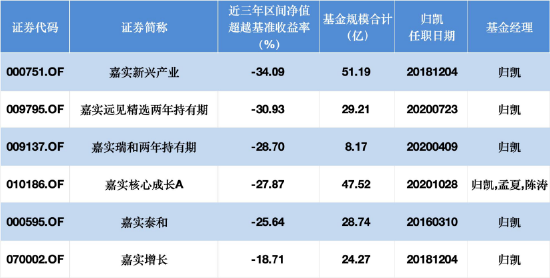
薪酬新规透视 | 嘉实归凯在管189亿规模6产品近三年全线跑输基准,嘉实新兴产业跑输超34.09%
Xin Lang Cai Jing· 2025-12-10 09:22
Core Viewpoint - The fund industry is undergoing significant reform in its compensation system, with nearly a thousand fund managers facing potential salary reductions due to underperformance over the past three years [1][5]. Group 1: Compensation Reform - New regulations from the Asset Management Association of China stipulate that if a fund manager's product returns are more than 10 percentage points below the benchmark and the fund's profit is negative, their performance-based compensation must be reduced by at least 30% [1][5]. - Fund companies are required to assess fund managers managing multiple products based on weighted performance metrics, considering fund size and management duration, while excluding funds managed for less than a year from evaluations [1][5]. Group 2: Performance of Guikai - Guikai, a fund manager with nearly ten years of experience at Harvest Fund, manages six funds with a total scale of 18.911 billion yuan, all of which have underperformed their respective benchmarks over the past three years [6][8]. - The performance data shows that the funds managed by Guikai have all recorded negative returns, with the worst performer, Harvest Emerging Industries, lagging the benchmark by 34.09% [2][3][7]. Group 3: Fund Size and Performance Pressure - Among the funds that underperformed by over 30%, Harvest Emerging Industries has a scale of 5.119 billion yuan, and Harvest Vision Select has a scale of 2.921 billion yuan, together accounting for 42.5% of Guikai's total managed assets [3][8]. - The new "tiered salary adjustment" mechanism creates significant pressure, as all six funds managed by Guikai have underperformed by more than 18 percentage points, exceeding the 10 percentage point threshold [8]. Group 4: Future Outlook - The implementation of the new regulations is expected to lead to a more refined and transparent assessment system within the fund industry [4][8]. - Fund managers like Guikai may need to reassess their investment strategies and focus areas, while fund companies should balance product distribution and research resources more effectively to avoid over-reliance on individual managers [4][8].

嘉实基金的长跑密码:体系化投研支撑下的协同进化
Sou Hu Cai Jing· 2025-10-28 06:52
Core Viewpoint - The article discusses the evolution of the A-share market, highlighting the importance of being present during key investment opportunities, particularly since the "9·24" market event, which marked the beginning of a bull market and a revaluation of assets in China [1][2]. Group 1: Market Performance - The A-share market has reached new highs in 2024, with significant performance from growth sectors since the "9·24" event [1]. - From September 24, 2024, to September 30, 2025, 41 funds under the management of Jiashi Fund achieved "doubling" performance, with 21 active equity products and 20 passive index products [3]. Group 2: Active Equity Performance - Notable active equity funds include those managed by Cai Chengfeng, who focused on the semiconductor industry with a return of 170.38%, and Li Tao, who achieved returns of 146.6% and 100.86% through his management of Jiashi Information Industry and Jiashi Quality Core [4]. - Other successful managers include Meng Xia, with a return of 132.53% in the robotics sector, and Yang Huan, whose funds achieved returns exceeding 113% [4][5]. Group 3: Passive Investment Strategy - Jiashi Fund has effectively captured beta opportunities in various technology sectors through its forward-looking index fund strategies, with significant performance in ETFs such as the Jiashi Shanghai Stock Exchange Sci-Tech Innovation Board Chip ETF, which rose by 206.72% since the "9·24" event [8][9]. - The fund has a comprehensive range of ETFs covering high-growth sectors, including technology and rare metals, demonstrating its capability in identifying long-term investment opportunities [9].