基金业绩考核

Search documents
预警!新规之下,广发基金或成基金经理降薪重灾区
Xin Lang Cai Jing· 2025-12-23 14:23
Core Viewpoint - In a generally recovering market, the average return rate of actively managed equity products reached 30% this year, benefiting many investors. However, for GF Fund's investors and fund managers, the situation is grim as over 30% of their products underperformed the market, with six of the bottom twenty funds belonging to GF Fund [1][19]. Group 1: Performance Overview - GF Fund managed to maintain its position as the third-largest in the industry despite poor performance this year [19]. - As of the end of the third quarter, 94 out of 142 of GF Fund's products, accounting for over 66%, underperformed their benchmarks over the past three years, placing them at the bottom among large active equity fund companies [19][20]. - The new regulatory guidelines link fund managers' compensation directly to their performance, with those underperforming by more than 10% facing a salary reduction of over 30% [19][20]. Group 2: Key Fund Managers and Products - Notable underperforming products include "GF High-end Manufacturing Stock A," which has a return rate of -85.79% this year and -41.71% over three years, making it the worst performer in the market [4][23]. - Fund manager Zheng Chengran, who managed several poorly performing products, has seen an average loss of 30% across his managed funds over the past three years [25][27]. - Liu Gesong, another prominent fund manager, has also faced significant underperformance, with an average shortfall of 39% across his five managed products [10][31]. Group 3: Broader Implications - The poor performance of GF Fund's products raises questions about the overall investment research and management strategies of the company, indicating a systemic issue rather than isolated failures of individual fund managers [37]. - The concentration of performance risk among a few key fund managers highlights a significant flaw in GF Fund's operational structure, as nearly 44% of the underperforming products are managed by just three individuals [37].

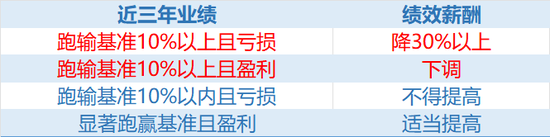
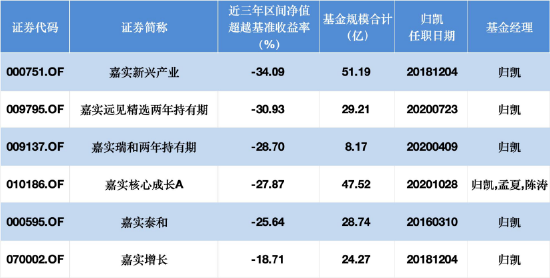
薪酬新规透视 | 嘉实归凯在管189亿规模6产品近三年全线跑输基准,嘉实新兴产业跑输超34.09%
Xin Lang Cai Jing· 2025-12-10 09:22
Core Viewpoint - The fund industry is undergoing significant reform in its compensation system, with nearly a thousand fund managers facing potential salary reductions due to underperformance over the past three years [1][5]. Group 1: Compensation Reform - New regulations from the Asset Management Association of China stipulate that if a fund manager's product returns are more than 10 percentage points below the benchmark and the fund's profit is negative, their performance-based compensation must be reduced by at least 30% [1][5]. - Fund companies are required to assess fund managers managing multiple products based on weighted performance metrics, considering fund size and management duration, while excluding funds managed for less than a year from evaluations [1][5]. Group 2: Performance of Guikai - Guikai, a fund manager with nearly ten years of experience at Harvest Fund, manages six funds with a total scale of 18.911 billion yuan, all of which have underperformed their respective benchmarks over the past three years [6][8]. - The performance data shows that the funds managed by Guikai have all recorded negative returns, with the worst performer, Harvest Emerging Industries, lagging the benchmark by 34.09% [2][3][7]. Group 3: Fund Size and Performance Pressure - Among the funds that underperformed by over 30%, Harvest Emerging Industries has a scale of 5.119 billion yuan, and Harvest Vision Select has a scale of 2.921 billion yuan, together accounting for 42.5% of Guikai's total managed assets [3][8]. - The new "tiered salary adjustment" mechanism creates significant pressure, as all six funds managed by Guikai have underperformed by more than 18 percentage points, exceeding the 10 percentage point threshold [8]. Group 4: Future Outlook - The implementation of the new regulations is expected to lead to a more refined and transparent assessment system within the fund industry [4][8]. - Fund managers like Guikai may need to reassess their investment strategies and focus areas, while fund companies should balance product distribution and research resources more effectively to avoid over-reliance on individual managers [4][8].
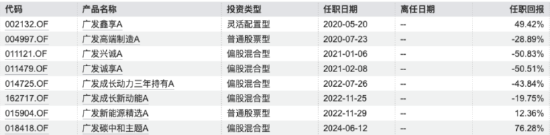
薪酬新规透视 | 广发郑澄然近三年在管7只仅1只跑赢基准,广发高端制造A跑输近82%,首尾业绩相差99%
Xin Lang Cai Jing· 2025-12-09 10:34
Core Viewpoint - The fund industry is undergoing significant reform in its compensation system, emphasizing performance-based pay for fund managers, which may lead to salary reductions for nearly a thousand fund managers [1][4]. Summary by Sections Compensation Reform - New regulations from the Asset Management Association of China stipulate that if a fund manager's product returns are more than 10 percentage points below the benchmark over the past three years and the fund is unprofitable, their performance pay must be reduced by at least 30% [1][4]. - Fund companies are required to assess fund managers managing multiple products based on weighted performance metrics, considering fund size and management duration, excluding funds managed for less than a year from evaluations [1][4]. Performance Analysis - Fund manager Zheng Chengran's portfolio has gained attention, managing eight funds with a total size of 13.877 billion yuan as of December 8 [1][4]. - The best-performing fund, Guangfa Carbon Neutrality Theme A, has achieved a return of over 76% since its management began in June 2024 [2][6]. - Over the past three years, Guangfa New Energy Select A outperformed its benchmark by 17.99%, while other funds managed by Zheng Chengran significantly underperformed, with Guangfa High-end Manufacturing A lagging by 81.71% [7][9]. Structural Implications - There is a notable divergence between fund performance and size, with Guangfa High-end Manufacturing A being the largest fund at 5.272 billion yuan but having shrunk by 12.973 billion yuan over three years [9]. - The new regulations will fundamentally change the incentive structure for fund managers, shifting from a focus on standout products to an overall weighted performance approach, promoting accountability for each product [3][9].
重磅文件落地!事关基金经理薪酬改革
凤凰网财经· 2025-12-06 12:39
Core Viewpoint - The article discusses the newly released "Guidelines for Performance Assessment and Compensation Management of Fund Management Companies (Draft for Comments)", which aims to standardize performance assessment and compensation management in the fund industry, ensuring long-term incentives are aligned with the interests of fund shareholders [3][9]. Summary by Sections Performance Assessment and Compensation Structure - The guidelines emphasize strengthening performance assessments, requiring that the weight of long-term performance indicators (over three years) in overall quantitative assessments should not be less than 80% [4][10]. - For senior management, the weight of investment return indicators in performance assessments should be at least 50% [11]. Investment in Own Funds - Senior management and key personnel are required to invest a minimum of 30% of their total performance compensation in their company's funds, with at least 60% of that in equity funds [5][15]. - Fund managers must invest at least 40% of their total performance compensation in the funds they manage, excluding non-equity products [5][15]. Salary Adjustments Based on Performance - Fund managers whose performance lags behind the benchmark by more than 10% over three years and have negative profit margins will see a minimum 30% reduction in their performance compensation [6][16]. - The guidelines establish a tiered adjustment mechanism for performance compensation based on the fund's performance relative to benchmarks [16]. Long-term Incentives and Accountability - The guidelines allow for the use of equity, options, and other long-term incentives to align employee interests with the long-term benefits of fund shareholders [9][18]. - A strict accountability mechanism is introduced, which includes salary stoppage, recovery, and clawback provisions applicable even to departing employees [19]. Overall Compensation Management - Fund management companies are encouraged to manage total compensation budgets effectively, linking changes in total compensation to fund performance and company profitability [17]. - The structure of compensation should include basic salary, performance pay, benefits, and long-term incentives, ensuring a balanced approach to avoid risks associated with unreasonable compensation structures [18].
基金经理薪酬重大改革征求意见 业绩不达标可能降薪超30%
Sou Hu Cai Jing· 2025-12-06 09:53
Core Viewpoint - The newly released "Guidelines for Performance Evaluation and Compensation Management of Fund Management Companies (Draft for Comments)" aims to standardize performance evaluation and compensation management in the fund management industry, promoting sustainable development and robust operations by aligning employee incentives with long-term fund performance [1][2]. Summary by Sections Performance Evaluation - The guidelines emphasize strengthening performance evaluation, requiring that the weight of long-term investment return indicators (over three years) in overall quantitative assessments must not be less than 80% [2][9]. - For senior management, the weight of investment return indicators should be at least 50%, while for active equity fund managers, the performance indicators should account for no less than 80% [2][10]. Compensation Structure - Fund company executives must invest at least 30% of their annual performance compensation in their own company's funds, with fund managers required to invest at least 40% [3][16]. - The deferred payment of performance compensation must last for at least three years, with a minimum of 40% of the deferred payment for senior management and key personnel [3][16]. Salary Adjustments - Fund managers whose performance lags behind the benchmark by more than 10% over three years and have negative profit margins will face a minimum 30% reduction in their performance compensation [4][17]. - A tiered adjustment mechanism for performance compensation is established based on the fund's performance relative to benchmarks [17][18]. Long-term Incentives - The guidelines allow for the use of equity, options, and other long-term incentives to align with the long-term interests of fund shareholders [6][19]. - The compensation structure should include basic salary, performance pay, benefits, and long-term incentives, ensuring a balanced approach to avoid risks associated with unreasonable compensation structures [19][20]. Accountability Mechanism - A strict accountability mechanism is mandated, which includes salary suspension, recovery, and clawback provisions applicable even to departing employees [7][21]. - Fund management companies must clearly define the conditions under which performance compensation can be reduced or reclaimed in their internal management systems and contracts [21].
重磅文件落地!事关基金经理薪酬改革
财联社· 2025-12-06 08:55
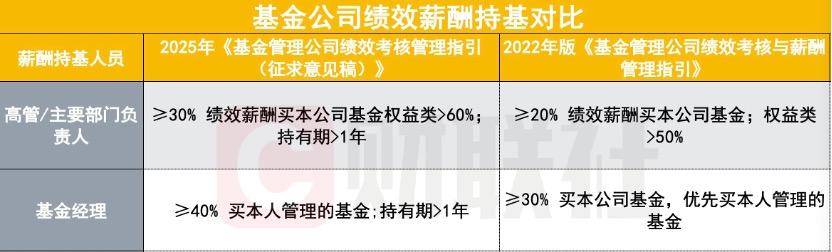
Core Viewpoint - The newly released "Guidelines for Performance Assessment and Compensation Management of Fund Management Companies (Draft for Comments)" aims to standardize performance assessment and compensation management in the fund management industry, ensuring long-term incentives are aligned with the interests of fund shareholders and promoting sustainable development of the industry [1][2]. Summary by Sections Performance Assessment and Compensation Structure - The guidelines emphasize performance assessment, requiring that the weight of long-term indicators (over three years) in the overall quantitative assessment of fund investment returns must not be less than 80% [2][10]. - For senior management, the weight of fund investment return indicators should be no less than 50% [11]. - Differentiated assessments for fund managers are mandated, with performance indicators for actively managed equity fund managers having a weight of at least 80%, and the benchmark comparison weight not less than 30% [12]. Investment in Own Funds - Fund company chairpersons and senior executives must use at least 30% of their annual performance compensation to purchase their company's funds, while fund managers must invest at least 40% of their performance compensation in the funds they manage [3][20]. Deferred Compensation and Co-investment Requirements - The guidelines introduce new requirements for deferred compensation, mandating a minimum deferral period of three years and a co-investment ratio of at least 40% for senior management and key personnel [4][18]. - Senior management and key department heads must invest at least 30% of their total performance compensation in their company's funds, with at least 60% of that in equity funds [20][21]. Salary Adjustments Based on Performance - Fund managers whose performance lags the benchmark by more than 10% over three years and have negative profit margins will face a salary reduction of at least 30% [5][22]. - A tiered salary adjustment mechanism is established based on performance relative to benchmarks, ensuring that poor performance directly impacts compensation [22]. Long-term Incentives and Accountability Mechanisms - The guidelines allow for the use of equity, options, and other long-term incentives to align employee interests with the long-term benefits of fund shareholders [7][23]. - A strict accountability mechanism is introduced, which includes salary stoppage, recovery, and clawback provisions applicable even to departing employees [8][25]. Encouragement of Pension Systems - Fund companies are encouraged to establish enterprise annuities and support employees in participating in personal pension systems, integrating compensation mechanisms with pension insurance [9]. Overall Compensation Structure - The guidelines stress the importance of linking total compensation changes to fund investment returns and company performance, while ensuring a balanced structure that avoids excessive focus on senior management [24].

独家|基金经理薪酬重大改革征求意见,强化薪酬与业绩绑定
Sou Hu Cai Jing· 2025-12-06 08:37
Core Viewpoint - The newly released "Guidelines for Performance Assessment and Compensation Management of Fund Management Companies (Draft for Comments)" aims to standardize performance assessment and compensation management in the fund management industry, promoting sustainable development and aligning employee incentives with long-term fund performance [1][2]. Summary by Sections Performance Assessment and Compensation Structure - The guidelines emphasize performance assessment, requiring that the weight of long-term indicators (over three years) in the overall quantitative assessment of fund investment returns must not be less than 80% [2][7]. - For senior management, the weight of fund investment return indicators should be no less than 50% [8]. - Differentiated assessments for fund managers are mandated, with performance indicators for actively managed equity fund managers having a weight of at least 80% [2][8]. Investment in Own Funds - Senior management and key personnel must invest a minimum of 30% of their annual performance compensation in the company's funds, with at least 60% of that in equity funds [3][12]. - Fund managers are required to invest at least 40% of their annual performance compensation in the funds they manage, excluding non-equity products [3][12]. Deferred Compensation and Accountability - Performance compensation must have a deferred payment period of no less than three years, with a minimum of 40% of the deferred payment for senior management and key personnel [3][12]. - A strict accountability mechanism is established, allowing for salary suspension, recovery, and deductions for those who fail to meet performance expectations, applicable even to departing employees [5][17]. Salary Adjustments Based on Performance - Fund managers whose performance lags behind the benchmark by more than 10% and have negative profit margins over the past three years will face a salary reduction of at least 30% [3][13]. - A tiered salary adjustment mechanism is introduced based on performance relative to benchmarks, ensuring that poor performance directly impacts compensation [13][14]. Long-term Incentives and Salary Structure - The guidelines encourage the use of long-term incentives such as equity, options, and restricted stock to align with the long-term interests of fund shareholders [4][15]. - The overall salary structure should include basic salary, performance salary, benefits, and long-term incentives, with a focus on maintaining a reasonable ratio between basic and performance salaries to mitigate risks [15][16].
公募基金《行动方案》,对基金经理的考核,还缺少什么?
Sou Hu Cai Jing· 2025-05-09 00:01
Core Viewpoint - The China Securities Regulatory Commission (CSRC) has released an action plan aimed at promoting the high-quality development of public funds, focusing on changing the previous model of guaranteed returns and linking fund performance to differentiated fee rates for investors based on their holding periods [1][2]. Group 1: Key Highlights of the Action Plan - The action plan emphasizes that for investors with a holding period, differentiated fee rates will be applied based on the product's performance during that period [1]. - It mandates that leading institutions in the industry should issue no less than 60% of the number of actively managed equity funds compared to the total fund issuance in the coming year [1]. - Performance assessment for funds will place a weight of no less than 80% on medium to long-term returns over three years [2]. Group 2: Fund Manager Performance Evaluation - Fund managers whose products underperform the benchmark by more than 10 percentage points over three years will see a significant decrease in their performance compensation [2]. - Conversely, fund managers whose products significantly outperform the benchmark can receive reasonable increases in their performance compensation [2]. - The new rules will only apply to newly issued funds, while existing funds will continue under the previous assessment rules, indicating a clear distinction between old and new regulations [2]. Group 3: Industry Implications - The current public fund operation reflects a focus on individual fund managers rather than team collaboration, which may lead to talent retention issues as high-performing managers often leave for private funds [4]. - The action plan encourages better performance incentives for fund managers, suggesting that extending the assessment period to 3-5 years could enhance motivation and retention of top talent [4][5]. - Addressing the distribution of excess returns for fund managers is seen as a necessary step to prevent the loss of talented managers due to inadequate incentive mechanisms [5].