四价亚单位流感疫苗慧尔康欣

Search documents
我国首款创新型6月龄以上四价流感亚单位疫苗在济南开打
Qi Lu Wan Bao Wang· 2025-09-28 04:47
Group 1 - Influenza is a highly contagious respiratory disease caused by the influenza virus, with the World Health Organization reporting approximately 300,000 to 650,000 deaths annually due to influenza-related respiratory diseases globally, particularly affecting high-risk groups such as pregnant women, infants, the elderly, and individuals with chronic illnesses [1] - The risk of influenza activity increases with population movement and gatherings during school openings and holidays, emphasizing the importance of timely vaccination, especially for vulnerable populations like infants [1] Group 2 - The four-valent subunit influenza vaccine, developed by Jiangsu Zhonghui Yuantong Biotechnology Co., Ltd., is recognized as a preferred choice for vaccination due to its safety and efficacy, being the first of its kind in China and an advanced third-generation influenza vaccine internationally [3] - Compared to traditional split vaccines, the subunit vaccine has a higher purity by extracting and purifying only the key antigens, hemagglutinin (HA) and neuraminidase (NA), while eliminating internal proteins and impurities, thus reducing allergic risks [3] - Clinical data indicates that the subunit vaccine has superior safety, with local adverse reaction rates in infants being 54% of that of the control group split vaccine, and fever rates in children aged 3-8 being only 46% of the control group [3] - The vaccine demonstrates good immunogenicity, effectively stimulating protective antibodies, and its safety and immunogenicity results have been recognized in the "Technical Guidelines for Influenza Vaccine Prevention and Immunization (2023-2024)" [3] - The vaccine allows for a unified dosage for individuals aged 6 months and older, simplifying outpatient procedures, and employs isotonic technology and a five-faceted micro-needle to significantly reduce injection pain and bleeding rates, enhancing the vaccination experience for infants and the elderly [3]

流感疫苗出现5.5元“冰点价”
第一财经· 2025-09-04 03:44
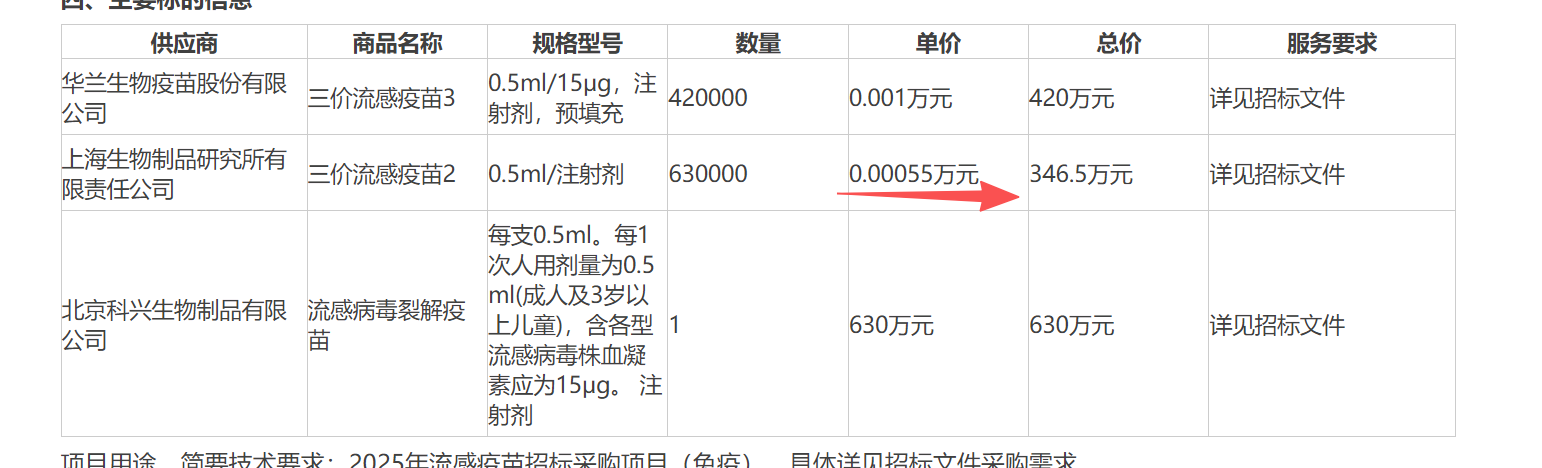
Core Viewpoint - The article highlights the significant price drop of influenza vaccines in China, particularly in public procurement, with the price of the trivalent influenza vaccine reaching a new low of 5.5 yuan per dose, raising concerns about market dynamics and the sustainability of vaccine manufacturers [3][5]. Group 1: Vaccine Pricing and Procurement - The trivalent influenza vaccine from Shanghai Biological Products Research Institute won the bid at a price of 5.5 yuan per dose, while Hualan Biological's bid was 10 yuan per dose [3][5]. - The current bid prices for public flu vaccines are lower than the service fees charged in some regions, which range from 6 to 25 yuan per dose [3][5]. - The price of domestic trivalent influenza vaccines has been consistently decreasing in the public market since last year, with multiple instances of bids falling below 10 yuan per dose [5][7]. Group 2: Market Dynamics and Competition - The ongoing price war in the influenza vaccine market is attributed to the introduction of similar products and the need for companies to maintain or expand their market share [7][8]. - Companies are increasingly focusing on the public market due to rising government budgets for influenza vaccination, while facing competition from quadrivalent vaccines [7][8]. - The production and distribution timelines for influenza vaccines necessitate early market entry, leading to higher potential waste if companies fail to secure bids [8]. Group 3: Vaccine Types and Innovations - The current influenza vaccines in China are categorized into three types: split virus vaccines, subunit vaccines, and live attenuated vaccines, with split virus vaccines being the most prevalent [11]. - The first quadrivalent subunit influenza vaccine, Huierkangxin, has been included in the national health insurance list, priced between 326.5 and 359 yuan per dose [11][12]. - Innovative vaccine products are less affected by the price competition seen in traditional vaccines, indicating a potential market for differentiated products [11][12]. Group 4: Public Health and Vaccination Rates - Vaccination with influenza vaccines can significantly reduce related medical costs and improve public health outcomes, particularly for vulnerable populations [12]. - There has been a noted decline in vaccination rates for non-national immunization program vaccines, including influenza vaccines, with an average annual vaccination rate below 4% from 2020 to 2023 [13]. - Experts suggest that improving public awareness and encouraging differentiated competition among manufacturers are essential for increasing vaccination rates and moving beyond price wars [13].


流感疫苗出现5.5元“冰点价”,今年以来价格多次探底
Di Yi Cai Jing· 2025-09-04 03:00
Core Insights - The price of domestic trivalent influenza vaccines in the public market has significantly decreased, with recent bids showing prices as low as 5.5 yuan per dose, marking a new low in the public vaccine market [1][3][4] Pricing Trends - The price of trivalent influenza vaccines has dropped below 10 yuan per dose since last year, with multiple instances of price reductions in 2023 [1][3] - In September, the Beijing public resource trading platform announced that the Shanghai Biological Products Research Institute won a bid for trivalent influenza vaccines at 5.5 yuan per dose, while Hualan Biological's bid was 10 yuan per dose [1][4] - The price of vaccines in the public market may not cover production costs, leading to a price war among manufacturers aiming to maintain market share [4][5] Market Dynamics - The public health budget for influenza vaccinations has increased, prompting manufacturers to focus more on the public market amid competition from quadrivalent vaccines [4][5] - The production of influenza vaccines is time-sensitive, as they must be produced based on the WHO's annual strain recommendations, leading to potential waste if bids are unsuccessful [5] Vaccine Types and Innovations - The market includes various types of influenza vaccines, with the most common being split virus vaccines, while innovative products like quadrivalent subunit vaccines are less affected by price competition [8] - The first quadrivalent subunit influenza vaccine, Hui Er Kang Xin, has been listed in the national insurance directory with a price range of 326.5 to 359 yuan per dose [8] Vaccination Rates - The average vaccination rate for influenza vaccines in China has remained below 4% from 2020 to 2023, with higher rates among children (12%) and lower rates among the elderly (below 5%) [10]